


The global Non-Destructive Testing in Power Generation Market is gaining importance as power utilities prioritize equipment reliability, operational safety, regulatory compliance, and infrastructure life extension. Growing adoption of advanced inspection technologies is transforming how operators evaluate critical power generation assets without damaging or dismantling components.
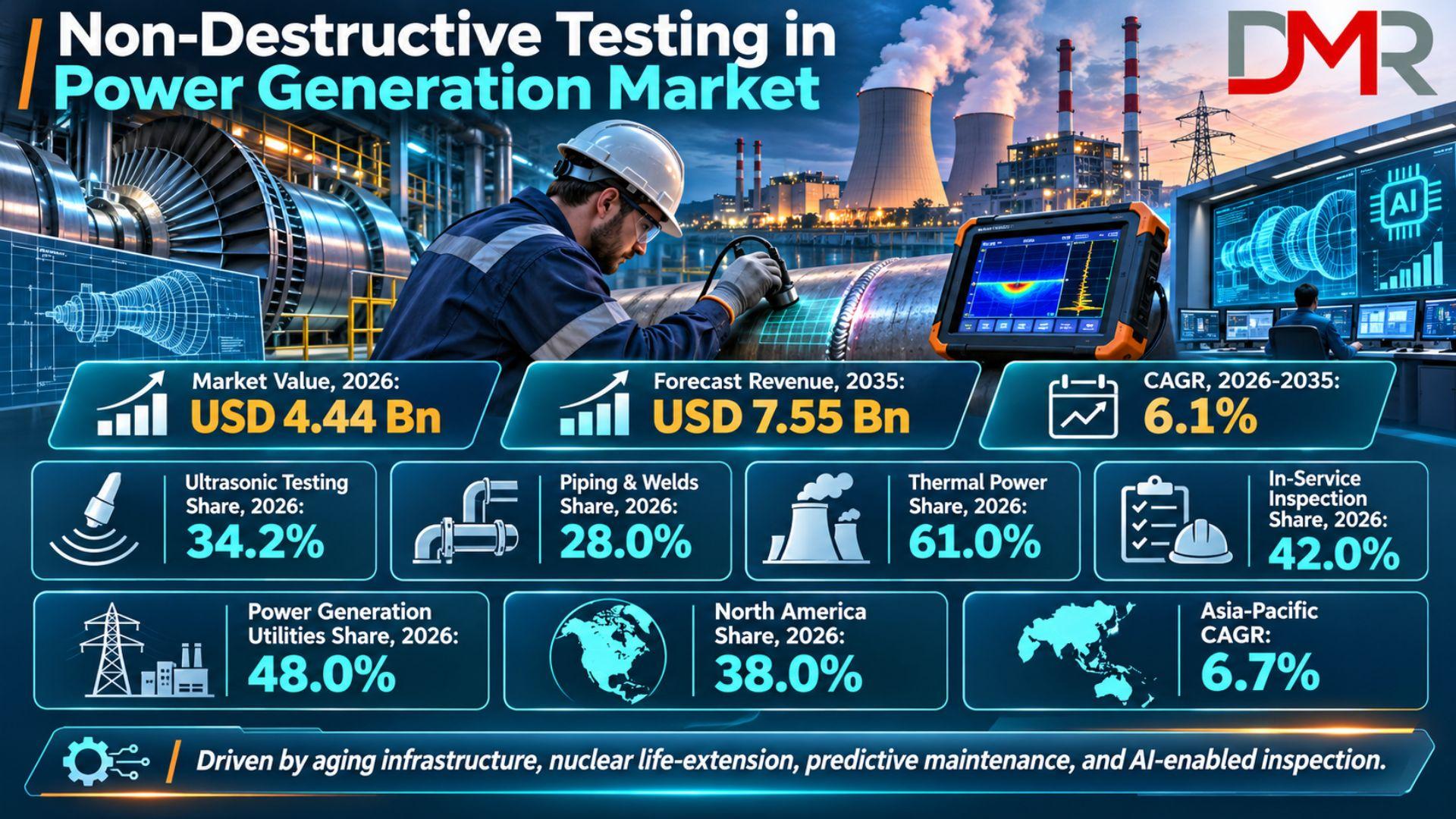
According to Dimension Market Research, the market is estimated at USD 4.44 billion in 2026 and is projected to reach USD 7.55 billion by 2035, expanding at a CAGR of 6.1% during the forecast period.
Aging thermal and nuclear facilities, expanding renewable energy infrastructure, stricter asset-integrity requirements, and predictive maintenance adoption are creating sustained demand for inspection technologies. Artificial intelligence, automated ultrasonic systems, and digital radiography are also improving how operators detect defects and manage equipment performance.
What Is the Non-Destructive Testing in Power Generation Market?
The Non-Destructive Testing in Power Generation Market covers inspection equipment, technologies, and services used to evaluate the structural integrity and operating condition of power generation equipment without causing permanent damage.
Non-destructive testing (NDT) identifies cracks, corrosion, material discontinuities, weld defects, wall thinning, fatigue, and other abnormalities that could compromise equipment reliability.
Common methods include ultrasonic testing, radiographic testing, magnetic particle testing, liquid penetrant testing, eddy current testing, and visual inspection.
These technologies are applied to turbines, boilers, pressure vessels, piping, welds, heat exchangers, generators, pumps, and valves across thermal, nuclear, hydropower, and renewable energy facilities.
Why Is Demand for Power Generation NDT Increasing?
Aging power generation infrastructure represents a major structural driver of market expansion. Thermal and nuclear power plants frequently operate for decades, exposing critical components to repeated temperature fluctuations, pressure variations, vibration, and corrosion.
Utilities increasingly rely on scheduled inspections and condition monitoring to evaluate remaining equipment life and prevent unplanned failures.
Nuclear power facilities generate additional demand because safety-significant equipment requires rigorous inspection and regulatory oversight. Life-extension programs also encourage comprehensive assessments of reactor components, pressure systems, and associated infrastructure.
Renewable energy development is broadening the market's application base. Wind turbines, hydroelectric facilities, and other renewable generation assets require specialized inspection procedures to assess structural integrity and operational performance.
Get a Free Sample of the Non-Destructive Testing in Power Generation Market Report
Evaluating investment opportunities, inspection technologies, or supplier positioning in the global power generation industry? Request a free sample to review the report's market coverage, segmentation, competitive landscape, and strategic relevance.
Ultrasonic Testing Leads the Global Market
Ultrasonic testing is the leading inspection method, accounting for approximately 34.2% of the global market in 2026.
Its market position reflects widespread applications in weld examination, crack detection, corrosion monitoring, and material thickness measurement.
Advanced ultrasonic technologies, including phased-array ultrasonic testing (PAUT) and time-of-flight diffraction (TOFD), improve inspection coverage and defect characterization in complex industrial components.
By component tested, piping and welds account for approximately 28.0% of market revenue. These components are continuously exposed to operating stresses, making inspection essential for maintaining plant integrity.
Thermal power remains the largest power generation source segment, contributing approximately 61.0% of market demand. Its leadership reflects the extensive installed base of coal, natural gas, and oil-fired generation infrastructure.
In-service inspection represents approximately 42.0% of applications, highlighting the recurring requirement to evaluate operating equipment throughout its service life.
Power generation utilities constitute the largest end-user segment, accounting for approximately 48.0% of market revenue.
How AI and Digital Inspection Are Transforming NDT
Artificial intelligence and advanced analytics are changing NDT from isolated defect identification toward continuous asset-condition monitoring.
AI-enabled inspection platforms can analyze ultrasonic signals, radiographic images, and historical inspection records to improve defect recognition and support consistent interpretation.
Automated scanning technologies can also reduce repetitive manual work and improve inspection documentation.
Digital radiography enables electronic image capture, storage, and comparison, while advanced ultrasonic systems generate detailed inspection data that can support maintenance planning.
Integration with digital twins and computerized maintenance management systems allows operators to evaluate equipment conditions across multiple inspection cycles.
For inspection equipment manufacturers and service providers, these developments suggest increasing commercial opportunities in software integration, automated defect analysis, and long-term asset-monitoring solutions.
Regional Analysis: North America Leads While Asia-Pacific Expands Faster
North America is projected to dominate the global market with approximately 38.0% revenue share in 2026, equivalent to USD 1.69 billion.
The region's leadership is supported by its extensive thermal and nuclear power infrastructure, stringent inspection requirements, and established ecosystem of qualified NDT service providers.
The United States represents a major national market, with an estimated value of USD 1.45 billion in 2026 and a projected value of USD 2.30 billion by 2035.
Asia-Pacific is expected to be the fastest-growing region, recording approximately 6.7% CAGR through 2035.
China and India are important demand centers due to their large thermal generation fleets, ongoing power infrastructure development, and investments in nuclear and renewable energy.
Europe continues to generate demand through nuclear life-extension programs, offshore wind development, aging thermal assets, and equipment safety requirements.
The Middle East and Africa region also offers opportunities as utilities modernize generation infrastructure and expand inspection capabilities.
Market Challenges and Competitive Landscape
Despite expanding demand, the industry faces limitations involving qualified personnel availability, advanced equipment costs, and inspection complexity.
Specialized techniques require trained inspectors capable of interpreting complex signals and applying appropriate testing standards.
Advanced automated inspection systems also involve substantial investments in equipment, software, and integration.
The competitive landscape includes Baker Hughes, Waygate Technologies, MISTRAS Group, SGS, Intertek, Applus+, Evident Scientific, Bureau Veritas, TÜV SÜD, Eddyfi Technologies, and other specialized service providers.
Companies compete through inspection accuracy, equipment performance, certification capabilities, technical expertise, software integration, and recurring maintenance contracts.
Future Growth Opportunities Through 2035
The transition toward predictive maintenance is creating opportunities for integrated inspection equipment and digital analytics providers.
Advanced and AI-enabled NDT is identified as a faster-growing area, with approximately 7.0% CAGR.
Automated ultrasonic inspection, robotic scanning, digital radiography, high-temperature testing, and renewable energy asset inspection represent additional areas of commercial interest.
For manufacturers, utilities, and investors, future opportunities will depend on matching inspection capabilities with evolving equipment designs, plant operating requirements, and regulatory standards.
View the Non-Destructive Testing in Power Generation Market Report and Purchase Options
Explore the complete report to understand market forecasts, regional performance, testing method demand, competitive developments, and opportunities across the global power generation inspection industry.
https://dimensionmarketresearch.com/checkout/non-destructive-testing-in-power-generation-market/
Frequently Asked Questions
1. What is the size of the Non-Destructive Testing in Power Generation Market?
The global market is estimated at USD 4.44 billion in 2026 and is projected to reach approximately USD 7.55 billion by 2035.
2. What is the expected CAGR of the market?
The market is forecast to grow at a CAGR of 6.1% during 2026 to 2035, supported by aging infrastructure, regulatory inspection, and predictive maintenance adoption.
3. Which testing method dominates the market?
Ultrasonic testing leads the market with approximately 34.2% share in 2026, supported by applications in weld inspection, corrosion detection, and equipment integrity evaluation.
4. Which region holds the largest market share?
North America leads with approximately 38.0% market share in 2026, while Asia-Pacific is expected to be the fastest-growing region at 6.7% CAGR.
5. What factors are driving future market growth?
Major factors include aging power plants, nuclear life-extension programs, renewable energy expansion, regulatory compliance, automated inspection, and AI-powered predictive maintenance.
Conclusion
The Non-Destructive Testing in Power Generation Market is expected to experience sustained expansion through 2035 as utilities strengthen asset-integrity programs and invest in advanced inspection technologies.
Aging infrastructure, nuclear safety requirements, renewable energy expansion, and automated maintenance systems will continue shaping inspection demand.
The integration of AI-enabled analytics, robotic inspection, and digitally connected NDT platforms presents meaningful opportunities for equipment manufacturers, inspection contractors, and technology developers.
Related Industrial Testing and Inspection Market Insights
The Industrial X-Ray Inspection Equipment Imaging Software Market Size report examines digital inspection and defect-detection software used across manufacturing industries. The global market is estimated at USD 1.07 billion in 2026 and is projected to reach USD 2.29 billion by 2035, expanding at a CAGR of 8.8%. Growth is supported by automated quality control, industrial computed tomography, and AI-enabled image analysis.
The Testing, Inspection and Certification Market Share report explores independent testing, inspection, compliance assessment, and certification services across multiple industries. The global market was projected at USD 416.3 billion in 2025 and is forecast to reach USD 589.8 billion by 2034, registering a CAGR of 3.9%. Asia-Pacific was projected to lead with approximately 34.0% market share in 2025.
