

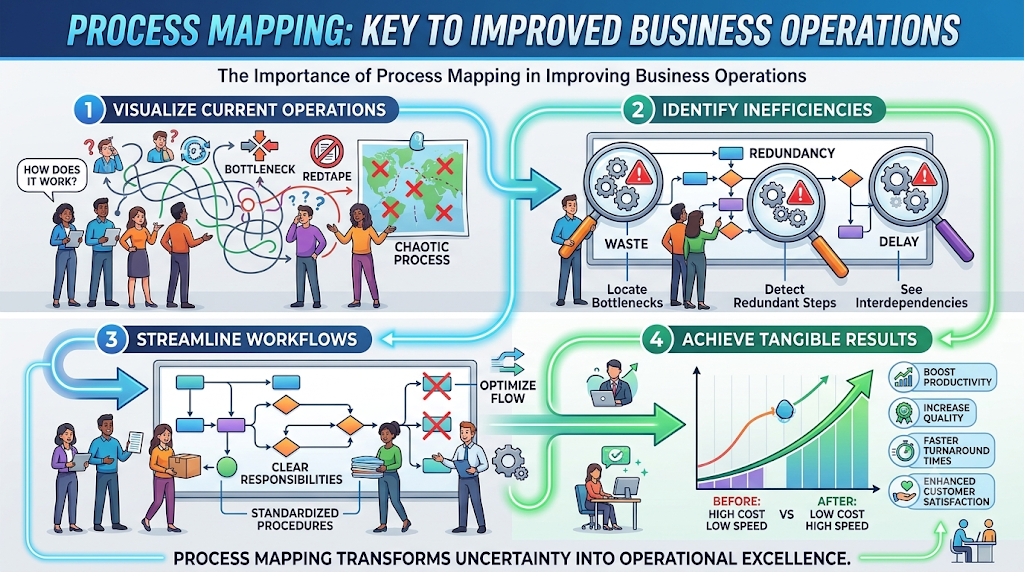

Every successful business depends on well-organized processes to complete daily activities, serve customers, and achieve long-term goals. However, as organizations grow, their operations can become increasingly complicated. Different departments may follow inconsistent procedures, employees may struggle with unclear responsibilities, and important tasks may experience unnecessary delays. These challenges can affect productivity, increase costs, and reduce customer satisfaction.
Process mapping provides a practical way to understand how work moves through an organization. By visually representing individual steps, responsibilities, decisions, and interactions, businesses can identify inefficiencies and discover opportunities for improvement. It helps organizations create more structured workflows and ensure that everyone understands how different activities contribute to overall business performance.
Understanding the Basics of Process Mapping
Process mapping is the practice of creating a visual representation of a business process from beginning to end. It illustrates the sequence of activities involved in completing a particular task, including the people responsible, decisions required, and information exchanged along the way.
Businesses commonly use flowcharts, diagrams, and other visual formats to document their processes. These representations make complicated operations easier to understand and help employees recognize how their responsibilities connect with other departments.
For example, a customer order process may include receiving an order, verifying payment, checking inventory, preparing the product, arranging delivery, and notifying the customer. Mapping these activities makes it easier to identify unnecessary steps, communication gaps, and potential delays.
Process mapping is useful across various industries, including manufacturing, healthcare, retail, finance, education, and professional services. Any organization that relies on structured activities can benefit from understanding how its processes work.
Why Businesses Need Process Mapping
One of the biggest advantages of process mapping is improved operational visibility. Business owners and managers can understand how tasks are performed instead of relying on assumptions or incomplete information. This makes it easier to identify bottlenecks and areas where resources are being wasted.
Another important benefit is better communication. When processes are documented visually, employees can understand their responsibilities and follow consistent procedures. This reduces confusion, prevents misunderstandings, and improves coordination between departments.
Process mapping also supports employee training and onboarding. New team members can use documented workflows to learn how different activities are performed without depending entirely on verbal instructions.
Additionally, organizations can use process maps to establish performance standards, improve accountability, and prepare for future automation initiatives.
How to Understand and Improve Existing Processes
Before making operational changes, businesses need a clear understanding of their current workflows. Knowing what is process mapping helps organizations recognize how visual documentation can simplify complicated activities and reveal opportunities for improvement. It is not simply about creating diagrams; it involves examining how work is performed, identifying inefficiencies, and designing more effective ways to complete tasks.
Organizations that want a structured approach can benefit from professional process mapping services. Experienced specialists can evaluate existing workflows, document important activities, identify operational gaps, and recommend practical improvements. This allows businesses to develop clearer procedures and create processes that support their specific objectives.
For example, a company experiencing delays in invoice approvals can map its entire payment process to understand where requests become stuck. By identifying unnecessary approval stages or communication problems, management can redesign the workflow to improve turnaround times.
Common Process Mapping Techniques
Different process mapping techniques are suitable for different business requirements. Flowcharts are among the most widely used methods because they represent activities and decisions through simple symbols connected by arrows.
Swimlane diagrams divide processes according to departments, employees, or responsibilities. They are particularly useful for understanding how work moves between different teams.
Value stream mapping focuses on identifying activities that create value and highlighting unnecessary steps that consume time or resources. Businesses often use it to improve operational efficiency and reduce waste.
Organizations may also use business process modeling notation (BPMN) to document complex workflows using standardized symbols. Choosing the right technique depends on the complexity of the process and the level of detail required.
Steps to Create an Effective Process Map
Creating a useful process map begins with selecting a specific workflow that needs improvement. Businesses should gather information from employees who perform the activities and understand how each step is completed.
Next, they should identify the starting point, ending point, individual tasks, decision stages, and responsible team members. Once this information is collected, it can be organized into a visual diagram that clearly represents the workflow.
After creating the map, managers should review it with relevant employees to confirm its accuracy. They can then identify unnecessary activities, duplicated work, delays, and opportunities for improvement.
Finally, organizations should update their process maps whenever procedures change. Regular reviews ensure that documentation remains accurate and useful.
Conclusion
Process mapping is an effective way for businesses to understand their operations, improve communication, and identify opportunities for greater efficiency. By documenting workflows visually, organizations can eliminate unnecessary complexity, establish clearer responsibilities, and create more consistent procedures.
Whether a company wants to improve customer service, simplify internal operations, or prepare for workflow automation, process mapping provides a strong foundation for better decision-making. Investing time in understanding and improving business processes can help organizations achieve sustainable growth and maintain a competitive advantage.
