

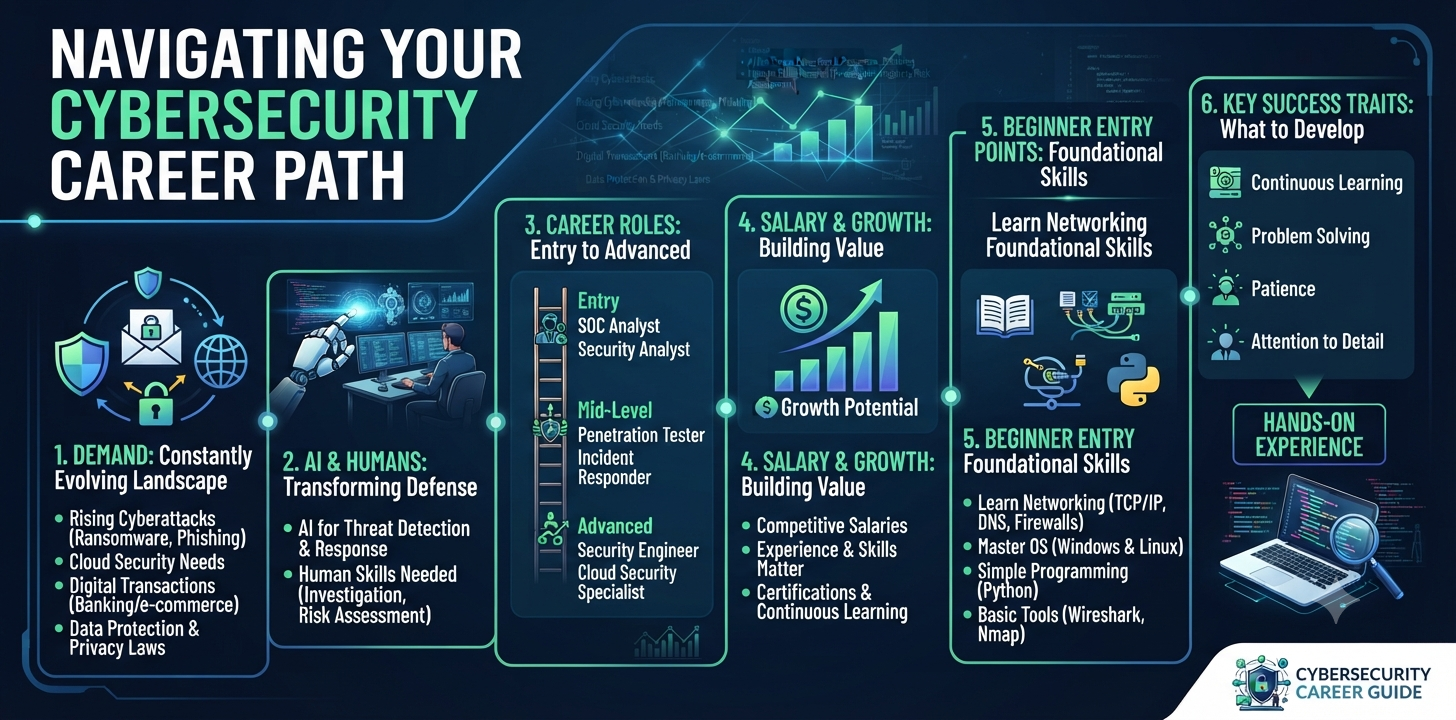

Cybersecurity remains a hot topic for learners, graduates and career-seekers seeking jobs in the tech field. The shift to digital operations has put protecting sensitive information, digital infrastructure, and customer data at the forefront of businesses' concerns. But, given the role of AI in handling certain technical aspects, and the growing number of individuals in the field, many new entrants may question whether cyber security is a viable career path. The answer is based on your interests, willingness to learn and ability to acquire skills in a hands-on technical skill.
1. Why is Cyber Security continuing to be in Demand?
As threats evolve in the cyber landscape, there is a constant demand for expertise in identifying vulnerabilities and securing digital environments. Secure networks, applications and databases are essential to organisations in myriad industries.
Factors that contribute to the demand are:
-
Security challenges for businesses due to increased cyberattacks such as ransomware, phishing, identity theft and data breach.
-
When it comes to cloud adoption, businesses require experts who know how to ensure that these applications and infrastructure are secure.
-
Online banking, e-commerce and digital payment are part of digital transactions and demand high level of security.
-
Data protection: Organisations have a responsibility to secure customer information and comply with relevant privacy laws.
While cybersecurity is still relevant, the skills that employers are looking for from cybersecurity professionals are continually changing.
2. Is Artificial Intelligence impacting Cybersecurity Careers?
AI is transforming security teams in their threat detection and response. AI tools can process vast security data sets, spot anomalies and automate mundane monitoring activities.
However, there is still a need for human professionals. There are many occasions where you will need to investigate, make decisions, and assess risks relating to security incidents. You can also gain an understanding of your role through taking a Cyber Security Course in Pune.
The following are the skills cybersecurity experts need to know how to:
-
Explore security alarms and issues.
-
Assess issues and offer solutions.
-
Handle incidents that cannot be resolved autonomously by automated tools.
-
Awareness of the potential threats to security when using AI technologies.
Working with AI tools can be a valuable skill for new entrants to this field.
3. What Jobs can you get?
With the knowledge and interests, there are a few career paths in cybersecurity. There is no need for the beginning learner to begin with the complex penetration testing or security engineering.
There are entry-level and specialized jobs that include:
-
SOC Analyst: Keeps an eye on security alerts and delves into suspicious network activities.
-
Security Analyst: Discovers vulnerabilities and aids organizations to enhance their security.
-
A penetration tester is someone who tests the security with permission to identify weaknesses.
-
A Network Security Engineer safeguards the network infrastructure from potential threats.
An individual who is responsible for investigating a security incident and assisting in the recovery process.
Learners who want to pursue their technical learning journey in the field of cyber security can look into these jobs to gain insight into the specialization they are interested in.
4. Is Salary the Right Choice?
Cybersecurity careers are attractive to job seekers, in part, due to the potential for growth and competitive salaries. However, salaries in cyber security can differ based on experience, technical skills, geographic location, organisation, etc. and the specific role cyber security professionals hold.
Typically, a professional can move up the following steps:
Freshers: Can explore junior SOC analyst, security support and trainee positions.
Mid-level professionals: Can progress to security analysis, penetration testing or incident response.
Experienced professionals can advance their careers to become security engineers, cloud security specialists, consultants, and leaders.
The primary thing that a beginner should look at is not just the salary but also the knowledge they have gained and the certifications they have achieved as well as the experience they have had in the industry.
5. What kind of entry point are there for beginners in this industry?
While a high-level technical specialty is not always essential to a career in cybersecurity, it is important to understand cyber fundamentals. A step-by-step method simplifies the process.
Try to use these skills:
1. Learn networking concepts like TCP/IP, DNS, Firewalls.
2. Understand the operating systems: Windows and Linux.
3. Learn simple programming, specially Python.
4. Learn about the common cyber threats and principles of cyber security.
5. Review tools like Wireshark, Nmap and Burp Suite.
6. Participate in hands-on activities in approved cybersecurity labs.
While educating learners on the basics of Cyber Security, they can consider a Cyber Security Course in Hyderabad to explore the options of technical education.
6. What to Think about Before you get into this Career?
Cybersecurity isn't a simple path to a lucrative technology career. Continued learning, problem solving skills, patience, attention to detail.
Before you go into the industry, think about how you like to solve problems, understand how technology works, and learn new technology concepts.
Using practice exercises, security reports, and documented projects to create a professional portfolio can also help prove your skills to prospective employers. People who are exploring career opportunities via a Cyber Security Course in Mumbai are also able to take a look at the hands on abilities and obligations of the chosen career field.
7. Continue to Develop Technical Skills
The cybersecurity landscape is constantly evolving with the emergence of new vulnerabilities, attack techniques, and technologies, making it essential for cybersecurity professionals to stay updated. Reading reports about security, keeping up with industry news and joining technical security communities can further bolster security knowledge.
In the same manner, the persons interested in Cyber Security Course in Bangalore may do some research on various specializations and the technicalities involved in each stream to make a decision.
A career in cybersecurity is still a great option for those who have a passion for technology and digital security. While AI is transforming the industry, the role of skilled professionals in detecting threats, managing risks, and safeguarding business systems is still vital. Emphasize on basic principles, hands-on experience and ongoing development, not just the salary. If someone is willing to put in the work and build the right skill sets—there are long-term career opportunities that can be found in cybersecurity.
