

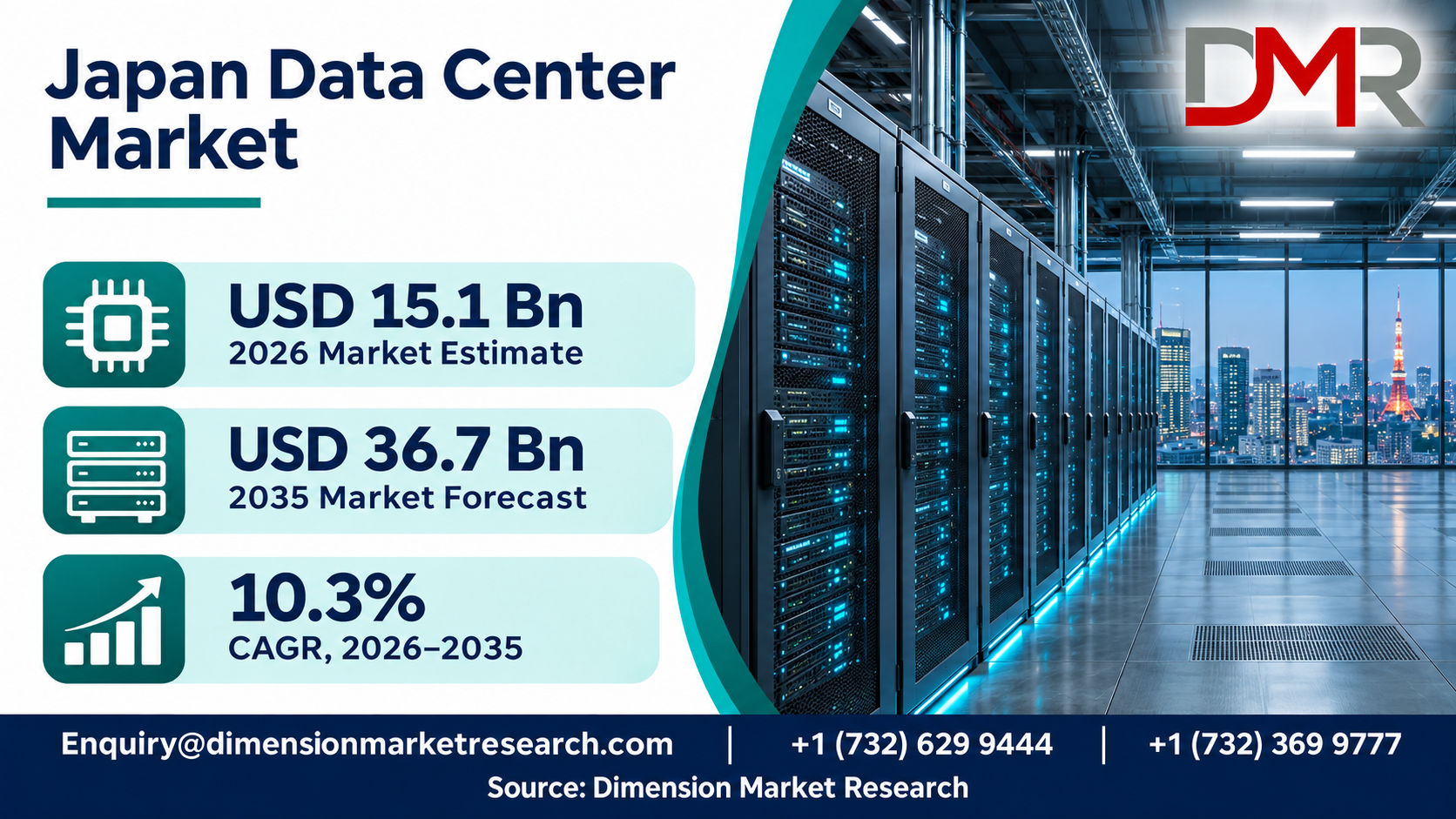

According to Dimension Market Research, the Japan Data Center Market is estimated at USD 15.1 billion in 2026 and projected to reach USD 36.7 billion by 2035, growing at a CAGR of 10.3%. Cloud migration and demand for AI computing are driving investment in hyperscale facilities, colocation, and edge infrastructure. For operators, the growth forecast raises a practical question. Where can they add capacity with sufficient power, suitable cooling, and the resilience customers expect?
What Does the Japan Data Center Market Cover?
The market covers the hardware, software, and services used to build and operate data centers in Japan. The report groups demand by deployment model, facility type, tier standard, enterprise size, and end user. These distinctions matter when assessing a project. A cloud provider planning a hyperscale campus may need large blocks of power and room to expand. An enterprise leasing colocation space may put more weight on connectivity to cloud platforms and the ability to retain control of selected workloads.
Get a Free Sample of the Japan Data Center Market Report
Request a free sample to review how the study defines its segments and assess whether its coverage fits your capacity planning, supplier strategy, or investment research.
https://dimensionmarketresearch.com/request-sample/japan-data-center-market/
Hyperscale Facilities Lead as Hybrid Deployment Sustains Colocation Demand
Hyperscale data centers lead by facility type, supported by demand for scalable cloud computing and storage. The report identifies AWS, Google, Microsoft, NTT, and SoftBank among the companies shaping this segment. Large campus developments create demand for electrical distribution, backup power, cooling, and networking equipment. For suppliers, the opportunity can extend to upgrades at existing sites as operators adapt them for more power-intensive workloads.
Hybrid is the leading deployment model, while cloud-based deployment is growing fastest. A hybrid setup allows enterprises to keep selected workloads on private infrastructure or in domestic colocation facilities while using public cloud services for others. This creates a role for colocation providers that offer direct connections to multiple cloud platforms. For enterprise buyers, the quality of those connections can influence where they place applications and how easily they move data between environments.
AI Workloads Increase Demand for Power and Cooling Equipment
Hardware is projected to account for 54.6% of Japan’s data center market in 2026, the largest share by offering. AI and high-performance computing are driving demand for specialized servers, faster networking, and equipment that can handle greater heat loads. DMR highlights direct-to-chip and immersion cooling as technologies gaining traction in high-density environments. For operators evaluating an upgrade, the key design question is whether the existing power and cooling systems can support the proposed equipment at the intended rack density.
Power Availability and Seismic Resilience Shape Site Selection
Securing suitable land and redundant power feeds can be difficult in the Tokyo and Osaka metropolitan areas. Seismic design adds engineering requirements, while shortages of specialized technical staff can raise operating costs. These factors make site readiness a commercial consideration alongside proximity to major customers and network hubs. An expansion plan can depend on when power becomes available, how much capacity a site can support, and whether the operator can staff it as it grows.
Regional edge facilities offer another opportunity. Smart factories and logistics operations can use local computing for workloads that need faster responses. Where that requirement is strong, a smaller facility near the point of use can complement the centralized capacity provided by hyperscale campuses.
Explore the Complete Japan Data Center Market Analysis
Use the full report to compare facility types, deployment models, and equipment categories before prioritizing capacity investment, supplier partnerships, or market entry.
https://dimensionmarketresearch.com/checkout/japan-data-center-market/
Frequently Asked Questions
1. How large is the Japan Data Center Market?
DMR estimates the market at USD 15.1 billion in 2026 and projects USD 36.7 billion by 2035.
2. What is the projected CAGR of the Japan Data Center Market?
The market is projected to grow at a CAGR of 10.3% from 2026 to 2035.
3. Which offering has the largest market share?
Hardware leads by offering, with an estimated 54.6% share in 2026.
4. Which data center type leads in Japan?
Hyperscale data centers lead by facility type, supported by demand for cloud computing and storage capacity.
5. Which deployment model is growing fastest?
Cloud-based deployment is the fastest-growing model in DMR’s analysis, while hybrid deployment remains the largest.
Conclusion
Japan’s outlook through 2035 reflects rising demand for hyperscale computing, continued use of hybrid infrastructure, and investment in equipment for AI workloads. Power availability and seismic resilience will help determine where capacity can expand. Opportunities include upgrading facilities for higher rack densities and adding regional capacity for applications that benefit from processing data closer to users.
Related Data Center Market Insights
The Data Center Market Size report estimates global revenue at USD 301.8 billion in 2026 and projects USD 805.3 billion by 2035, at an 11.5% CAGR. It provides global context for comparing hardware, software, services, and deployment models.
The India Data Center Market Share report estimates India’s market at USD 10.8 billion in 2026 and projects USD 36.6 billion by 2035. It highlights demand for hyperscale, cloud, and colocation capacity.
The South Korea Data Center Market Growth report projects an increase from USD 13.1 billion in 2026 to USD 68.4 billion by 2035, at a reported 20.2% CAGR. Cloud adoption, hyperscale investment, and demand for AI-ready facilities support its outlook.
