


Recreational Clubs Market to Reach USD 119.3 Billion by 2034, Driven by Rising Wellness and Lifestyle Participation
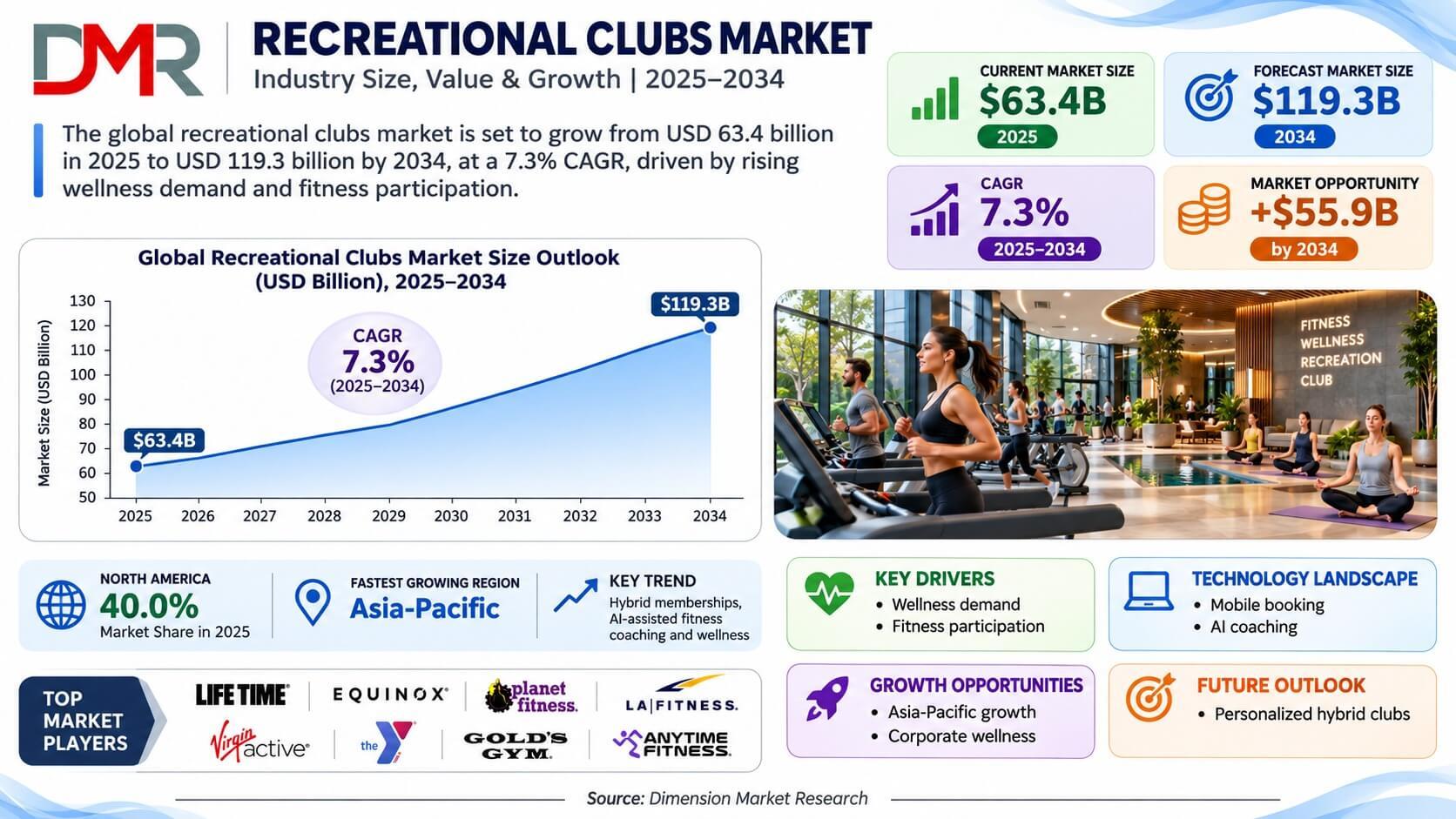
The global Recreational Clubs Market is entering a significant growth phase as consumers increasingly prioritize physical fitness, mental well-being, leisure activities, and social connections. According to Dimension Market Research, the global market is projected to reach USD 63.4 billion in 2025 and expand to USD 119.3 billion by 2034, registering a compound annual growth rate (CAGR) of 7.3% during 2025–2034. Growing participation in fitness programs, sports activities, wellness retreats, and community-based recreation is creating new opportunities for club operators worldwide.
Request Sample PDF of This Report: https://dimensionmarketresearch.com/request-sample/recreational-clubs-market/
What Is the Current Overview of the Recreational Clubs Market?
The Recreational Clubs Market includes organizations and facilities that provide structured leisure, fitness, sports, wellness, cultural, and social activities through membership-based or service-based models. Its scope covers fitness and wellness clubs, sports associations, golf and tennis clubs, adventure groups, country clubs, and arts and cultural organizations.
Changing lifestyles, increasing health awareness, urbanization, and rising disposable incomes are supporting market expansion. Consumers increasingly view recreational memberships as investments in personal well-being and social interaction rather than occasional leisure expenses. Clubs are responding with specialized programs, flexible membership plans, and integrated digital services.
Digital transformation is also changing how operators attract and retain members. Mobile applications, virtual fitness classes, AI-assisted coaching, and personalized wellness programs are helping recreational facilities improve accessibility. Meanwhile, emerging economies are creating opportunities through expanding middle-class populations and investments in sports and leisure infrastructure.
What Is the Expected Value of the Recreational Clubs Market by 2034?
The global market is forecast to reach USD 119.3 billion by 2034, supported by consistent demand for organized recreation, fitness, and wellness services.
- The market will reach USD 63.4 billion during 2025.
- Global revenue will reach USD 119.3 billion by 2034.
- The industry will expand at a 7.3% CAGR during 2025–2034.
- North America will account for 40.0% of revenue in 2025.
- The US market will reach USD 21.3 billion in 2025.
- US revenue will grow to USD 38.7 billion by 2034.
- The US market will register a 6.9% CAGR through 2034.
- Europe will reach USD 17.4 billion by 2034.
- Japan will reach USD 7.2 billion by 2034.
What Are the Latest Recreational Clubs Market Research Findings?
Research findings indicate that fitness and wellness clubs represent a leading category because of increasing health awareness and demand for structured physical activities. Individual memberships are expected to remain a major membership category, while membership fees provide the principal recurring revenue stream. Private clubs benefit from premium amenities, service customization, and flexible operating models. North America maintains the largest regional position, supported by established recreational infrastructure and strong membership participation. Asia-Pacific offers substantial expansion potential as urban populations, disposable incomes, and interest in organized wellness activities increase. Hybrid membership models, AI-powered personalization, and specialized lifestyle clubs are emerging as important competitive differentiators.
Why Is the Recreational Clubs Market Growing?
Market growth is primarily supported by increasing awareness of preventive healthcare, rising participation in fitness and outdoor activities, and the growing importance of mental wellness. Consumers are seeking convenient environments where they can exercise, develop hobbies, meet new people, and participate in organized community programs.
Urbanization and infrastructure investment are also encouraging new recreational facility development. Corporate wellness partnerships, university recreation programs, tourism-related wellness experiences, and senior-focused fitness services are expanding the customer base. Additionally, digital subscriptions and hybrid memberships allow operators to generate revenue beyond traditional physical attendance.
What Are the Key Growth Drivers of the Recreational Clubs Market?
- Increasing awareness of physical fitness and preventive healthcare.
- Growing demand for social interaction and community engagement.
- Expansion of urban recreational and sports infrastructure.
- Rising disposable incomes and lifestyle-oriented spending.
- Growing corporate investment in employee wellness programs.
- Increasing adoption of digital and hybrid membership services.
- Expansion of specialized fitness and wellness facilities.
Which Region Is Expected to Witness the Fastest Market Growth?
Asia-Pacific is expected to record the fastest growth in the Recreational Clubs Market during the forecast period. Expanding middle-class populations, rapid urbanization, increasing health consciousness, and rising participation in organized leisure activities are supporting regional opportunities. India, China, Indonesia, Vietnam, Thailand, and Malaysia are important markets benefiting from investments in fitness infrastructure, wellness facilities, and recreational tourism.
North America is projected to maintain the largest regional revenue share, accounting for approximately 40.0% in 2025. The United States leads through its established network of fitness chains, country clubs, sports organizations, and community recreation facilities.
Europe is estimated to reach USD 9.5 billion in 2025 and USD 17.4 billion by 2034, registering a 7.0% CAGR. Strong participation in sports, public recreational infrastructure, and wellness-focused community programs support regional expansion.
Japan's market is projected to reach USD 3.8 billion in 2025 and USD 7.2 billion by 2034, advancing at a 7.2% CAGR. Aging demographics and growing demand for senior wellness, yoga, and low-impact fitness activities support this development.
The US Recreational Clubs Market is projected to grow from USD 21.3 billion in 2025 to USD 38.7 billion by 2034, at a CAGR of 6.9%.
Which Segments Show the Highest Growth Potential Within the Recreational Clubs Market, and Why?
Fitness and Wellness Clubs
Fitness and wellness clubs represent a leading recreational club category because they serve a broad consumer base with diverse physical and mental health requirements. Gyms, yoga studios, Pilates facilities, wellness retreats, and specialized training centers attract young professionals, families, and older adults. Rising awareness of lifestyle-related health conditions is encouraging consumers to participate in structured exercise and preventive wellness programs.
Technology adoption further strengthens this segment. Digital workout platforms, wearable integrations, virtual coaching, and AI-assisted training allow operators to deliver personalized services and improve member engagement.
- Growing interest in preventive healthcare and fitness.
- Increasing popularity of yoga and specialized training.
- Expansion of hybrid fitness and wellness memberships.
Read More About This Market: Recreational Clubs Market
Individual Memberships
Individual memberships represent an important revenue and customer acquisition category across recreational clubs. These plans provide flexible access to fitness centers, sports facilities, social clubs, and wellness services. Their appeal comes from personalized participation, convenient payment structures, and the ability to select activities according to individual interests and schedules.
Mobile applications and automated membership management are improving the experience through digital booking, payment processing, activity tracking, and personalized recommendations. Introductory offers, referral incentives, and loyalty programs also help operators attract new customers and encourage renewals.
- Flexible monthly and annual membership options.
- Personalized fitness and recreational experiences.
- Recurring revenue through membership renewals.
Recreational Clubs Market Dynamics
What Are the Major Trends Shaping the Recreational Clubs Market?
Hybrid membership models and digital integration are transforming the recreational clubs industry. Facilities increasingly combine physical participation with virtual classes, online coaching, mobile booking, and personalized wellness tracking. This approach allows members to access services according to their schedules while helping operators strengthen engagement beyond facility visits. Another important trend is the expansion of niche lifestyle clubs. Women-exclusive fitness centers, senior wellness groups, adventure clubs, mindfulness communities, and boutique studios are attracting consumers seeking specialized experiences. Sustainability is also gaining importance as operators explore energy-efficient equipment, water conservation, and environmentally responsible facility designs. Together, these developments are encouraging clubs to move beyond conventional membership offerings toward more personalized recreational ecosystems.
What Are the Future Growth Opportunities in the Recreational Clubs Market?
AI-enabled personalization presents an important opportunity for recreational club operators. Intelligent fitness recommendations, predictive membership analytics, virtual coaching, and automated facility management can improve service quality while supporting operational efficiency. Expansion into tier-2 and tier-3 cities also offers considerable potential, particularly across Asia-Pacific and Latin America, where organized recreational infrastructure continues to develop. Corporate wellness partnerships, university recreation programs, and senior-living facilities provide additional customer acquisition opportunities. Operators can also diversify revenue through digital subscriptions, coaching services, event hosting, merchandise, and wellness tourism partnerships. Businesses that combine affordable membership structures with specialized services and technology-enabled experiences may strengthen their competitive position.
What Challenges Are Affecting the Market?
High operating expenses remain a significant challenge for recreational club operators. Real estate, equipment procurement, employee salaries, utilities, insurance, and maintenance can create considerable financial pressure, particularly for smaller businesses. Seasonal participation and fluctuating membership renewals may further affect cash flow and facility utilization. The fragmented market structure also creates inconsistencies in service quality, safety practices, and operating standards. Additionally, competition from low-cost fitness providers, boutique studios, digital workout platforms, and alternative leisure activities can make customer retention difficult. Regulatory requirements involving facility safety, employment practices, and member data protection add further complexity. Operators must balance competitive pricing with service improvements and sustainable operating costs.
Which Country Is Expected to Witness the Fastest Market Growth?
The United States is projected to reach USD 38.7 billion by 2034 at a 6.9% CAGR, while Japan is forecast to reach USD 7.2 billion at a 7.2% CAGR. Asia-Pacific is identified as the fastest-growing region; however, a specific country-level leader cannot be established from the available figures.
Who Are the Leading Companies in the Recreational Clubs Market?
The competitive landscape includes international fitness chains, premium lifestyle clubs, regional operators, and nonprofit recreational organizations. Major companies are focusing on facility expansion, differentiated membership programs, digital integration, and partnerships to strengthen their market presence.
- Life Time, Inc.
- Equinox Holdings, Inc.
- Planet Fitness, Inc.
- LA Fitness International LLC
- Town Sports International Holdings, Inc.
- Virgin Active Ltd.
- YMCA
- Gold’s Gym International, Inc.
- The Bay Club Company
- ClubCorp (Invited)
- Soho House & Co Inc.
- David Lloyd Leisure Ltd.
- Crunch Fitness
- Anytime Fitness, LLC
- Snap Fitness, Inc.
- GoodLife Fitness
- PureGym Ltd.
- F45 Training Holdings Inc.
- Curves International, Inc.
- Fitness First Ltd.
Get 10% instant discount on report purchase
Related Reports:
(FAQs)
1. What is the projected global Recreational Clubs Market size by 2034?
2. What is the expected CAGR of the Recreational Clubs Market during 2025–2034?
3. Which region holds the largest share of the global Recreational Clubs Market?
4. Why is Asia-Pacific expected to experience strong recreational club industry growth?
5. Which recreational club types are included in the global market segmentation?
6. How are digital technologies transforming recreational club membership services?
7. What are the major growth drivers influencing the Recreational Clubs Market?
8. Which companies are the leading competitors in the Recreational Clubs Market?
9. What challenges are affecting recreational club operators and membership retention?
10. What opportunities will AI and hybrid memberships create for recreational clubs?
About Us
Dimension Market Research (DMR) is a global market intelligence and consulting firm delivering data-driven insights that help organizations make informed strategic decisions. With expertise across 12+ industries and global markets, DMR provides syndicated reports, custom research, competitive analysis, white space analysis, and business strategy consulting.
Our research solutions combine analytical rigor, industry expertise, and forward-looking intelligence to identify opportunities, reduce risks, and support sustainable growth. Trusted by clients across diverse sectors, DMR is committed to delivering accurate, actionable insights that enable businesses to navigate evolving market landscapes with confidence.
Contact Us
Phone USA: +17323699777
Phone India: +919310023843
E-mail: [email protected]
Address USA: 957 Route 33, Suite 12 #308, Hamilton Square, NJ-08690
Address India: D44, Sector 6, Noida 201301, India
