

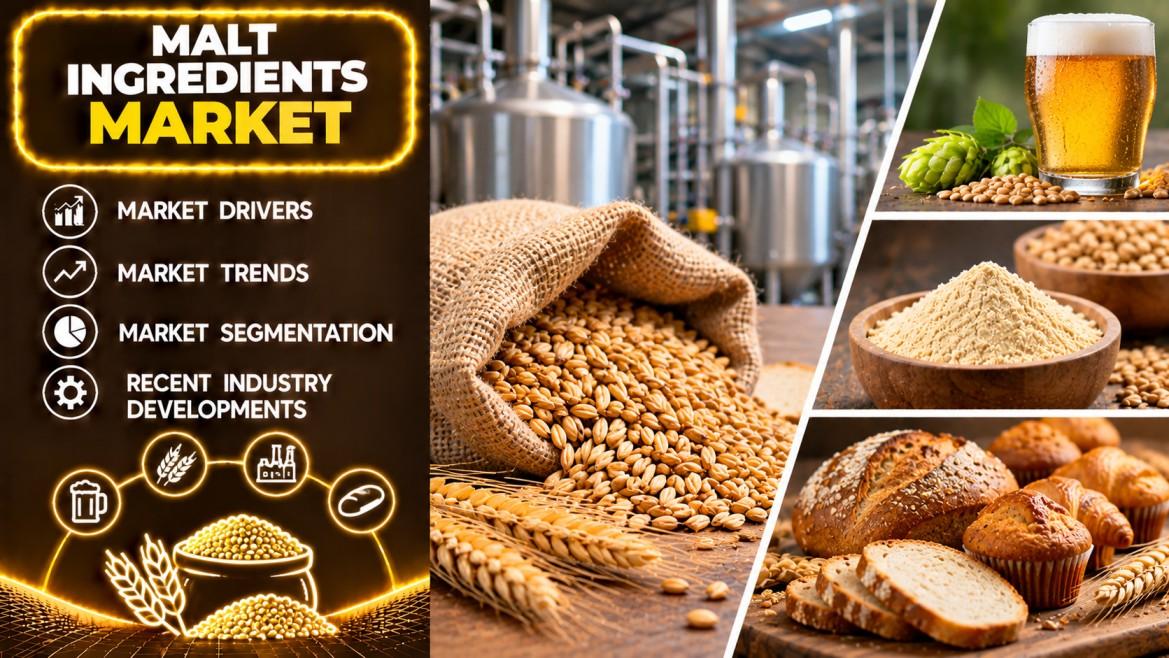

IMARC Group, a leading global market research and management consulting firm, has published its latest market intelligence report on the malt ingredients market. The global malt ingredients market size reached USD 27.7 Billion in 2025. Looking forward, IMARC Group expects the market to reach USD 40.4 Billion by 2034, exhibiting a growth rate (CAGR) of 4.14% during 2026-2034. Growth is driven by rising global consumption of beer and other alcoholic beverages, wider use of malt in bakery, dairy and non-alcoholic beverage formulations, ongoing innovation in specialty and dark malts, and rising consumer disposable incomes worldwide.
The malt ingredients market is gaining momentum as brewers, distillers and food manufacturers look for natural, flavorful and nutritionally rich inputs. Malt enhances flavor, deepens color and stabilizes texture. It also supplies proteins, B-complex vitamins, zinc, iron and calcium while staying low in fat. That profile suits it to beer and spirits, blended flour, biscuits, cakes and flavored milk. Social drinking, party and gathering culture is lifting alcoholic beverage volumes. At the same time, food processors are using malt as a clean-label ingredient that adds taste and structure without heavy reliance on artificial additives.
How AI is Reshaping the Future of the Malt Ingredients Market
- AI-Powered Barley Quality Prediction and Procurement Planning: Machine learning models are helping maltsters analyze crop data, weather patterns, grain protein levels and moisture content across supplier regions. This lets them plan barley sourcing, forecast malting quality and reduce the risk of rejected lots. Barley is the primary raw material for malt, so better yield and quality visibility supports steadier supply to breweries and food manufacturers.
- Smart Process Control in Steeping, Germination and Kilning: Sensor-based monitoring and AI-driven control systems are optimizing the temperature, humidity and timing of each malting stage. This improves batch-to-batch consistency in enzymatic activity and color, and it helps lower energy and water use per tonne of malt. Both are significant cost levers in a capital-intensive, energy-heavy industry.
- Data-Driven Specialty Malt Development: Consumer and sales analytics are helping malt suppliers and their brewing and food customers spot demand for dark, roasted and flavor-specific malts. Suppliers can design and test new grades faster. They can also match product specifications more closely to craft beer, non-alcoholic beverage and bakery applications before committing to full production runs.
Grab a sample PDF of this report: https://www.imarcgroup.com/malt-ingredients-market/requestsample
Malt Ingredients Market Trends and Drivers
The global malt ingredients market is witnessing steady expansion, fueled by the convergence of beverage consumption patterns, food industry demand and product innovation. Beer remains the largest anchor for malt demand, and its growing popularity in social settings across both developed and emerging economies supports consistent volume offtake from maltsters. Brewers rely on malt for fermentable sugars, flavor and color, so even small shifts in beer output translate into meaningful demand for malting capacity. Specialty malts are gaining attention as craft brewers and premium spirit makers differentiate on taste profile.
Beyond beverages, the food and beverage industry is a rapidly widening demand base. Malt flour and malt extracts are used in blended flours, biscuits, cakes and bread to improve dough performance, crust color and flavor. Dairy manufacturers use malt for flavoring milk-based drinks, and non-alcoholic malt beverages continue to attract health-conscious consumers. Product innovation such as dark malt is creating new flavor opportunities for both brewers and bakers. Rising disposable income is also encouraging consumers to trade up to premium beers, spirits and malted food products.
Government support for food processing is strengthening the broader ecosystem. India’s Production Linked Incentive Scheme for the Food Processing Industry has attracted cumulative investment of about Rs 9,207 crore from 168 approved applicants, including 69 MSMEs. It has created processing and preservation capacity of roughly 35 lakh metric tonnes per year, and incentives of about Rs 2,714.79 crore have been disbursed so far. Programs like this help expand grain-processing and value-added ingredient infrastructure, which benefits malt-based product manufacturing.
Ask an analyst for customized report: https://www.imarcgroup.com/request?type=report&id=1424&flag=E
Malt Ingredients Industry Segmentation:
The report has segmented the market into the following categories:
Breakup By Type:
- Dry Malt
- Liquid Malt
- Malt Flour
- Others
Dry malt and liquid malt serve brewers, bakers and food processors that need ease of storage, dosing accuracy and consistent enzymatic performance. Malt flour is valued in baking and blended flour formulations for its flavor and dough-conditioning benefits.
Breakup By Source:
- Barley
- Wheat
- Rye
- Others
Barley is the traditional and most widely recognized malting grain because of its enzyme profile and suitability for brewing. Wheat and rye malts add distinct flavor and texture characteristics for specialty beers and bakery products.
Breakup By Grade:
- Standard Malt
- Specialty Malt
Standard malt forms the base of most brewing and food applications. Specialty malts, including roasted and dark varieties, are in demand for color, aroma and premium product differentiation.
Breakup By Application:
- Alcoholic Beverages
- Non-Alcoholic Beverages
- Food Products
- Pharmaceuticals
- Others
Alcoholic beverages, led by beer and spirits, are the core application. Non-alcoholic beverages, bakery, dairy flavoring and nutritional products are expanding the use of malt ingredients across the wider food and beverage industry.
Breakup By Region:
- Europe
- Asia Pacific
- North America
- Middle East and Africa
- Latin America
Europe has a deep brewing heritage and an established malting base. Asia Pacific is drawing new investment as beer consumption, urbanization and food processing capacity rise. North America benefits from a strong craft brewing culture and a large bakery and packaged food sector.
Competitive Landscape:
The report provides a comprehensive analysis of the competitive landscape in the malt ingredients market with detailed profiles of all major companies, including:
- GrainCorp Limited
- Axéréal Group
- Malteurop Groupe
- Soufflet Group
- Crisp Malting Group Limited
- IREKS GmbH
- Muntons plc
- Simpsons Malt Ltd.
What Does The Full Report Cover?
If you are tracking the malt ingredients market for investment decisions, market entry planning, competitive benchmarking, or strategic advisory, IMARC Group’s report gives you everything in one place:
- Complete market sizing with revenue projections across the full study period
- Quantified growth driver analysis across type, source, grade, application and regional markets
- Sub-segment breakdowns for dry malt, liquid malt, malt flour, barley, wheat, rye, standard malt, specialty malt and key applications
- Regional coverage across Europe, Asia Pacific, North America, Latin America, and Middle East and Africa
- Competitive profiles of leading companies with strategic landscape assessment
- Porter’s Five Forces, SWOT analysis, value chain analysis and profit margin insights
- Latest product innovation trends, including dark malt and specialty malt development, shaping competition and customer preference
Recent News and Developments in Malt Ingredients Market
- October: Malteurop officially inaugurated its acquired Chunlei malting plant near Yancheng in Jiangsu province, China, about 300 km north of Shanghai. The plant has an officially stated annual capacity of 220,000 tonnes of malt, strengthening Malteurop’s presence in the Asian brewing market.
- July: Malteurop completed the acquisition of an 80% stake in the Chunlei malting plant, previously operated by Sheyang Chunlei Malt Co. in Jiangsu, China. The deal expands the company’s regional supply footprint for Asia Pacific customers.
- March: India’s Ministry of Food Processing Industries reported that its Production Linked Incentive Scheme had drawn about Rs 9,207 crore in cumulative investment and created roughly 35 lakh metric tonnes of annual processing capacity. This supports growth in grain-based and value-added ingredient manufacturing.
- January: Boortmalt, the malting arm of the French agricultural cooperative group Axéréal, published its sustainability report. The publication reflects the industry’s growing focus on responsible barley sourcing and lower-impact malting.
Note: If you require specific details, data, or insights that are not currently included in the scope of this report, we are happy to accommodate your request. As part of our customization service, we will gather and provide the additional information you need, tailored to your specific requirements. Please let us know your exact needs, and we will ensure the report is updated accordingly to meet your expectations.
Key Questions This Report Answers
- What is the current global malt ingredients market size and what is its projected value?
- Which type, source, grade and application segments hold the largest shares in the global malt ingredients market?
- What are the key drivers of global malt ingredients market growth?
- Which region dominates the global malt ingredients market and why?
- How are specialty malt innovation, non-alcoholic beverage demand and food industry applications reshaping competitive strategies?
- Who are the top companies in the global malt ingredients market and what are their competitive strategies?
- What are the investment and market entry opportunities across dry malt, liquid malt, malt flour and specialty malt segments?
About Us:
IMARC Group is a global management consulting firm that helps the world’s most ambitious changemakers to create a lasting impact. The company provides a comprehensive suite of market entry and expansion services. IMARC offerings include thorough market assessment, feasibility studies, company incorporation assistance, factory setup support, regulatory approvals and licensing navigation, branding, marketing and sales strategies, competitive landscape and benchmarking analyses, pricing and cost research, and procurement research.
Media and Sales Contact
IMARC Group
Email: [email protected]
United States: +1-201-971-6302
India: +91-120-433-0800
United Kingdom: +44-753-714-6104
