

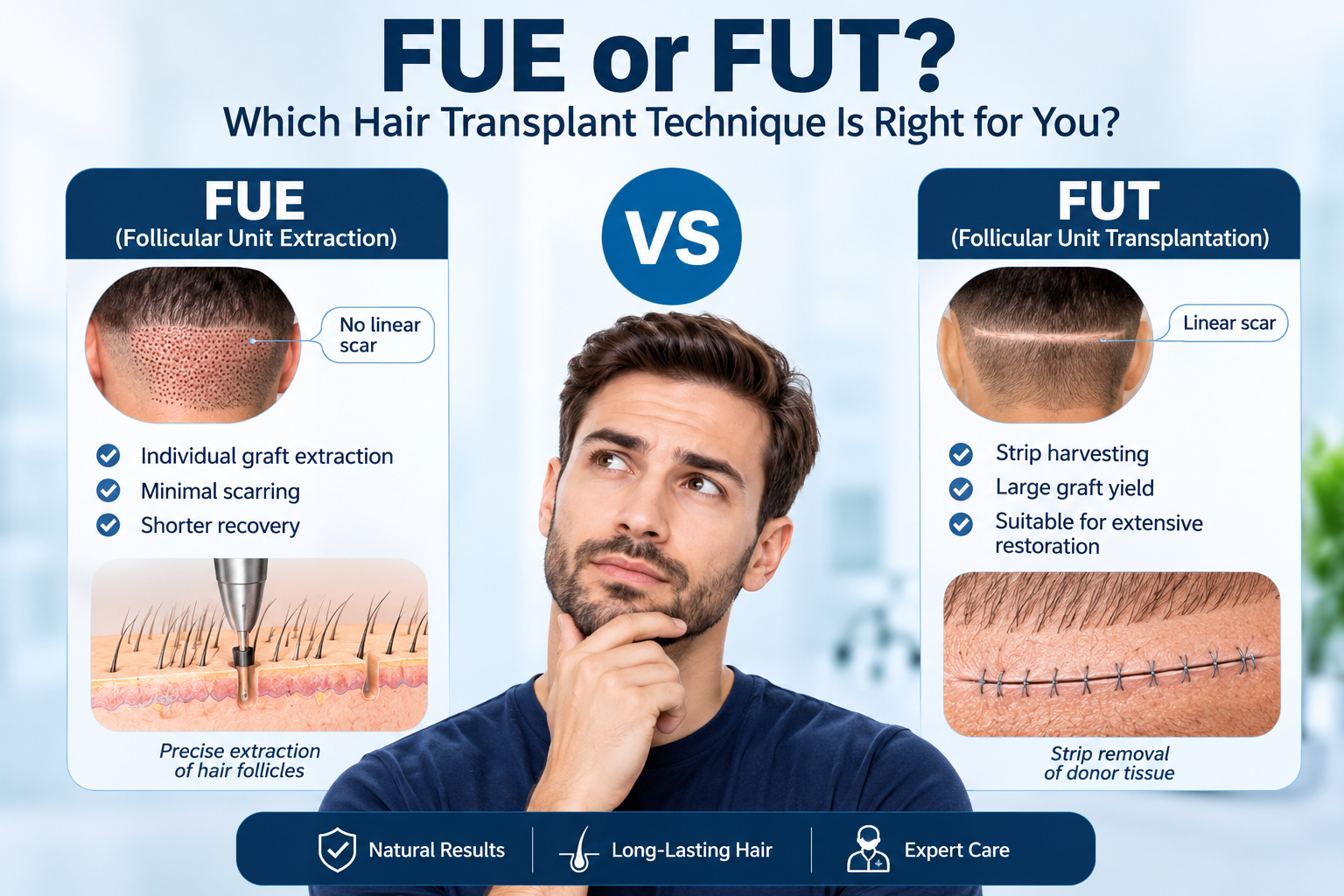
Choosing between FUE (Follicular Unit Extraction) and FUT (Follicular Unit Transplantation) is an important decision for anyone considering hair restoration. Both procedures move healthy hair follicles from a donor area—usually the back or sides of the scalp—to areas affected by thinning or baldness. However, they differ in how grafts are collected, the type of scarring they leave, recovery time, and suitability for different hair-loss patterns.
The better technique depends on your hair-loss stage, donor hair supply, hairstyle preferences, scalp characteristics, and long-term restoration goals. FUE Hair Transplant in Jeddah is often preferred by people who want to avoid a linear scar and keep their hair short, while FUT may be suitable for selected patients who need a substantial number of grafts and have an appropriate donor area.
Understanding the Two Hair Transplant Techniques:
What Is FUE Hair Transplantation?
Follicular Unit Extraction involves removing individual follicular units from the donor area using a specialised micro-punch instrument. Each graft is carefully extracted and prepared before being implanted into areas with thinning or missing hair.
Because FUE does not require removing a continuous strip of scalp, it avoids the long linear donor scar associated with FUT. Instead, it leaves multiple tiny extraction marks that generally become less noticeable as they heal. However, FUE is not completely scar-free, and excessive extraction can create visible thinning in the donor area.
FUE is commonly considered for people experiencing:
-
Receding hairlines and temple thinning
-
Male pattern baldness
-
Crown or vertex hair loss
-
Diffuse thinning in suitable candidates
-
Selected eyebrow or beard restoration cases
What Is FUT Hair Transplantation?
Follicular Unit Transplantation, commonly called the strip method, involves surgically removing a narrow strip of hair-bearing skin from the donor area. The strip is then divided under magnification into individual follicular unit grafts, which are transplanted into the recipient area.
Unlike FUE, FUT requires closing the donor incision, which usually leaves a linear scar. The scar may remain concealed beneath longer hair, but it can become visible when the hair is cut very short or if the incision heals with noticeable widening.
FUT may be considered for selected patients who require a substantial number of grafts and have sufficient scalp flexibility and donor density.
FUE vs FUT: What Actually Makes Them Different?
Although both techniques use your own hair follicles, their harvesting methods create different surgical experiences.
| Comparison Factor | FUE | FUT |
|---|---|---|
| Full Name | Follicular Unit Extraction | Follicular Unit Transplantation |
| Graft Collection | Individual follicular units | A strip of scalp tissue |
| Donor Scarring | Multiple small extraction scars | Usually one linear scar |
| Donor Wound Closure | Individual extraction sites heal | Surgical incision requires closure |
| Short Hairstyles | Often more suitable | Linear scar may become visible |
| Donor Area Requirements | Requires sufficient density across the harvesting area | Requires suitable scalp laxity |
| Recovery Considerations | No strip incision to heal | Additional donor incision healing |
| Future Procedures | Depends on remaining donor density | Depends on remaining scalp laxity and scar characteristics |
Neither technique guarantees better hair growth or a more natural appearance. Results depend on patient selection, graft quality, surgical planning, follicle handling, and implantation technique.
Which Technique Provides Better Hair Density?
Hair density is one of the most important concerns for people considering a hair transplant. However, the number of grafts harvested does not automatically determine the final appearance.
FUE and FUT can both provide high-quality follicular unit grafts when performed appropriately. FUT may offer an advantage in selected patients who need a substantial number of grafts because strip harvesting can preserve some surrounding donor areas for possible future FUE procedures.
FUE, on the other hand, allows the surgeon to select individual follicular units from suitable parts of the donor region. This can be useful when designing a restoration plan around particular areas of thinning.
The final density also depends on:
-
Donor hair thickness and quality
-
Number of hairs within each follicular unit
-
Size of the recipient area
-
Existing hair density
-
Hairline design and implantation direction
-
Long-term progression of hair loss
A realistic treatment plan should prioritise natural coverage and responsible donor management rather than promising maximum density.
FUE or FUT: Which Is Better for Different Hair-Loss Patterns?
The most appropriate procedure depends on the patient's individual hair-loss characteristics.
For a receding hairline: FUE may be attractive to patients who prefer shorter hairstyles and want to avoid a linear donor scar. The surgeon must still consider facial proportions, age, existing hair density, and the possibility of future recession.
For extensive baldness: FUT may be considered when a substantial number of grafts are required and the patient has suitable scalp laxity. Some patients may benefit from a carefully planned combination of FUT and FUE over multiple procedures.
For crown thinning: Either technique may be suitable depending on donor availability, the size of the thinning area, and the expected progression of hair loss.
For patients who regularly wear short hairstyles: FUE may be preferable because it avoids a single linear scar. However, extensive FUE can also produce visible small scars or uneven donor density.
For patients considering future procedures: Long-term donor management is essential. A surgeon should assess how the selected technique will affect the remaining donor supply and future restoration options.
Hair Transplant Cost: Is FUE More Expensive Than FUT?
Hair Transplant pricing depends on the technique, number of grafts, severity of hair loss, donor hair quality, surgeon's experience, and additional treatments included in the package.
The published pricing information for FUE at Enfield Royal Clinic Jeddah lists the following estimated costs:
| FUE Treatment Type | Estimated Cost (SAR) |
|---|---|
| Standard FUE Hair Transplant | 8,000–14,000 |
| Sapphire FUE Hair Transplant | 10,000–16,000 |
| DHI Hair Transplant | 12,000–20,000 |
| No-Shave FUE Hair Transplant | 12,000–18,000 |
| Beard Hair Transplant | 6,000–10,000 |
| FUE + PRP Programme | 9,000–15,000 |
The general estimated FUE price range published on the treatment page is SAR 8,000–15,000. The final cost is confirmed following consultation and assessment. Tabby and Tamara payment plans are also facilitated, subject to applicable arrangements.
What about FUT pricing? The referenced clinic page publishes FUE prices but does not provide a separate FUT price. Therefore, an exact FUT cost cannot be stated from that source. Patients comparing both methods should request an individualised quotation rather than assume that FUT is automatically cheaper.
Meet the Medical Expert Behind the Hair Restoration Approach:
The clinic's published FUE treatment page identifies Dr. Mohamed Elnahas as its medical expert. He is a Plastic and Reconstructive Surgeon with more than 17 years of clinical experience.
His listed professional background includes advanced surgical fellowship training in South Korea, plastic and reconstructive surgery training in Egypt, Arab Board training in surgical plastic practices, and a Harvard University training reference.
His experience in facial surgery and anatomical planning is relevant to considerations such as hairline design, graft placement, and individual treatment planning.
Before proceeding, patients should confirm the operating surgeon's identity, current professional registration, relevant hair-transplant experience, and responsibility for each stage of the procedure.
Recovery: What Should Patients Expect After FUE or FUT?
Recovery varies according to the surgical technique, number of grafts, individual healing response, and postoperative care.
After FUE, patients may experience temporary redness, mild swelling, tenderness, and small scabs around the donor and recipient sites. There is no linear donor incision, which removes the need to heal a strip wound.
FUT recovery also involves recipient-site healing, but the donor incision requires additional attention. Patients may experience tightness or tenderness around the linear scar, and wound closure must be protected during the early healing period.
Common recovery milestones include:
-
Days 1–10: Redness, tenderness, and small scabs may be present.
-
Weeks 2–4: Scabs generally fall away as the scalp continues healing.
-
Weeks 4–8: Transplanted hairs may shed temporarily, which is a normal part of the hair-growth cycle.
-
Months 3–4: Early new hair growth may become noticeable.
-
Months 6–12: Hair growth and visible coverage gradually improve.
-
Months 12–18: Results continue to mature.
These timelines are general estimates rather than guaranteed outcomes. Patients should follow their surgeon's instructions for washing, medication, sun exposure, and physical activity.
Possible Risks and Limitations of Both Procedures:
Hair transplantation is a surgical procedure, and neither FUE nor FUT is completely risk-free.
Possible complications include:
-
Temporary shock loss of existing hair
-
Swelling, redness, itching, or tenderness
-
Infection or delayed wound healing
-
Poor graft survival
-
Unnatural hairline design
-
Visible donor scarring
-
Donor-area thinning caused by excessive harvesting
-
Temporary or persistent changes in scalp sensation
FUE can cause scattered extraction scars and donor depletion if grafts are removed too aggressively. FUT can produce a widened linear scar, wound tension, or prolonged donor-area discomfort.
A qualified surgeon should explain these risks before treatment and assess whether the expected benefits justify surgery.
Frequently Asked Questions:
Is FUE better than FUT for natural-looking results?
Both procedures can produce natural-looking results. Hairline design, graft selection, implantation angle, and surgical expertise are more important than the technique's name alone.
Does FUT provide more grafts than FUE?
FUT can provide a substantial number of grafts in selected patients, particularly when scalp laxity and donor density are favourable. However, the actual graft yield depends on individual anatomy and surgical planning.
Does FUE leave a permanent scar?
Yes. FUE creates small circular scars at extraction sites. They are generally less noticeable individually than a linear FUT scar, but they do not disappear completely.
Is FUT more painful than FUE?
FUT involves a donor incision that may cause additional tightness or discomfort during healing. FUE avoids this linear incision, but both procedures involve surgery and can cause postoperative tenderness.
Can FUE and FUT be combined?
In selected patients, surgeons may use both methods across different procedures to manage donor resources. This decision requires careful evaluation of previous surgery, remaining donor density, and scalp characteristics.
How long do hair transplant results last?
Transplanted follicles taken from an appropriate donor area can provide long-lasting growth. However, existing non-transplanted hair may continue to thin, so long-term hair-loss management remains important.
Final Verdict: Should You Choose FUE or FUT?
There is no universal winner between FUE and FUT. FUE may suit patients who want to avoid a linear donor scar and prefer shorter hairstyles. FUT may be appropriate for selected individuals who need substantial graft numbers and have suitable scalp characteristics.
The most effective approach is the one that balances natural-looking coverage, donor-area preservation, recovery expectations, and future hair-loss management. A detailed consultation with an appropriately qualified hair restoration surgeon can help determine which technique is suitable for your needs.
