

Green Hydrogen Market Size, Share, Industry Overview, Trends and Forecast 2026-2034

IMARC Group has recently released a new research study titled "Green Hydrogen Market Size, Share, Trends and Forecast by Technology, Application, Distribution Channel, and Region, 2026-2034", offering a detailed analysis of the market drivers, segmentation, growth opportunities, trends, and competitive landscape to understand the current and future market scenarios.
Green Hydrogen Market Size & Share 2026-2034
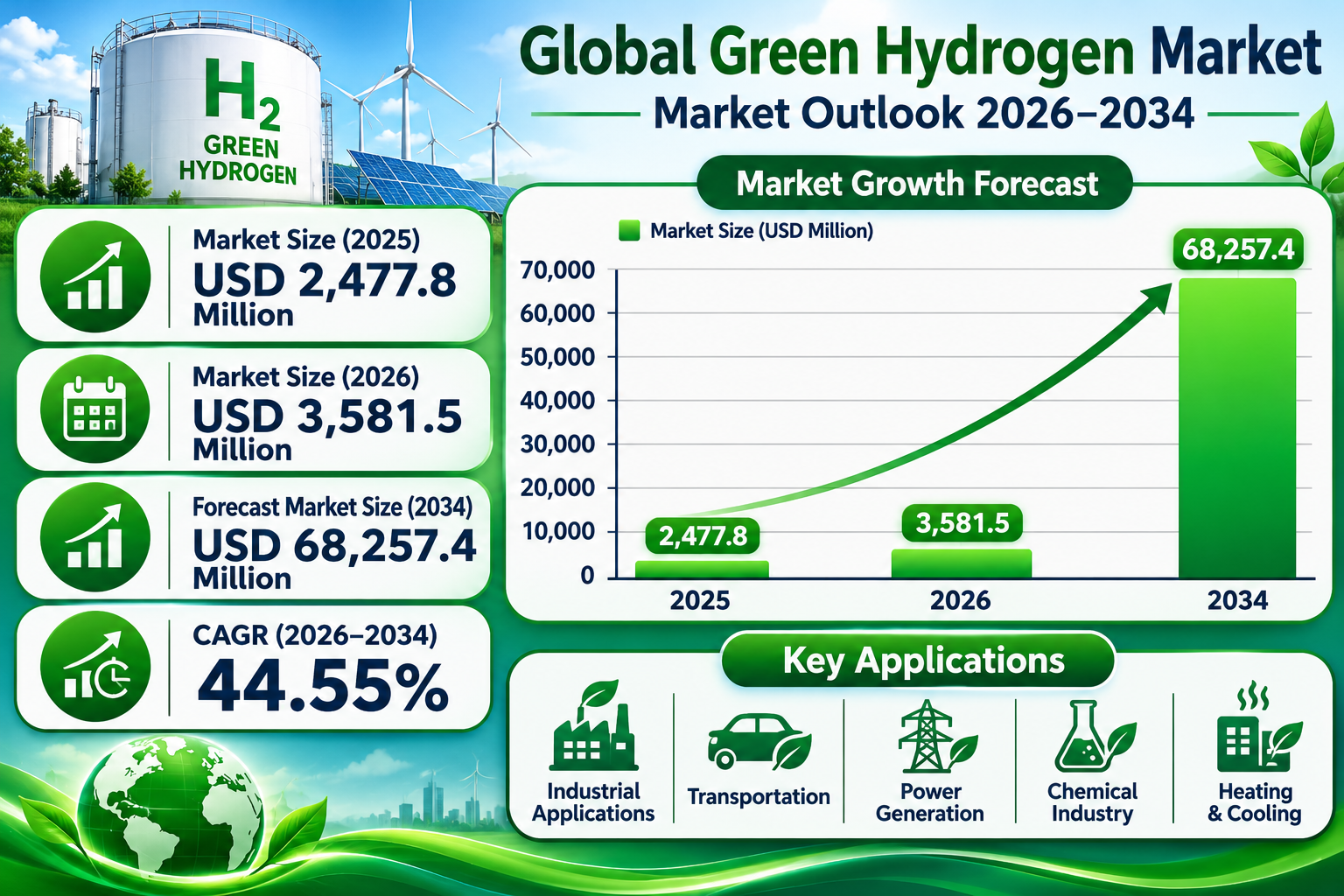
The global green hydrogen market size reached USD 2,477.8 Million in 2025 to USD 3,581.5 Million in 2026 and is projected to reach USD 68,257.4 Million by 2034, expanding at a CAGR of 44.55% during 2026-2034. Europe dominated the market in 2025. The market continues to gain momentum, shaped by stringent decarbonization policies, technological advancements in electrolysis, falling renewable energy costs, and rising demand for clean energy alternatives in hard-to-decarbonize sectors such as heavy industry and transport.
Growth is further reinforced by government policies and incentives for hydrogen produced via electrolysis with renewable power, rising investment in green hydrogen projects for industrial use, transport, and power generation, growing applications of hydrogen fuel cells in the automotive and aviation industries, and energy security concerns that encourage diversified energy sources. These dynamics are expected to strengthen the green hydrogen market share throughout the forecast period.
Key Market Statistics at a Glance
- Base Year: 2025
- Historical Years: 2020-2025
- Forecast Period: 2026-2034
- Market Size (2025): USD 2,477.8 Million
- Market Size (2026): USD 3,581.5 Million
- Projected Market Size (2034): USD 68,257.4 Million
- Growth Rate: CAGR of 44.55% (2026-2034)
Explore Opportunities in the Global Green Hydrogen Market: Download the IMARC Sample Report: https://www.imarcgroup.com/green-hydrogen-market/requestsample
Key Growth Drivers and Trends in the Global Green Hydrogen Market
Growth in the global green hydrogen market is being driven primarily by rising decarbonization goals and climate policies. Governments worldwide are setting stringent climate targets, and green hydrogen is considered a critical tool for achieving them. Policies supporting renewable energy, carbon pricing mechanisms, and incentives for low-carbon technologies are lifting demand across sectors such as transport. These developments are shaping green hydrogen market trends 2026, as countries increasingly prioritize clean energy alternatives to reduce carbon emissions. In February 2024, UN Member States adopted the Inland Transport Committee’s strategy for reducing greenhouse gas emissions from inland transport. Transport accounts for approximately 23% of annual GHG emissions, of which inland transport holds 72%, while demand for passenger transport is projected to increase by 79% and freight transport by 100% by 2050.
One of the leading global green hydrogen market trends is the advancement of renewable energy and electrolysis technology. Renewable energy costs continue to decline, making hydrogen production through water electrolysis increasingly viable. According to the International Energy Agency, in 2023, 96% of new utility-scale solar PV and offshore wind capacity was cheaper than new coal or natural gas plants. Improvements in electrolysis technology are also enhancing energy efficiency and reducing production costs. These technological advancements are strengthening the green hydrogen market forecast, as improved production economics and scalable electrolyzer solutions support wider commercial adoption. In July 2024, F2N Green Hydrogen Srl (FGH) of Varese, Italy, completed internal qualification tests and launched its CORNERSTONE alkaline stack product line, including a 500-kW prototype that can scale up to 2 MW and passed pressure equipment certification for applications up to 30 bars.
Another key factor supporting global green hydrogen market growth is rising demand from industry and transport. Hard-to-decarbonize sectors such as steel, cement, chemicals, shipping, aviation, and long-haul trucking are increasingly turning to green hydrogen as a clean alternative to fossil fuels. According to the Rhodium Group, U.S. transportation sector emissions rose 1.6% in 2023 relative to 2022. In May 2024, Volvo Trucks announced that it was developing trucks with hydrogen-fueled combustion engines, with on-road tests beginning in 2026 and commercial launch projected for the end of the decade. Increasing investments in hydrogen-powered transportation and industrial decarbonization solutions are expected to accelerate green hydrogen market growth over the forecast period.
Speak to an Analyst: https://www.imarcgroup.com/request?type=report&id=7717&flag=C
Global Green Hydrogen Industry Segmentation Insights
Breakup by Technology:
- Proton Exchange Membrane Electrolyzer: Electrolysis technology that splits water into hydrogen and oxygen using a proton exchange membrane.
- Alkaline Electrolyzer: The largest technology segment in 2025, owing to mature technology, cost-effectiveness, long operational life, and reliable large-scale production suited to industrial applications and steady, continuous operation. In March 2024, Greenzo Energy India Limited launched India’s first 1 MW alkaline electrolyser.
- Others: Includes other electrolyzer technologies not captured above.
Breakup by Application:
- Power Generation: Use of green hydrogen to generate electricity and support utility-scale energy needs.
- Transport: The leading application, offering a sustainable alternative for hard-to-electrify sectors such as heavy-duty vehicles, shipping, and aviation. Hydrogen fuel cells provide longer ranges and faster refueling than batteries, and growing infrastructure investment and fuel cell vehicle innovation support the segment.
- Others: Includes other applications not captured above.
Breakup by Distribution Channel:
- Pipeline: The largest distribution channel, valued for cost-efficiency and reliability over long distances; existing natural gas pipelines can often be repurposed for hydrogen, and pipelines enable continuous, large-scale delivery from production sites to end-users with lower energy losses than road or maritime transport.
- Cargo: Transport of green hydrogen by road or maritime cargo.
Breakup by Region:
- Europe: The largest region in 2025, driven by stringent EU climate targets, significant government funding, the European Green Deal and Fit for 55 packages, and the EU Hydrogen Strategy, along with “hydrogen valleys” and partnerships with North Africa and other regions for future imports. In September 2024, bp and Iberdrola formed a 50:50 joint venture in Spain for a 25 MW green hydrogen project at bp’s Castellón refinery, expected to avoid 23,000 tons of CO2 emissions per year.
- North America: The United States is a key regional market, supported by tax credits and subsidies, the Inflation Reduction Act, the Department of Energy’s Hydrogen Shot program, declining solar and wind costs, and net-zero targets for 2050.
- Asia Pacific: Growth supported by carbon neutrality commitments in Japan, South Korea, China, and Australia, extensive renewable energy investment, and industrial demand in steel, ammonia, and chemical refining. India added a record 18.48 GW of renewable energy capacity in 2023-24, per its Ministry of New & Renewable Energy.
- Latin America: Growth supported by abundant solar and wind resources in Chile, Brazil, and Argentina and export ambitions toward Europe and Asia. Brazil announced a USD 12.5 Billion growth acceleration plan for new renewable energy projects in 2023.
- Middle East and Africa: Growth supported by solar and wind potential in Saudi Arabia, the UAE, and South Africa, government policies, international investment, and export opportunities to Europe and Asia; Saudi Arabia had more than 8 GW of renewable capacity under construction by the end of 2023.
Key Challenges and Growth Opportunities in the Global Green Hydrogen Market
The global green hydrogen market must address the need to keep reducing production costs to compete with conventional fuels, the variable-load limitations of some electrolyzer types, and the build-out of storage, pipeline, and distribution infrastructure, which depends on sustained policy support and large-scale investment.
The market offers considerable growth opportunities driven by falling renewable energy costs, advances in electrolyzer efficiency, and expanding use in heavy industry, heavy transport, and power generation. Repurposing existing natural gas pipelines, growing export potential from renewable-rich regions such as Australia, Chile, and the Middle East, and collaboration among governments, industry, and research institutions are also expected to support long-term growth across both developed and emerging regions.
Competitive Landscape
Key players in the market are investing heavily in research and development to improve electrolyzer efficiency, reduce production costs, and enhance storage and distribution technologies. Global energy companies are forming strategic partnerships to co-develop large-scale production facilities, aligning with government incentives such as tax credits under the Inflation Reduction Act, integrating vertically by securing renewable energy assets, and collaborating with automakers and heavy industries. Recent moves include Hero Future Energies signing an MoU with the Government of Karnataka in December 2024 to invest in renewable energy and green hydrogen projects, the IIT Bombay and HSBC India green hydrogen program shortlisting six projects in November 2024, a U.S.-based firm opening a green hydrogen electrolyser gigafactory near Doddaballapur in July 2024, and the inauguration of India’s first multi-purpose green hydrogen pilot project at the Nathpa Jhakri Hydro Power Station in April 2024. Major companies profiled in the IMARC report include Air Liquide S.A., Air Products and Chemicals Inc., Enapter AG, Green Hydrogen Systems A/S, Linde plc, Nel ASA, Ørsted A/S, Plug Power Inc., Siemens Energy AG, and Uniper SE (Fortum Oyj).
Author IMARC Group
IMARC Group is a leading global market research company providing data-driven insights and expert consulting services to businesses seeking to achieve their strategic objectives. With a multidisciplinary team of industry experts, IMARC delivers reliable market intelligence across sectors including Chemicals and Materials, Healthcare, Technology, Agriculture, and Retail.
Contact Us:
IMARC Group
Email: [email protected]
United States: +1-201-971-6302
