

Log Periodic Dipole Antenna: Wideband Communication Solutions by Star Antenna
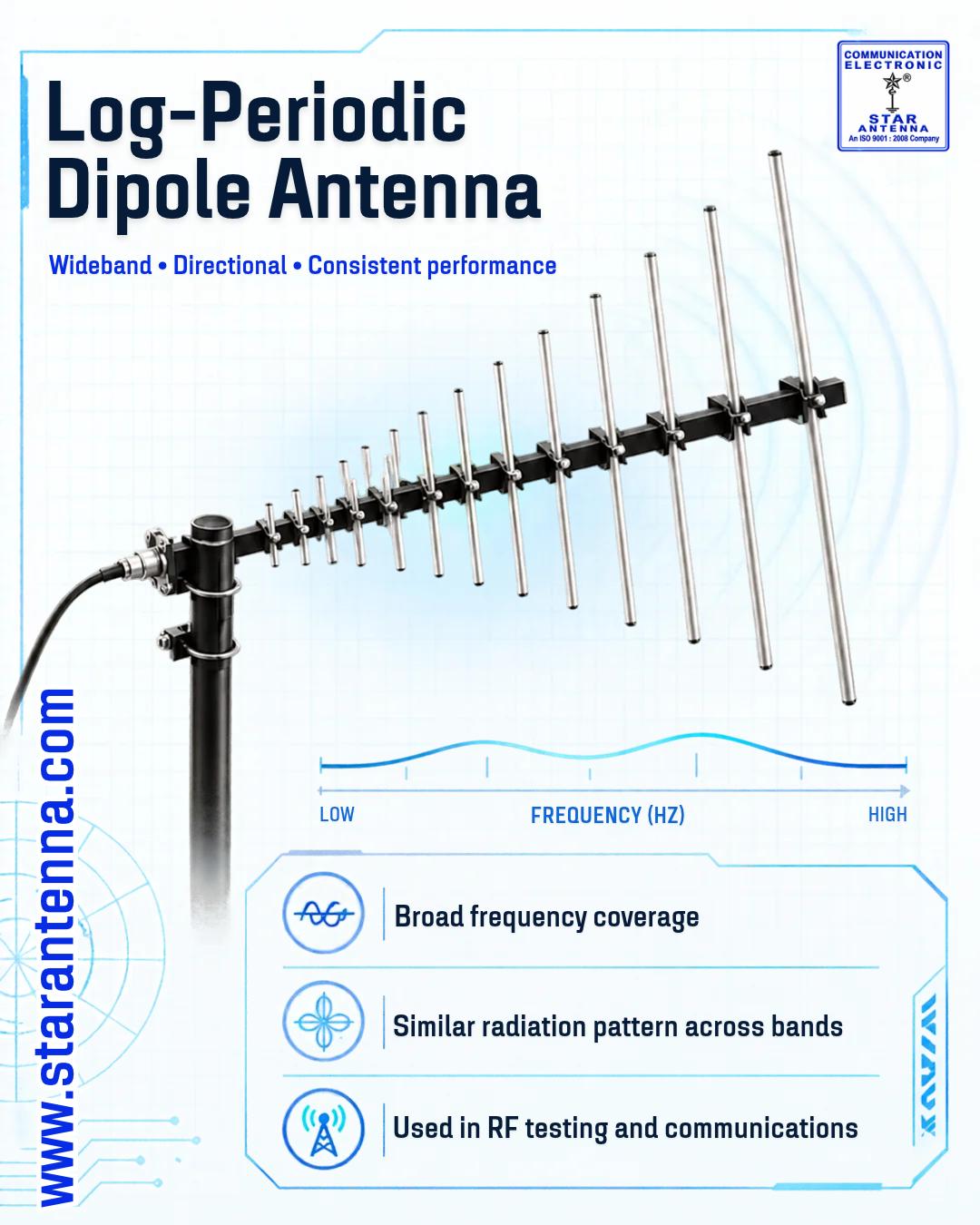
In the modern communication industry, reliable signal transmission and reception across multiple frequency bands are essential for various professional and industrial applications. A Log Periodic Dipole Antenna (LPDA) is a highly versatile directional antenna designed to provide wide frequency coverage, consistent performance, and reliable signal reception. Its unique structure and broadband capabilities make it an excellent choice for applications in telecommunications, defence, broadcasting, RF monitoring, and wireless communication systems.
Star Antenna, an established antenna manufacturer, offers high-quality Log Periodic Dipole Antenna solutions designed to meet diverse RF communication requirements. With decades of experience in antenna engineering and manufacturing, Star Antenna focuses on delivering reliable, durable, and application-oriented antenna solutions for different industries.
What Is a Log Periodic Dipole Antenna?
A Log Periodic Dipole Antenna, commonly known as an LPDA, is a directional broadband antenna consisting of multiple dipole elements arranged along a supporting boom. These elements are designed with progressively varying lengths and spacing, creating a structure that allows the antenna to operate across a wide range of frequencies.
Unlike conventional antennas designed for a specific frequency band, an LPDA can cover multiple frequencies without requiring frequent adjustments. This makes it particularly useful for applications where broadband signal transmission and reception are necessary.
The distinctive arrangement of its dipole elements provides directional radiation characteristics, making the LPDA suitable for both transmitting and receiving RF signals in a preferred direction.
How Does a Log Periodic Dipole Antenna Work?
The working principle of a Log Periodic Dipole Antenna is based on its progressively scaled dipole elements. Each element is designed to operate effectively within a particular frequency region.
When the operating frequency changes, the active region of the antenna shifts from one group of elements to another. This allows the antenna to maintain its performance over a broad frequency range.
The dipole elements are connected through a transmission line in an alternating arrangement, which contributes to the antenna's broadband characteristics and directional radiation pattern.
This unique design makes the LPDA an effective solution for applications requiring wideband frequency coverage, directional signal reception, and dependable RF performance.
Key Advantages of Log Periodic Dipole Antennas
Log Periodic Dipole Antennas offer several advantages that make them popular across professional communication and RF applications.
1. Wide Frequency Coverage: One of the biggest advantages of an LPDA is its ability to operate across a broad frequency range. This reduces the requirement for multiple antennas covering different frequency bands.
2. Directional Performance: The antenna provides directional radiation characteristics, allowing it to focus signal transmission and reception toward a particular direction.
3. Consistent Performance: Its carefully designed element arrangement helps maintain relatively stable electrical characteristics across its intended operating frequency range.
4. High Versatility: LPDA antennas are suitable for different communication, monitoring, testing, and broadcasting applications where broadband operation is required.
5. Reliable Signal Reception: Their directional characteristics make them useful for receiving signals from selected directions while helping reduce unwanted signals from other directions.
6. Customized Design Options: Depending on operational requirements, LPDA antennas can be designed with different frequency ranges, gain levels, dimensions, and mechanical configurations.
Applications of Log Periodic Dipole Antennas
Due to their broadband capabilities and directional characteristics, Log Periodic Dipole Antennas are used in several industries and technical applications.
-
Telecommunications: Used in communication systems requiring wide frequency coverage and directional signal performance.
-
Defence and Military: Suitable for specialized communication, surveillance, and RF monitoring applications.
-
RF Testing and Measurement: Used in laboratories and testing facilities for antenna evaluation, signal measurements, and electromagnetic compatibility testing.
-
Spectrum Monitoring: Helps monitor radio frequency signals across multiple frequency bands.
-
Broadcasting: Used in selected broadcasting applications requiring broadband directional reception or transmission.
-
Industrial Communication: Supports wireless communication systems used in different industrial environments.
-
Research and Development: Useful for antenna research, RF experimentation, and broadband signal analysis.
Why Choose Star Antenna for Log Periodic Dipole Antennas?
Selecting the right antenna manufacturer is important for achieving dependable performance and long-term reliability. Star Antenna, a registered brand of Communication Electronic, has been involved in antenna design and manufacturing since 1990.
With extensive experience in RF engineering, Star Antenna provides a comprehensive range of antenna solutions for telecommunications, defence, marine, aviation, navigation, UAV, and industrial communication applications.
The company's product portfolio includes Log Periodic Dipole Antennas, Yagi antennas, discone antennas, HF broadband antennas, VHF and UHF antennas, and various specialized RF antenna systems.
Star Antenna emphasizes quality, engineering precision, and product reliability throughout its manufacturing process. Its in-house research, development, manufacturing, and testing capabilities help support the production of antennas designed for diverse technical and operational requirements.
Understanding that different applications require different antenna specifications, Star Antenna also offers customized antenna solutions. Customers can explore specific frequency ranges, gain requirements, and other design parameters to identify an appropriate solution for their applications.
Whether you need an LPDA for RF testing, spectrum monitoring, professional communication, or specialized industrial applications, Star Antenna offers antenna solutions focused on performance and reliability.
How to Select the Right LPDA Antenna?
Choosing the right Log Periodic Dipole Antenna requires evaluating several technical specifications. Important parameters include operating frequency range, gain, VSWR, impedance, polarization, front-to-back ratio, beamwidth, and power-handling capacity.
Environmental conditions, installation height, mounting arrangements, and cable specifications should also be considered to achieve optimal performance.
Consulting an experienced antenna manufacturer can help you select an LPDA that matches your specific communication and operational requirements.
Conclusion
Log Periodic Dipole Antennas are an excellent choice for applications requiring broadband frequency coverage, directional performance, and reliable RF signal transmission and reception. Their unique design and versatility make them valuable for telecommunications, defence, RF testing, spectrum monitoring, and industrial communication.
With decades of experience in antenna manufacturing, Star Antenna is committed to delivering dependable and application-specific antenna solutions. Explore Star Antenna's Log Periodic Dipole Antenna range and connect with its technical team to find the right solution for your RF communication needs.
