

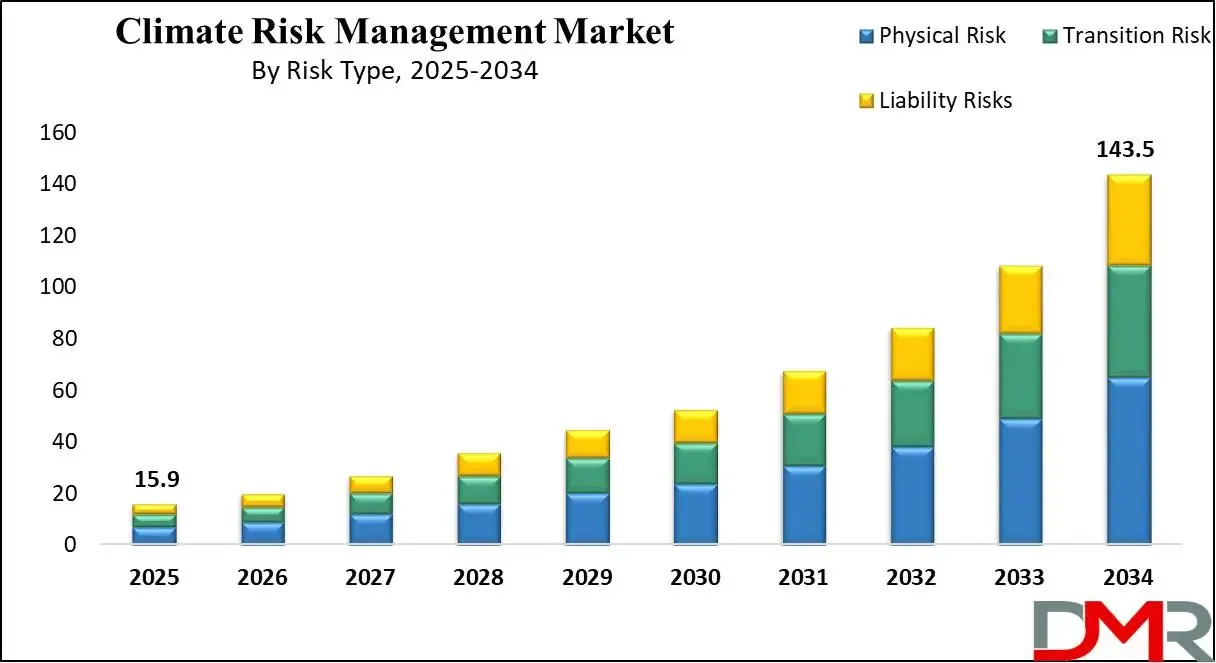

The global Climate Risk Management Market is experiencing rapid expansion as businesses, financial institutions, governments, and infrastructure operators increasingly recognize the economic consequences of climate change. Extreme weather events, rising temperatures, flooding, regulatory developments, and changing environmental expectations are increasing the need for structured climate risk assessment and mitigation strategies.
According to Dimension Market Research, the global Climate Risk Management Market is projected to reach USD 15.9 billion in 2025 and expand to USD 143.5 billion by 2034, registering a CAGR of 27.7%. This growth reflects rising demand for climate intelligence, risk analytics, environmental reporting, and enterprise-level climate adaptation solutions.
Organizations are increasingly integrating climate considerations into financial planning, investment decisions, insurance assessments, supply chain management, and infrastructure development. As a result, climate risk management is becoming an important component of enterprise risk management.
What Is the Climate Risk Management Market?
The Climate Risk Management Market includes software, analytical platforms, consulting services, and other solutions designed to identify, assess, monitor, and mitigate climate-related risks.
These risks generally fall into three major categories.
Physical risks include direct impacts from floods, hurricanes, extreme temperatures, droughts, wildfires, and rising sea levels.
Transition risks arise from changes associated with the transition toward a low-carbon economy. These include regulatory developments, carbon pricing, technological changes, and shifts in consumer preferences.
Liability risks relate to legal exposure, financial claims, and accountability associated with climate-related impacts and corporate environmental responsibilities.
Climate risk management solutions help organizations evaluate these exposures and incorporate climate scenarios into their operational and financial decisions.
Key Factors Driving Climate Risk Management Market Growth
Increasing climate-related disruptions are a major factor supporting market expansion. Extreme weather conditions can affect manufacturing facilities, agricultural production, transportation networks, energy infrastructure, and real estate assets.
Organizations increasingly require detailed information about their exposure to climate hazards to improve operational continuity and financial planning.
Regulatory developments are another important driver. Climate disclosure requirements and sustainability reporting frameworks are encouraging organizations to improve the measurement and documentation of climate-related risks.
The financial services and insurance industries also represent important sources of demand. Banks, insurers, and investment managers need climate-related information to evaluate portfolio exposure, underwriting risks, and long-term financial stability.
Additionally, artificial intelligence, geospatial analytics, satellite data, and predictive modelling are improving the capabilities of climate risk assessment platforms.
Climate Risk Management Market Statistics
● 2025 Market Size: USD 15.9 Billion
● 2034 Forecast Value: USD 143.5 Billion
● Forecast CAGR: 27.7%
● Leading Region: North America, with approximately 37.2% share in 2025.
● Leading Risk Type: Physical Risks.
● Leading Deployment Mode: Cloud-Based Solutions.
Get a Free Sample of the Climate Risk Management Market Report
https://dimensionmarketresearch.com/request-sample/climate-risk-management-market/
Market Segmentation: Understanding Climate Risk Solutions
The Climate Risk Management Market is segmented by risk type, solution, enterprise size, deployment mode, and industry vertical.
By Risk Type
Physical risks are expected to hold the largest market share in 2025. Organizations increasingly require tools to evaluate exposure to extreme weather, flooding, heat stress, and other environmental hazards.
Transition risks are also gaining importance as industries adapt to changing environmental regulations, low-carbon technologies, and evolving market expectations. Liability risks represent another important category.
By Solution
Risk Assessment and Analysis solutions help organizations identify exposure and evaluate potential financial and operational consequences.
Risk Mitigation and Adaptation solutions support the development of strategies to reduce climate vulnerability. Monitoring and Reporting solutions help organizations track environmental exposure and communicate relevant information.
Consulting and Advisory Services provide specialized guidance on climate scenarios, risk frameworks, regulatory requirements, and resilience planning.
By Deployment Mode
Cloud-based deployment is expected to account for the largest revenue share in 2025. Cloud platforms provide scalable data processing, remote accessibility, and integration capabilities for organizations managing complex climate information.
On-premises deployment remains relevant for organizations with specific data governance, security, or infrastructure requirements.
By Industry Vertical
Important industries include financial services and insurance, energy and utilities, agriculture and forestry, manufacturing, real estate and infrastructure, and government and public sector organizations.
How AI and Climate Analytics Are Transforming Risk Assessment
Artificial intelligence is improving the way organizations evaluate climate-related threats. Machine learning algorithms can process large datasets and identify patterns associated with changing weather conditions, environmental exposure, and asset vulnerability.
Geospatial analytics also plays an important role. Organizations can combine geographical information, satellite observations, infrastructure data, and climate projections to understand potential exposure at specific locations.
Predictive modelling enables businesses to evaluate different climate scenarios and examine their possible financial and operational consequences.
These technologies are particularly important for insurance providers, financial institutions, infrastructure operators, and multinational businesses managing geographically distributed assets.
Regional Outlook: North America Leads Climate Risk Management Adoption
North America is expected to dominate the global Climate Risk Management Market with approximately 37.2% of revenue in 2025.
The region benefits from established financial institutions, insurance infrastructure, climate analytics providers, and growing demand for enterprise risk assessment solutions.
The US Climate Risk Management Market is projected to grow from USD 6.3 billion in 2026 to USD 50.8 billion by 2035, registering a CAGR of 26.0%.
Europe represents another important regional market. The Europe Climate Risk Management Market is projected to increase from USD 5.7 billion in 2026 to USD 45.3 billion by 2035, at a CAGR of 25.9%.
Japan is also developing as an important market. Its climate risk management industry is projected to reach approximately USD 854.1 million in 2026 and USD 7.1 billion by 2035.
Competitive Landscape and Industry Developments
Competition in the Climate Risk Management Market involves consulting firms, climate analytics providers, financial data companies, and specialized environmental technology developers.
Prominent companies identified in the DMR report include KPMG, Deloitte, RMS, Bain & Company, Boston Consulting Group, Anthesis Group, Aon, RepRisk, PwC, EY, MSCI, BlackRock, Jupiter Intelligence, ERM, and other industry participants.
Companies are strengthening their capabilities through climate data analytics, predictive modelling, consulting services, and enterprise reporting platforms.
Challenges and Future Opportunities
Despite strong growth prospects, climate risk management providers face challenges related to data availability, modelling accuracy, inconsistent reporting standards, and the complexity of evaluating long-term climate scenarios.
Organizations also need to integrate climate information with existing enterprise risk management systems, financial models, and operational databases.
However, increasing demand for climate disclosure, physical risk assessment, AI-driven analytics, and climate adaptation planning is creating substantial opportunities.
Explore the Complete Climate Risk Management Market Analysis
https://dimensionmarketresearch.com/checkout/climate-risk-management-market/
Frequently Asked Questions (FAQs)
1. What is the global Climate Risk Management Market size in 2025?
The global market is projected to reach USD 15.9 billion in 2025.
2. What is the expected CAGR of the Climate Risk Management Market?
The market is expected to grow at a CAGR of 27.7% from 2025 to 2034.
3. Which risk type leads the Climate Risk Management Market?
Physical risks are expected to hold the largest market share in 2025.
4. Which region dominates the Climate Risk Management Market?
North America is expected to lead with approximately 37.2% of global market revenue in 2025.
5. What is the future outlook for the Climate Risk Management Market?
The market is projected to reach USD 143.5 billion by 2034, supported by growing demand for climate analytics, risk assessment, and adaptation solutions.
Conclusion
The Climate Risk Management Market is becoming increasingly important as organizations integrate climate resilience into their financial, operational, and strategic decisions. Growing physical climate threats, regulatory requirements, and demand for advanced environmental analytics are accelerating adoption. AI, geospatial intelligence, and predictive modelling will continue to influence the development of climate risk management solutions.
Related Climate Risk Management Market Insights
US Climate Risk Management Market Size
The US Climate Risk Management Market Size is projected to increase from USD 6.3 billion in 2026 to USD 50.8 billion by 2035, registering a CAGR of 26.0%. Regulatory developments, investor expectations, and increasing demand for climate risk analytics are supporting market expansion.
Europe Climate Risk Management Market Share
The Europe Climate Risk Management Market Share is represented by a market valuation of USD 5.7 billion in 2026, projected to reach USD 45.3 billion by 2035 at a CAGR of 25.9%. Physical risk assessment, climate disclosure, and cloud-based analytical platforms are important market factors.
Japan Climate Risk Management Market Growth
The Japan Climate Risk Management Market Growth is supported by climate resilience initiatives, financial sector requirements, and Japan's Green Transformation policies. The market is projected to increase from approximately USD 854.1 million in 2026 to USD 7.1 billion by 2035.
