


Full Service Carrier Market
Market Overview
The global Full Service Carrier Market is experiencing steady growth, supported by increasing international air passenger traffic, expanding airline networks, rising demand for premium travel experiences, and improvements in aviation infrastructure. Full-service carriers (FSCs) are airlines that provide comprehensive passenger transportation services, including multiple cabin classes, checked baggage, in-flight meals, entertainment, loyalty programmes, and connecting flight options. These airlines operate domestic and international routes through hub-and-spoke networks and generate revenue from passenger transportation, air cargo, and additional services.
The growing preference for comfortable air travel, particularly among business and international leisure passengers, is strengthening the position of full-service airlines. These carriers are investing in fleet modernization, premium cabin facilities, digital booking platforms, and improved customer experiences to remain competitive. Additionally, strategic alliances, codeshare agreements, and international route expansion are helping airlines increase connectivity and attract passengers across global markets.
Download Free PDF Brocures-https://www.maximizemarketresearch.com/request-sample/331125/
Market Size and Growth
According to Maximize Market Research, the global Full Service Carrier Market was valued at USD 684.6 billion in 2025 and is projected to reach USD 1,117.9 billion by 2034, growing at a CAGR of 5.6% during the forecast period 2026–2034.
Market expansion is primarily driven by increasing passenger demand, international tourism, business travel, and the growing popularity of premium airline services. Airlines are expanding their long-haul operations and introducing premium economy and business-class offerings to improve passenger satisfaction and increase revenue per passenger.
Furthermore, increasing investments in fuel-efficient aircraft, digital airline management systems, and customer loyalty programmes are supporting operational improvements. Growing demand for air cargo and ancillary services is also creating additional revenue opportunities for full-service carriers.
Key Market Segmentation
The Full Service Carrier Market is segmented by service type, cabin class, route type, aircraft type, passenger type, distribution channel, ownership structure, and region.
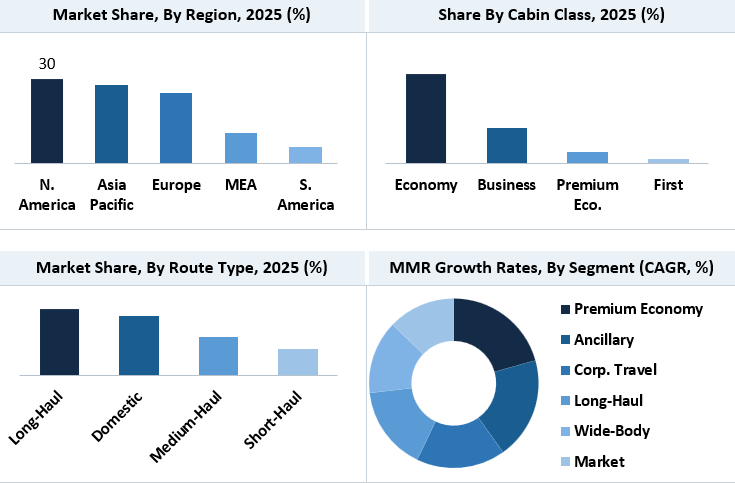
By Service Type: The market includes scheduled passenger transportation, air cargo, and ancillary and additional services. Scheduled passenger transportation dominates the market, accounting for approximately 76% of the market value in 2025. Ancillary services, including baggage fees, seat selection, upgrades, and loyalty partnerships, are gaining importance and are expected to grow at a CAGR of 8.5%.
By Cabin Class: Major segments include economy class, business class, premium economy, and first class. Economy class holds the largest share, representing approximately 64% of market value. Premium economy is expected to experience faster growth, supported by increasing demand for affordable premium travel experiences.
By Route Type: The market covers domestic, international short-haul, international medium-haul, and international long-haul routes. International long-haul operations represent approximately 35% of market value and benefit from increasing global connectivity and international business travel.
By Aircraft Type: The market includes wide-body aircraft, narrow-body aircraft, and regional jets. Wide-body aircraft account for approximately 52% of market value due to their extensive use in international long-distance operations.
By Passenger Type: Key categories include business and corporate travellers, leisure and holiday travellers, visiting friends and relatives (VFR), religious and pilgrimage travellers, and other passengers.
By Distribution Channel: Direct airline websites and mobile applications, online travel agencies, travel agents, and corporate travel management platforms are important distribution channels. Corporate travel management platforms are gaining popularity due to increasing demand for organized business travel.
By Ownership Structure: The market includes publicly listed airlines, privately owned airlines, and state-owned carriers.
Growth Drivers
The growth of the Full Service Carrier Market is supported by several important factors.
-
Increasing Global Air Passenger Traffic: Rising international tourism, business travel, and disposable incomes are increasing demand for scheduled airline transportation.
-
Growing Premium Travel Demand: Business-class and premium economy services are attracting passengers seeking additional comfort, flexibility, and personalized experiences.
-
International Airline Network Expansion: Airlines are introducing new international routes, increasing flight frequencies, and developing hub connections to improve global accessibility.
-
Increasing Loyalty Programme Adoption: Frequent flyer programmes, co-branded credit cards, and airline partnerships are helping carriers retain customers and generate additional revenue.
-
Fleet Modernization: Investments in fuel-efficient aircraft and advanced aviation technologies are improving operational efficiency and supporting long-distance connectivity.
However, rising aviation fuel prices, aircraft delivery delays, labour expenses, geopolitical uncertainties, and competition from low-cost carriers may restrict market growth.
Emerging Trends
Digital transformation is becoming an important trend in the Full Service Carrier Market. Airlines are adopting artificial intelligence, automated booking systems, personalized pricing, biometric passenger processing, and predictive maintenance technologies to improve operational performance and customer experiences.
Another major trend is premiumization, with airlines upgrading business-class cabins, introducing premium economy seating, and enhancing airport lounge facilities. These investments help airlines attract higher-value passengers and increase revenue.
Strategic partnerships, codeshare agreements, and airline consolidation are also gaining importance. Furthermore, sustainable aviation fuel (SAF), lightweight aircraft materials, and fuel-efficient engines are encouraging airlines to reduce emissions and improve environmental performance.
Regional Analysis
North America dominated the global Full Service Carrier Market, accounting for approximately 30% of market value in 2025. The United States represents the leading market due to established airline networks, strong corporate travel demand, extensive airport infrastructure, and major airline operators such as Delta Air Lines, United Airlines, and American Airlines. The region is expected to grow at a CAGR of approximately 4.7%.
Europe accounted for approximately 25% of market value in 2025. Germany, France, the United Kingdom, and other European countries contribute significantly through international connectivity, established airline groups, and premium travel services. Lufthansa Group, Air France-KLM, and International Airlines Group are major regional participants.
Asia Pacific is expected to register the fastest growth, with a projected CAGR of 7.1%. Increasing disposable incomes, expanding middle-class populations, rising international tourism, and growing aviation infrastructure investments are supporting regional expansion. China, India, Japan, Singapore, and South Korea are important markets.
The Middle East and Africa region is projected to grow at approximately 5.9%, supported by international transit traffic, airline network expansion, and investments in aviation infrastructure. South America is also witnessing growth opportunities through expanding international connectivity and increasing passenger demand, with a projected CAGR of 5.7%.
Competitive Landscape
The Full Service Carrier Market is highly competitive, with major airlines focusing on network expansion, premium services, strategic partnerships, and fleet modernization. Leading market participants include Delta Air Lines, United Airlines, American Airlines, Lufthansa Group, Air France-KLM, International Airlines Group (IAG), Emirates, Qatar Airways, Etihad Airways, Singapore Airlines, Cathay Pacific, ANA, Japan Airlines, Korean Air, Qantas, and Air India.
Companies are strengthening their market positions through improved passenger experiences, digital transformation, loyalty programmes, and investments in next-generation aircraft. Airline alliances such as Star Alliance, oneworld, and SkyTeam also support international connectivity and customer acquisition.
Download Free PDF Brocures-https://www.maximizemarketresearch.com/request-sample/331125/
Recent Developments
-
January 2026: Delta Air Lines reported record FY2025 revenue of USD 58.3 billion, supported by strong premium travel demand and a 10% operating margin.
-
February 2026: Air France-KLM reported a record EUR 2.0 billion operating result and announced plans to increase its stake in SAS.
-
February 2026: International Airlines Group reported 2025 revenue of EUR 33.2 billion and operating profit of approximately EUR 5.0 billion.
-
March 2026: Lufthansa Group reported record 2025 revenue of EUR 39.6 billion, highlighting continued demand for international airline services.
-
May 2026: Lufthansa Group announced plans to increase its stake in ITA Airways from 41% to 90%, strengthening its European airline network.
Future Outlook
The future of the Full Service Carrier Market is expected to remain positive due to increasing international travel, expanding airline networks, and rising demand for premium passenger experiences. Airlines are expected to prioritize digital retailing, artificial intelligence, sustainable aviation fuel, and advanced fleet management technologies to improve profitability and operational efficiency.
Asia Pacific is anticipated to provide significant growth opportunities, particularly through expanding aviation infrastructure and increasing passenger traffic in India and China. Meanwhile, North America and Europe will continue benefiting from established airline networks and premium travel demand.
The increasing importance of ancillary revenue, loyalty programmes, premium economy cabins, and international long-haul routes will create new opportunities for airlines throughout the forecast period.
For full access to the comprehensive strategic report, visit:https://www.maximizemarketresearch.com/market-report/global-full-service-carrier-market/331125/
Conclusion
The global Full Service Carrier Market is growing steadily, driven by increasing air passenger traffic, international connectivity, premium travel demand, and airline network expansion. The market is projected to increase from USD 684.6 billion in 2025 to USD 1,117.9 billion by 2034, registering a CAGR of 5.6%. While North America currently dominates the market, Asia Pacific is expected to experience the fastest growth. Continuous investments in fleet modernization, digital technologies, customer loyalty programmes, and sustainable aviation solutions will play an important role in shaping the industry's future.
About Maximize Market Research
Maximize Market Research is a multifaceted market research and consulting company with professionals from several industries. Some of the industries we cover include medical devices, pharmaceutical manufacturers, science and engineering, electronic components, industrial equipment, technology and communication, cars and automobiles, chemical products and substances, general merchandise, beverages, personal care, and automated systems. To mention a few, we provide market-verified industry estimations, technical trend analysis, crucial market research, strategic advice, competition analysis, production and demand analysis, and client impact studies.
Contact Maximize Market Research
3rd Floor, Navale IT Park, Phase 2
Pune Bangalore Highway, Narhe,
Pune, Maharashtra 411041, India
[email protected]
+91 96071 95908, +91 9607365656
