

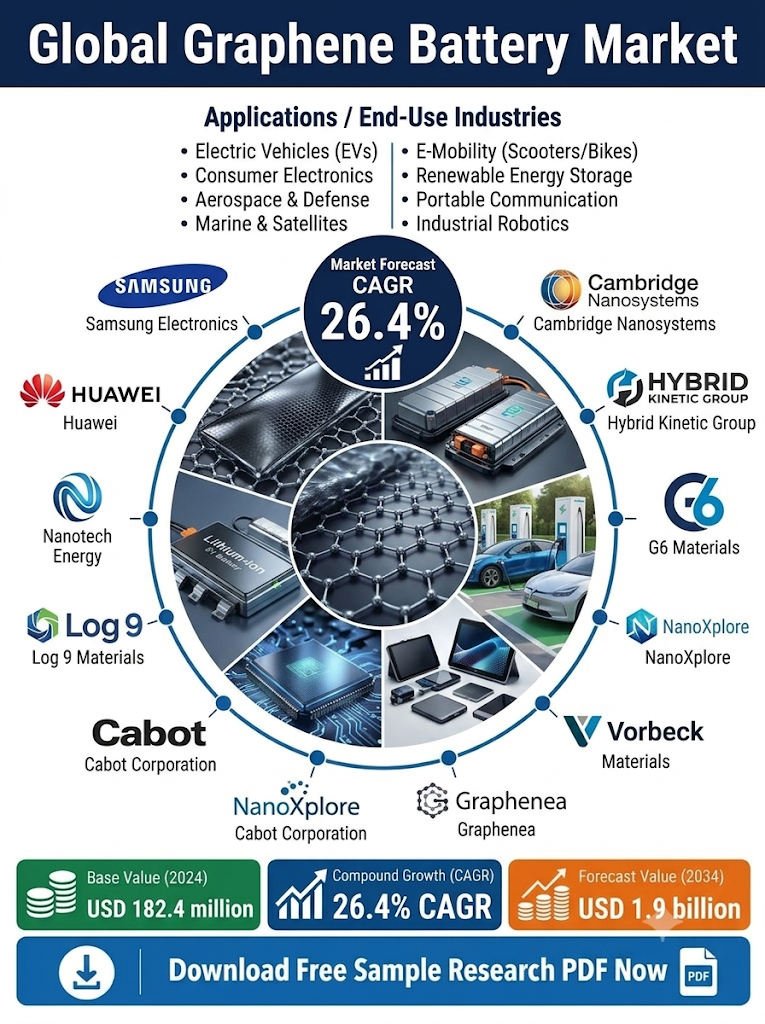

Rockville, MD, November 24, 2026 — The global graphene battery market is projected to grow from USD 182.4 million in 2024 to USD 1.9 billion by 2034, registering a compound annual growth rate (CAGR) of 26.4% during the forecast period, according to a revised industry analysis by Fact.MR, a market research and competitive intelligence provider. Increasing adoption of electric vehicles, expanding consumer electronics applications, and continued research into advanced battery materials are supporting demand for graphene-enhanced energy storage technologies.
The expansion reflects growing requirements for batteries that charge faster and retain energy for longer periods. Graphene's electrical conductivity, lightweight structure, and thermal properties make it a valuable material for improving conventional battery performance. North America accounted for 26.4% of the global market in 2024, while the lithium-ion segment is projected to reach USD 976 million by 2034.
Request for PDF Report Sample Pages: https://www.factmr.com/connectus/sample?flag=S&rep_id=8492
The Short Version
Graphene is a carbon-based material consisting of atoms arranged in a honeycomb lattice. Its high electron mobility, heat conductivity, mechanical strength, and chemical stability make it suitable for applications involving energy storage and power management.
Fact.MR is a market research and competitive intelligence provider that delivers industry analysis, market forecasts, and strategic insights to businesses worldwide. Its graphene battery market assessment examines demand across battery types, end-use industries, and key geographical markets.
Graphene-enhanced batteries are gaining attention because they can improve the energy density, charging speed, and operational lifespan of conventional battery systems. These characteristics are particularly relevant to electric vehicle manufacturers and consumer electronics companies seeking improved battery efficiency.
Three Numbers That Matter
- USD 1.9 billion: Projected global graphene battery market value by 2034.
- 26.4%: Expected global CAGR between 2024 and 2034.
- USD 976 million: Forecast value of the graphene lithium-ion battery segment by 2034.
Electric Vehicle Production Strengthens Battery Demand
Automotive applications are becoming an important source of demand for graphene battery technology. Electric vehicle manufacturers are focusing on battery systems that support longer driving ranges and shorter charging periods. Graphene's electrical and thermal properties offer opportunities to improve battery performance.
According to Fact.MR, the automotive segment was valued at USD 63.1 million in 2024 and is projected to reach USD 653.2 million by 2034, expanding at a CAGR of 26.3%.
The technology also has potential applications beyond passenger vehicles. Electric scooters, motorcycles, bicycles, and other mobility platforms require compact battery systems capable of delivering dependable performance.
One notable development is the S1 Lite electric scooter launched by Indian electric vehicle startup iVOOMi, which offers graphene and lithium-ion battery options. This product illustrates how graphene-based battery configurations are entering the electric mobility market.
Lithium-Ion Batteries Maintain a Leading Position
The lithium-ion segment is expected to remain a major contributor to graphene battery market revenue. Its value is forecast to increase from USD 95 million in 2024 to USD 976 million by 2034, registering a CAGR of 26.2%.
Graphene integration can improve conventional lithium-ion battery characteristics, including energy density, charging speed, and battery longevity. These improvements support applications across electric vehicles, portable electronics, and renewable energy storage.
Manufacturers are also investing in research and development to produce higher-quality graphene materials for battery electrodes. Improvements in material quality and manufacturing processes are important for expanding commercial applications.
Graphene supercapacitors represent another developing opportunity. Their ability to store and release energy rapidly makes them relevant to electronics and automotive applications where faster charging and discharging are required.
North America Leads Regional Demand
North America is estimated to account for 26.4% of the global graphene battery market in 2024. Demand from consumer electronics and electric vehicle industries supports the region's position. Government initiatives encouraging advanced battery development and sustainable energy technologies also contribute to market activity.
The United States market is projected to increase from USD 40.6 million in 2024 to USD 416.8 million by 2034, advancing at a CAGR of 26.2%.
Aerospace and defense applications provide an additional source of demand. Graphene batteries are being considered for unmanned surface vehicles (USVs), unmanned aerial vehicles (UAVs), satellites, rovers, and portable communication equipment.
China is another important growth market. Its graphene battery market is projected to rise from USD 19.6 million in 2024 to USD 205.1 million by 2034, representing a CAGR of 26.5%. Expanding electric vehicle manufacturing and industrial robotics are supporting demand for advanced energy storage materials.
Manufacturing Costs Remain a Market Constraint
Despite the favorable growth outlook, high production costs remain a challenge for graphene battery manufacturers. Producing high-quality single-layer graphene sheets requires specialized processes, while limited production volumes can increase material expenses.
These costs influence the final price of graphene-based batteries and may restrict adoption among price-sensitive customers. Limited consumer awareness of graphene battery advantages also presents a challenge to broader commercialization.
Manufacturers are therefore concentrating on research and development to improve production efficiency and expand the availability of high-quality graphene materials.
Competitive Landscape and Industry Developments
Companies operating in the graphene battery market are pursuing product development, research partnerships, and portfolio expansion. Key participants profiled by Fact.MR include Vorbeck Materials Corp., Cabot Corporation, Hybrid Kinetic Group Ltd., Cambridge Nanosystems Ltd., Nanotech Energy, G6 Materials Corp., Log 9 Materials, Graphenano S.L., Huawei, Samsung Electronics, Graphenea S.A., XG Sciences Inc., NanoXplore Inc., and Real Graphene USA.
Recent product developments demonstrate the expanding commercial interest in graphene applications. Melbourne-based EnyGy, founded on research by Professor Dan Li and Dr. Yufei Wang at Monash University, launched an ultracapacitor incorporating graphene technology. Xiaomi also introduced the Mijia Graphene Skirting Board Heater 2, featuring a 2,200-watt heating mechanism.
These developments indicate the expanding range of applications for graphene-based materials beyond conventional battery manufacturing.
View Related Reports ;
Hybrid Electric Vehicles Market : https://www.factmr.com/report/270/hybrid-electric-vehicles-market
Electric Vehicle (EV) Battery Market : https://www.factmr.com/report/3587/electric-vehicle-battery-market
Graphene Market : https://www.factmr.com/report/graphene-market
Electric Vehicle Market : https://www.factmr.com/report/electric-vehicle-market
About Fact.MR
Fact.MR is a global market research and competitive intelligence provider delivering actionable insights, industry forecasts, and strategic analysis across multiple sectors. The company supports businesses, investors, and industry stakeholders with data-driven research to help them understand market developments, evaluate opportunities, and make informed business decisions.
