

e-Learning App Market Projected at USD 470.1 Billion by 2034, With South Korea Leading Regional Growth

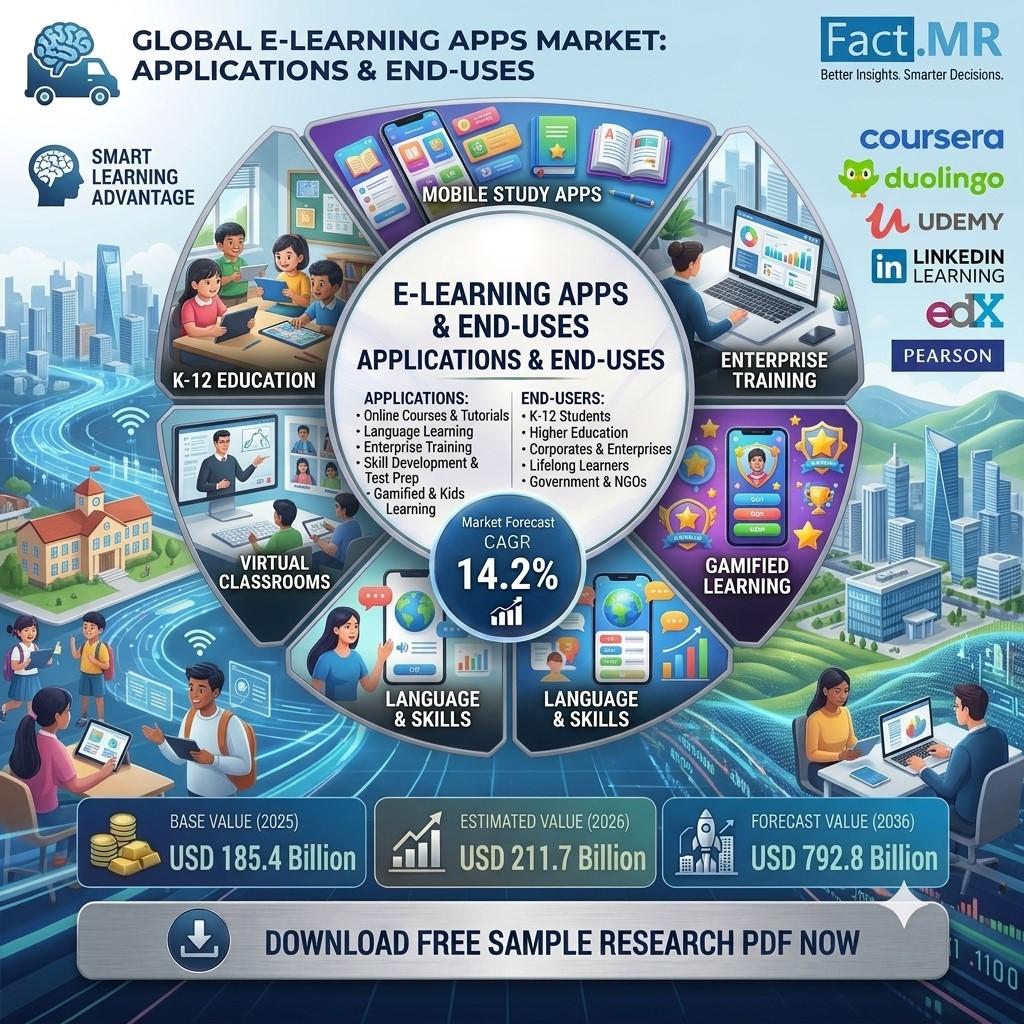
The global e-learning app market is forecast to expand from USD 267.5 billion in 2024 to USD 470.1 billion by 2034, registering a CAGR of 5.8% over the forecast period. Fact.MR attributes this growth to increasing demand for flexible learning solutions, wider adoption of digital education platforms, and growing use of smartphones, tablets, and other connected devices. Educational institutions and businesses are increasingly incorporating online learning applications to improve access to courses, support employee development, and deliver specialized training.
The growing adoption of artificial intelligence and machine learning is also influencing the development of e-learning applications. These technologies are supporting more personalized learning experiences, adaptive course recommendations, and interactive educational content. At the same time, microlearning, gamification, and mobile learning are creating opportunities for application providers to improve learner engagement and course accessibility.
Get detailed market forecasts, competitive benchmarking, and pricing trends:
https://www.factmr.com/connectus/sample?flag=S&rep_id=7486
E2C e-Learning Retains Dominant Position
By category, E2C e-learning is expected to account for approximately 70% of the global e-learning app market in 2024. Its leading position is supported by growing demand for accessible and affordable digital education. Students and individual learners are increasingly using online platforms to access specialized courses, professional training, and educational resources without the geographical and scheduling limitations associated with traditional classroom-based learning.
Synchronous online learning represents another important segment, accounting for approximately 20% of the market in 2024. This learning approach enables instructors and participants to interact in real time through digital classrooms and online communication tools. Its adoption is supported by demand from academic institutions and corporate training programs, where direct interaction and immediate feedback remain important.
Cloud-based deployment is also gaining attention among e-learning application providers. Cloud solutions simplify the maintenance and implementation of learning platforms while supporting access across multiple devices and locations. Educational institutions and businesses can use these systems to manage courses, distribute learning materials, and maintain continuity in online education.
The expansion of massive open online courses (MOOCs), virtual classrooms, assessment software, and learning management systems is further broadening the market. Providers are focusing on improving course delivery, developing interactive learning environments, and introducing flexible subscription models to attract a wider user base.
South Korea, Canada, and the United States Show Strong Growth Potential
South Korea is projected to register a CAGR of 6.5% from 2024 to 2034, making it one of the fastest-growing country markets covered by Fact.MR. Increasing adoption of digital technologies, advanced internet connectivity, and growing use of connected devices are supporting the development of online learning solutions. The country's technology-oriented education environment is creating opportunities for providers offering interactive and digitally delivered educational content.
Canada is expected to advance at a CAGR of 6.3% through 2034. The adoption of digital education platforms and increasing demand for flexible learning opportunities are supporting market development. E-learning applications are providing students and professionals with greater access to specialized courses and training resources. The growing importance of continuous skill development is also encouraging educational institutions and organizations to incorporate digital learning solutions.
The United States market is projected to expand at a CAGR of 6.2% during the forecast period. Widespread adoption of smartphones, tablets, and laptops is supporting the use of online educational platforms across academic and non-academic institutions. Technology commoditization is also improving access to affordable digital learning services. Companies and educational service providers are increasingly using advanced tools to make learning applications more engaging and interactive.
Beyond these countries, East Asia and Europe represent important regional markets. East Asia is projected to expand at a CAGR of 6.1%, supported by increasing internet penetration and wider adoption of digital learning technologies. Europe is expected to register a CAGR of 5.8% through 2034, reflecting continued demand for online education and professional training solutions.
Competitive Landscape
Competition in the e-learning app market includes technology companies, online education platforms, and specialized digital learning providers. Key companies profiled by Fact.MR include Alison, Amazon Kindle, Byju's, Coursera Inc., edX Inc., FutureLearn, Intellipaat, and Iverity.
Market participants are focusing on improving course accessibility, expanding educational content libraries, and introducing technology-driven learning features. Partnerships, collaborations, acquisitions, and research and development investments are among the strategies being used to strengthen market positions. Companies are also developing solutions for academic institutions, corporate training programs, and individual learners to address different educational requirements.
Competition is increasingly influenced by platform usability, course quality, affordability, content variety, and the ability to deliver personalized learning experiences. Providers that combine accessible educational resources with interactive technologies are positioned to address changing learner expectations.
Technology and Digital Learning Trends Shape the Market
The e-learning app market is experiencing continued technological development as providers incorporate artificial intelligence, machine learning, augmented reality, and virtual reality into educational platforms. These technologies can support interactive simulations, personalized course recommendations, and more engaging learning environments.
Microlearning and gamification are also gaining importance. Breaking educational content into shorter modules allows learners to study specific subjects at their own pace, while game-based features can encourage participation and improve engagement. Mobile learning is further supporting market expansion by enabling users to access educational resources through smartphones and tablets.
However, limited internet connectivity and inadequate digital infrastructure remain challenges in certain developing regions. The requirement for reliable internet access and compatible smart devices can restrict adoption among populations with limited technological resources. Differences in digital infrastructure and bandwidth availability may therefore influence the pace of market development across countries.
As educational institutions, businesses, and individual learners increasingly adopt digital learning solutions, e-learning applications are expected to remain an important part of the global education ecosystem. Continued developments in cloud technology, artificial intelligence, interactive content, and mobile learning are likely to shape the competitive environment through 2034.
To View Top Reports
IoT in Education Market: https://www.factmr.com/report/3073/iot-in-education-market
Massive Open Online Course (MOOC) Market: https://www.factmr.com/report/3077/mooc-market
Augmented Reality (AR) in Education Market: https://www.factmr.com/report/ar-in-education-market
About Fact.MR
Fact.MR is a market research and consulting company providing market intelligence, competitive analysis, and forecasting across global industries. Its research supports businesses with data-driven insights into emerging markets, technology trends, competitive dynamics, regional opportunities, and changing demand patterns.
