

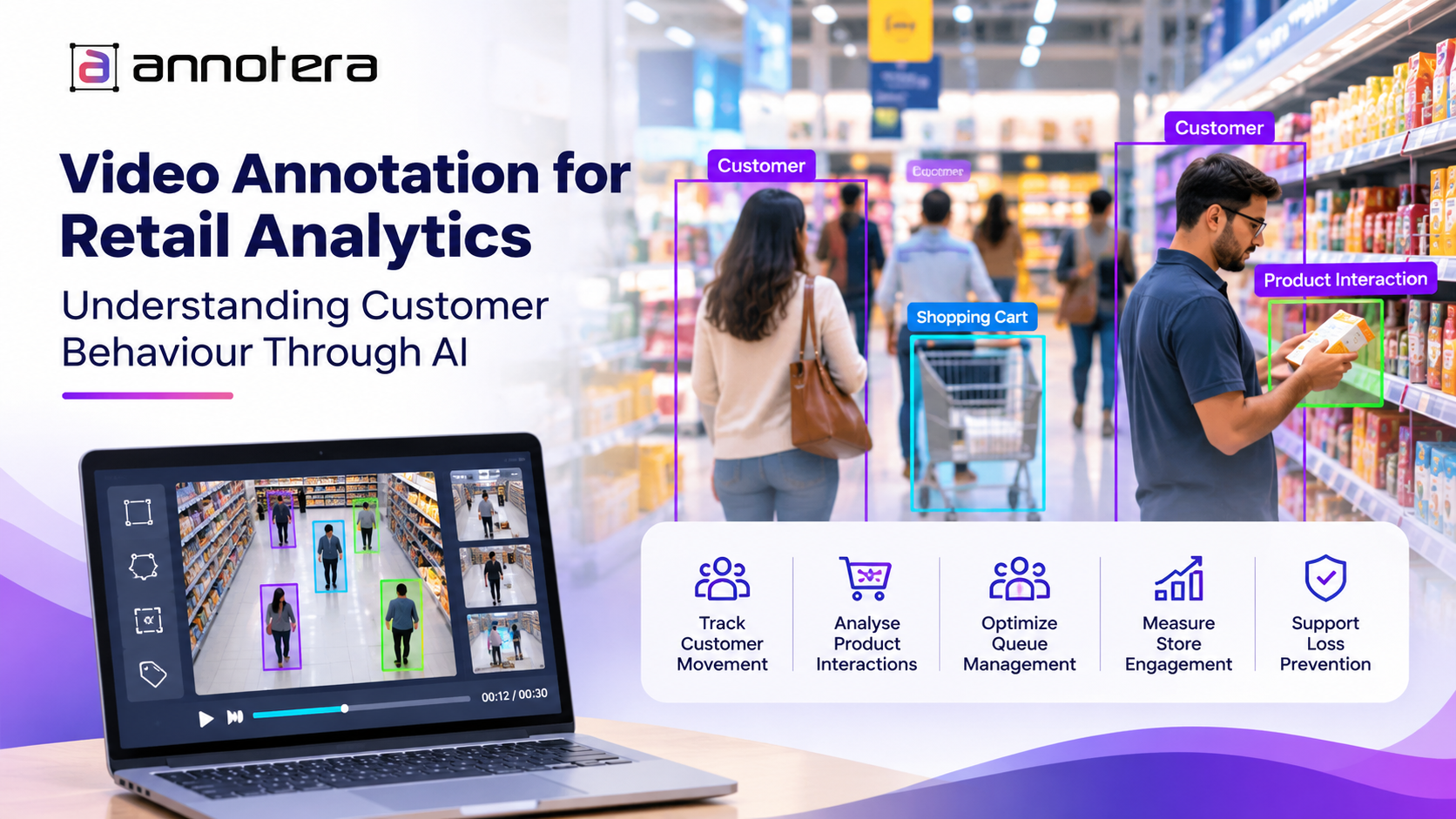
Video Annotation for Retail Analytics: Understanding Customer Behaviour Through AI

The retail industry is increasingly adopting artificial intelligence (AI) to understand customer behaviour, improve shopping experiences, and optimize store operations. From identifying customer movement patterns to analysing product interactions, AI-powered video analytics enables retailers to make informed, data-driven decisions. However, the effectiveness of these systems depends heavily on the quality of the visual data used to train them. This is where video annotation plays an essential role.
By converting raw surveillance and in-store video footage into structured, machine-readable datasets, video annotation helps AI models recognize customer activities, understand shopping patterns, and identify opportunities for operational improvements. Retailers working with a reliable video annotation company can develop more accurate AI systems that deliver actionable insights while improving customer experiences.
What Is Video Annotation in Retail Analytics?
Video annotation is the process of adding meaningful labels, tags, and metadata to objects, movements, and activities within video footage. In retail environments, this involves identifying customers, tracking their movements, recognizing product interactions, and labelling specific activities such as browsing, picking up products, and waiting in checkout queues.
Annotated videos provide supervised training data that enables computer vision models to recognize and interpret different retail scenarios.
Common video annotation techniques used in retail analytics include:
-
Object Detection: Identifying customers, shopping carts, products, and store equipment within video frames.
-
Object Tracking: Following customer movement across multiple frames to understand shopping journeys.
-
Bounding Box Annotation: Drawing rectangular boxes around customers and relevant objects.
-
Polygon Annotation: Precisely outlining objects or specific areas within video frames.
-
Action Recognition: Labelling activities such as picking products, browsing shelves, and interacting with displays.
-
Keypoint Annotation: Identifying body joints and movement points to support posture and activity analysis.
These techniques help retailers transform ordinary video footage into valuable datasets for AI-powered decision-making.
How Video Annotation Helps Understand Customer Behaviour
Understanding customer behaviour is essential for improving store layouts, product placements, and overall shopping experiences. AI-powered video analytics uses annotated datasets to identify patterns that might otherwise remain difficult to detect.
1. Analysing Customer Movement Patterns
Customer movement analysis helps retailers understand how shoppers navigate different sections of a store. By tracking customer positions across video frames, AI models can identify frequently visited areas, popular aisles, and sections that receive limited attention.
For example, retailers can analyse whether customers naturally move towards promotional displays or avoid certain store sections. These insights help businesses optimize store layouts, improve product visibility, and create more convenient shopping journeys.
Accurate object tracking and consistent frame-level annotations are essential for developing reliable customer movement analysis systems.
2. Understanding Product Interaction Behaviour
Knowing which products attract customer attention can help retailers improve merchandising strategies. Video annotation enables AI systems to identify interactions such as picking up products, examining packaging, returning items to shelves, and placing products into shopping carts.
These insights can reveal differences between customer interest and actual purchase behaviour.
For instance, if shoppers frequently examine a particular product but rarely purchase it, retailers may investigate its pricing, packaging, or placement. AI-driven product interaction analysis helps businesses make more informed merchandising decisions.
3. Improving Queue Management
Long checkout queues can negatively affect customer satisfaction and increase abandoned purchases. Video analytics systems trained on annotated footage can identify queue lengths, track customer arrivals, and estimate waiting times.
By analysing these patterns, retailers can determine when additional checkout counters or staff members may be required.
Video annotation helps AI models recognize customers, distinguish individual movements, and identify queue-related activities across multiple frames. This supports more efficient workforce allocation and smoother checkout operations.
4. Measuring Store Section Engagement
Retailers often invest in promotional displays, product demonstrations, and strategically positioned merchandise. However, understanding whether these initiatives attract customer attention requires detailed behavioural analysis.
Annotated video datasets help AI models identify customer dwell time, repeated visits, and interactions with specific store sections.
For example, retailers can compare engagement across different promotional displays to understand which arrangements generate greater customer interest. These insights support better visual merchandising and promotional planning.
5. Supporting Loss Prevention and Security Analytics
AI-powered video analytics can also support retail security by identifying unusual activities and potentially suspicious movement patterns.
Annotated datasets can help train computer vision models to recognize specific events, including unauthorized access to restricted areas, unattended objects, and unusual product handling.
However, these systems must be carefully designed, validated, and monitored to minimize false positives and avoid unfair behavioural assumptions. Retailers should also ensure that video monitoring complies with applicable privacy regulations.
The Importance of High-Quality Video Annotation for Retail AI
Even sophisticated AI algorithms cannot consistently deliver accurate results when trained on poorly labelled datasets. Inaccurate annotations, inconsistent object tracking, and missing activity labels can negatively affect model performance.
Retail environments introduce several additional challenges:
-
Crowded Environments: Multiple customers may overlap or obstruct one another, making object identification difficult.
-
Changing Lighting Conditions: Variations in lighting, reflections, and shadows can affect object visibility.
-
Occlusion: Customers, shelves, and shopping carts may temporarily hide important objects.
-
Camera Angles: Different camera positions create variations in perspective and object appearance.
-
Complex Customer Activities: Similar movements may represent different shopping activities and require contextual labelling.
A professional video annotation company addresses these challenges through standardized annotation guidelines, trained annotation teams, and multi-level quality assurance processes.
At Annotera, structured annotation workflows help businesses prepare high-quality visual datasets for computer vision and AI applications. By combining appropriate annotation techniques with rigorous quality checks, retailers can build more reliable training datasets for their analytics requirements.
Best Practices for Video Annotation in Retail Analytics
To achieve dependable AI-driven insights, retailers should follow a structured approach to video annotation.
1. Define Clear Annotation Guidelines: Establish consistent rules for identifying customers, products, activities, and store interactions.
2. Select Appropriate Annotation Techniques: Use bounding boxes, polygons, object tracking, and action recognition based on the specific analytics objective.
3. Maintain Temporal Consistency: Ensure that objects and activities are labelled consistently across consecutive video frames.
4. Include Diverse Retail Scenarios: Incorporate footage from different store layouts, lighting conditions, camera angles, and customer densities.
5. Implement Quality Assurance: Conduct annotation reviews, resolve inconsistencies, and validate datasets before using them for model training.
6. Protect Customer Privacy: Apply appropriate data minimization, access controls, anonymization, and consent practices in accordance with applicable regulations.
How Annotera Supports AI-Powered Retail Analytics
Building effective retail analytics solutions requires more than collecting large volumes of video footage. AI development teams need structured, accurately labelled datasets that represent real-world customer interactions and retail environments.
Annotera supports AI initiatives through professional video annotation services designed to help businesses prepare training datasets for computer vision applications. Its annotation capabilities include object detection, object tracking, activity recognition, bounding box annotation, and polygon annotation.
With scalable annotation workflows and quality-focused processes, Annotera helps AI teams develop datasets that support applications such as customer movement analysis, product interaction recognition, queue monitoring, and retail security analytics.
Whether businesses are developing new computer vision models or improving existing retail AI systems, partnering with an experienced video annotation company can help strengthen dataset quality and support more dependable model development.
Conclusion
Video annotation is becoming an important foundation for AI-powered retail analytics. By transforming raw video footage into structured training data, retailers can better understand customer movement, product interactions, shopping patterns, and store engagement.
As computer vision technology continues to evolve, high-quality annotated datasets will remain essential for building accurate and scalable retail intelligence solutions. With professional annotation support from Annotera, businesses can turn visual data into meaningful insights, improve operational efficiency, and create more informed retail strategies.
