


Shopping for gut health supplements can feel overwhelming. One brand promises better digestion, another highlights billions of beneficial bacteria, and a third claims to offer everything your gut needs in a single capsule.
The difficulty is knowing which information is genuinely useful and which is simply designed to encourage a purchase.
Whether you're researching Bio Complete 3 or exploring other digestive wellness supplements, understanding how to evaluate products independently can help you avoid unnecessary spending and unrealistic expectations.
Here is how to compare gut health supplements without getting distracted by persuasive marketing.
Why Can Gut Health Supplement Marketing Be Confusing?
Supplement companies often use scientific terminology, attractive packaging, customer testimonials and impressive-looking numbers to distinguish their products from competitors.
Although some products contain well-researched ingredients, marketing materials may not always explain the limitations of the available evidence.
Terms such as advanced formula, premium ingredients and maximum strength can sound convincing without providing meaningful information about product effectiveness.
Instead of relying on these descriptions, consumers should examine measurable details such as ingredient quantities, formulation transparency and relevant scientific research.
How Can You Compare Gut Health Supplements Effectively?
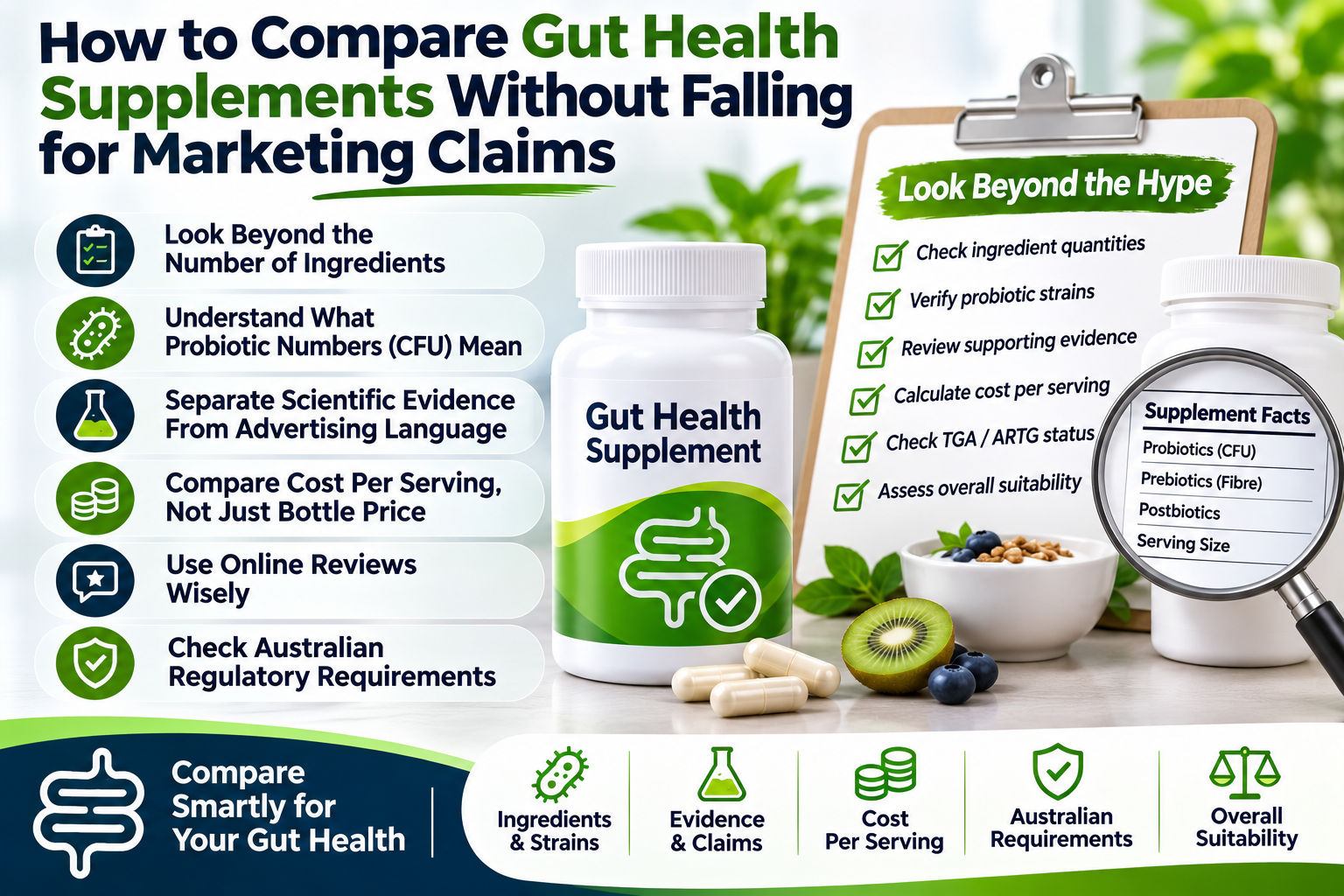
The most practical way to compare supplements is to evaluate their ingredients, scientific evidence, recommended serving sizes, regulatory status and overall cost.
Consider the following factors before making a decision.
1. Look Beyond the Number of Ingredients
A supplement containing ten ingredients is not necessarily better than one containing three.
Some formulations focus on a particular microbial strain or dietary fibre, while others combine several ingredient categories.
For instance, Gundry MD Bio Complete 3 is marketed as a combination of prebiotics, probiotics and postbiotic ingredients.
While combination formulas may offer convenience, their potential usefulness depends on their composition, ingredient quantities and individual suitability.
When examining a supplement label, consider:
-
Whether individual ingredients are clearly identified.
-
How much of each ingredient is included.
-
Whether specific probiotic strains are disclosed.
-
Whether potential allergens are listed.
-
Whether the recommended serving size is clearly explained.
Ingredient transparency is generally more useful than an impressive-looking list of compounds.
2. Understand What Probiotic Numbers Actually Mean
Many probiotic supplements display large numbers on their packaging, such as 10 billion or 50 billion CFU.
CFU stands for colony-forming units, a measurement used to describe the number of viable microorganisms in a product.
However, a higher CFU count does not automatically mean better results.
The specific microorganism, its characteristics, the quantity consumed and its intended purpose all matter.
Does a Higher CFU Count Mean Better Quality?
Not necessarily. A lower-CFU product containing a strain supported by relevant research may be more appropriate for a particular purpose than a higher-CFU product without comparable evidence.
Consumers should also check whether the stated CFU count applies at manufacturing or through the product's expiry date.
3. Separate Scientific Evidence From Advertising Language
There is an important difference between a supplement containing a scientifically studied ingredient and a finished product that has demonstrated benefits in clinical trials.
An ingredient may have been studied under specific conditions, at a particular dosage or within a particular population.
Those findings cannot automatically be applied to every supplement containing that ingredient.
When a company mentions scientific research, consider whether the study examined the actual product or only one of its components.
Common Supplement Marketing Claims and What They Really Mean
Learning to interpret advertising language makes comparing products considerably easier.
|
Marketing Claim |
What You Should Check |
|
Clinically studied ingredients |
Whether the finished formulation has been studied |
|
Maximum strength |
Actual ingredient quantities and suitability |
|
All-in-one formula |
Whether each ingredient serves a relevant purpose |
|
Doctor formulated |
Qualifications and independent supporting evidence |
|
Natural ingredients |
Potential side effects and interactions |
|
Thousands of positive reviews |
Whether experiences are representative and reliable |
|
Third-party tested |
What was tested and whether results are available |
These descriptions are not necessarily misleading on their own. However, they should not replace a careful assessment of product information.
Why Should You Compare Cost Per Serving Instead of Bottle Price?
Imagine two supplements sitting next to each other on a shelf. One costs $45, while the other costs $60.
At first glance, the cheaper option seems like better value. However, the number of daily servings could tell a different story.
|
Comparison |
Supplement A |
Supplement B |
|
Bottle price |
$45 |
$60 |
|
Daily servings |
15 |
30 |
|
Cost per serving |
$3.00 |
$2.00 |
|
Estimated 30-day cost |
$90 |
$60 |
Figures are hypothetical and provided for illustration only. All amounts are in Australian dollars.
Consumers researching Bio Complete 3 Australia pricing can apply the same comparison method by examining serving quantities, shipping charges and potential recurring expenses.
Remember that affordability and effectiveness are separate considerations. A lower cost per serving does not establish that a product offers better health outcomes.
Can You Trust Online Supplement Reviews?
Online reviews can be helpful when assessing delivery experiences, packaging quality and customer service.
However, personal experiences with digestive supplements are influenced by several factors, including diet, lifestyle, medications and existing health conditions.
A product receiving hundreds of positive reviews does not guarantee that another person will experience similar results.
Be particularly cautious when reviews contain identical wording, unrealistic timelines or dramatic before-and-after stories.
Use customer feedback as one part of your research rather than treating it as scientific proof.
What Should Australians Know About Supplement Regulations?
The Therapeutic Goods Administration (TGA) regulates products classified as therapeutic goods in Australia.
Where applicable, consumers should check whether a supplement is included in the Australian Register of Therapeutic Goods (ARTG).
Importantly, ordinary listed medicines are not individually assessed for efficacy by the TGA before listing. Different requirements apply to assessed listed and registered medicines.
Products classified as foods may be subject to separate regulations.
Overseas availability does not automatically establish that a supplement can legally be supplied in Australia. Check its regulatory status and applicable import requirements before purchasing.
Frequently Asked Questions
Are More Expensive Gut Health Supplements Better?
Not necessarily. Pricing may reflect branding, manufacturing expenses, ingredients or distribution costs rather than demonstrated effectiveness.
Are Combination Gut Health Supplements Better Than Probiotics Alone?
There is no universal answer. Their suitability depends on the formulation, supporting evidence and individual health requirements.
Are Natural Gut Health Supplements Always Safe?
No. Natural ingredients can still cause digestive discomfort, allergic reactions or interactions with medications.
Can Gut Health Supplements Replace a Balanced Diet?
No. Supplements should not replace a varied diet, adequate hydration or appropriate medical care.
Final Thoughts
Choosing a gut health supplement does not need to involve complicated scientific research or hours of reading customer reviews.
Start by looking beyond promotional language. Examine ingredient quantities, compare daily costs, investigate supporting evidence and check applicable Australian regulatory requirements.
Most importantly, avoid assuming that a more expensive product, a higher bacterial count or a longer ingredient list will deliver better results.
Making an informed decision based on reliable information is far more valuable than following the latest wellness trend.
Disclaimer: This article is intended for general informational purposes only and does not constitute medical advice. Consult a qualified healthcare professional before taking dietary supplements, particularly if you have an existing health condition or take medication.
