

HL7 FHIR Compliance Market Size, Share, and Competitive Landscape Analysis

The global HL7 FHIR Compliance Market is projected to increase from USD 2.60 billion in 2026 to USD 8.59 billion by 2036, registering a compound annual growth rate (CAGR) of 12.7% between 2026 and 2036. Market growth is supported by rising healthcare interoperability requirements, increasing adoption of standardized FHIR APIs, regulatory compliance initiatives and growing demand for automated conformance testing.
HL7 FHIR compliance solutions help healthcare organizations validate whether their application programming interfaces (APIs), data exchange systems and implementation guides follow established interoperability standards. These solutions include conformance testing platforms, certification support, security validation and implementation services that enable reliable exchange of regulated healthcare information.
Request a Sample and Research Information: https://www.futuremarketinsights.com/reports/sample/rep-gb-32198
HL7 FHIR Compliance Market: Key Growth Indicators
- Market value: USD 2.60 billion in 2026.
- Forecast value: USD 8.59 billion by 2036.
- Growth rate:7% CAGR between 2026 and 2036.
- Key growth driver: Increasing adoption of standardized healthcare interoperability frameworks.
- Leading compliance focus: Regulatory compliance and certification support, accounting for 41% share in 2026.
- Major customer segment: Providers and hospital systems, accounting for 40% share in 2026.
- Leading offering type: Implementation and integration services, accounting for 45% share in 2026.
Why Is Demand for HL7 FHIR Compliance Solutions Increasing?
The growing need for seamless healthcare information exchange is increasing demand for FHIR compliance solutions. Hospitals, insurance companies and digital health providers must exchange clinical records, patient information and administrative data across multiple healthcare platforms.
FHIR standards provide a structured approach to healthcare data interoperability through standardized resources and APIs. However, differences in implementation guides, resource profiles and security requirements can create compatibility challenges. Compliance solutions help organizations identify these gaps and validate whether their systems meet applicable technical specifications.
Regulatory initiatives are another important growth factor. Healthcare interoperability programs are encouraging organizations to establish standardized data exchange frameworks, creating demand for conformance testing, certification readiness and ongoing compliance monitoring.
The expansion of digital health infrastructure in emerging markets is further increasing the number of healthcare applications requiring FHIR-based integration and validation.
Regulatory Compliance and Certification Shape Market Demand
Regulatory compliance and certification support are projected to account for 41% of market share in 2026, making this the leading compliance focus.
Healthcare organizations increasingly require documented evidence that their systems comply with relevant FHIR specifications and implementation guides before connecting to healthcare networks.
Certification preparation and conformance testing help technology providers demonstrate that their APIs support required resource structures, interactions and security controls. Automated validation tools also help developers identify implementation errors and reduce repeated testing cycles.
The growing importance of audit readiness is encouraging organizations to move beyond one-time technical validation toward continuous compliance management.
Providers and Hospital Systems Influence Procurement
Providers and hospital systems are expected to account for 40% of the market in 2026. Hospitals manage multiple technology platforms and exchange information with laboratories, pharmacies, insurers, referral networks and other healthcare organizations.
FHIR compliance solutions help these institutions validate data exchange between different applications and maintain interoperability across clinical environments.
Healthcare providers also evaluate vendors based on integration compatibility, implementation guide coverage, security validation, audit reporting and technical support.
The increasing deployment of electronic health records and connected healthcare applications is creating additional opportunities for FHIR compliance testing and implementation services.
Implementation and Integration Services Drive Market Opportunities
Implementation and integration services are projected to account for 45% of market share in 2026.
Healthcare organizations frequently require specialized assistance to map existing data structures to FHIR resources, configure APIs, validate implementation guides and remediate conformance gaps.
Integration specialists support testing across multiple healthcare endpoints and help organizations prepare systems for production deployment.
Managed compliance and monitoring services also offer opportunities as healthcare providers increasingly require continuous validation of API performance, security controls and implementation guide updates.
Regional Growth Opportunities in the HL7 FHIR Compliance Market
Regional adoption is influenced by national digital health initiatives, interoperability regulations and healthcare technology investments. India is projected to record the highest country-level growth among the markets assessed in the FMI report.
- India: The market is projected to grow at a CAGR of 15.2% between 2026 and 2036, supported by Ayushman Bharat Digital Mission (ABDM) initiatives and expanding FHIR-based healthcare data exchange.
- United States: Demand is expected to increase at 13.6% CAGR, driven by federal interoperability initiatives and growing requirements for standardized healthcare API validation.
- Germany: The market is forecast to expand at 12.9% CAGR, supported by national digital health infrastructure and versioned FHIR implementation guides.
- United Kingdom: Demand is projected to grow at 12.6% CAGR, reflecting NHS interoperability standards and increasing requirements for API conformance.
- Canada: The market is expected to register a 12.1% CAGR, supported by provincial interoperability programs and expanding FHIR implementation activity.
Competitive Landscape: Interoperability Testing and Certification Define Competition
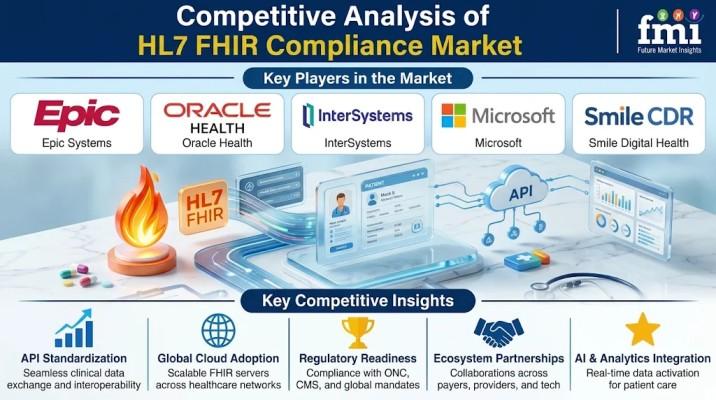
The HL7 FHIR Compliance Market includes healthcare technology companies, interoperability platform providers, managed FHIR infrastructure vendors and specialized conformance testing companies. Competition is influenced by implementation guide coverage, API validation capabilities, certification support, security compliance and integration expertise.
Notable companies include:
- Epic Systems
- Oracle Health
- InterSystems
- Microsoft (Azure Health Data Services FHIR)
- Redox
- Smile Digital Health (HAPI FHIR)
- Firely (Firely Server)
- net (Touchstone)
- Drummond Group (FHIRplace testing & certification)
- Health Gorilla
Epic Systems and Oracle Health participate through healthcare information technology platforms and interoperability capabilities. InterSystems contributes through healthcare data management and integration solutions, while Microsoft supports FHIR-based infrastructure through Azure Health Data Services.
Redox and Health Gorilla strengthen healthcare connectivity through interoperability and data exchange solutions. Smile Digital Health and Firely contribute FHIR server technologies and implementation capabilities.
AEGIS.net and Drummond Group participate in conformance testing and certification-related services, supporting organizations seeking to validate FHIR implementations against established standards.
Competitive differentiation increasingly depends on automated testing capabilities, implementation guide support, security validation and the ability to manage recurring compliance requirements.
Access The Full Report: https://www.futuremarketinsights.com/reports/hl7-fhir-compliance-market
What Should HL7 FHIR Compliance Solution Providers Prioritize?
Companies should prioritize automated conformance testing platforms that support multiple FHIR versions, implementation guides and healthcare data exchange requirements. Greater investment in certification readiness and continuous validation can help healthcare organizations reduce integration risks.
Vendors should also strengthen API security, consent management, privacy validation and audit reporting capabilities. Compatibility with major electronic health record systems and healthcare integration platforms will remain important for expanding adoption.
Managed compliance services represent another opportunity as healthcare organizations seek assistance with implementation guide updates, regression testing and ongoing monitoring.
Emerging markets offer additional growth potential through government-backed digital health programs and expanding healthcare interoperability infrastructure. Companies with strong implementation expertise, regional partnerships and scalable validation platforms may be better positioned to capture demand.
For strategic positioning, businesses can explore Future Market Insights' Competitive Analysis services to evaluate market participants, competitive structures and potential growth opportunities.
Frequently Asked Questions
- How large is the HL7 FHIR Compliance Market in 2026?
The global market is estimated to reach USD 2.60 billion in 2026, supported by increasing healthcare interoperability requirements and demand for FHIR conformance testing.
- What is the projected market value by 2036?
The market is forecast to reach USD 8.59 billion by 2036, registering a CAGR of 12.7% between 2026 and 2036.
- What is driving demand for HL7 FHIR compliance solutions?
Increasing healthcare data exchange, regulatory interoperability initiatives, digital health adoption and demand for standardized API validation are supporting market growth.
- Which compliance focus segment leads the market?
Regulatory compliance and certification support is projected to account for 41% of market share in 2026, reflecting the growing importance of documented conformance and audit readiness.
- Which customer segment holds the largest market share?
Providers and hospital systems are expected to account for 40% of market share in 2026 because of their extensive healthcare integration requirements.
Related Reports:
- Dental Operatory Products Market - https://www.futuremarketinsights.com/reports/dental-operatory-products-market
- Heart Failure Biomarker Market - https://www.futuremarketinsights.com/reports/heart-failure-biomarker-market
- Long-Acting Implantable GLP-1 Obesity Devices Market - https://www.futuremarketinsights.com/reports/long-acting-implantable-glp-1-obesity-devices-market
About Future Market Insights (FMI)
Future Market Insights (FMI) is a global market intelligence and consulting firm providing comprehensive market research, competitive intelligence, and strategic business insights across industries. The firm delivers detailed forecasts, technology analysis, and data-driven recommendations that support informed decision-making for manufacturers, investors, distributors, and policymakers worldwide.
For Press & Corporate Inquiries
Rahul Singh
AVP – Marketing and Growth Strategy
Future Market Insights, Inc.
+91 8600020075
For Sales – [email protected]
