

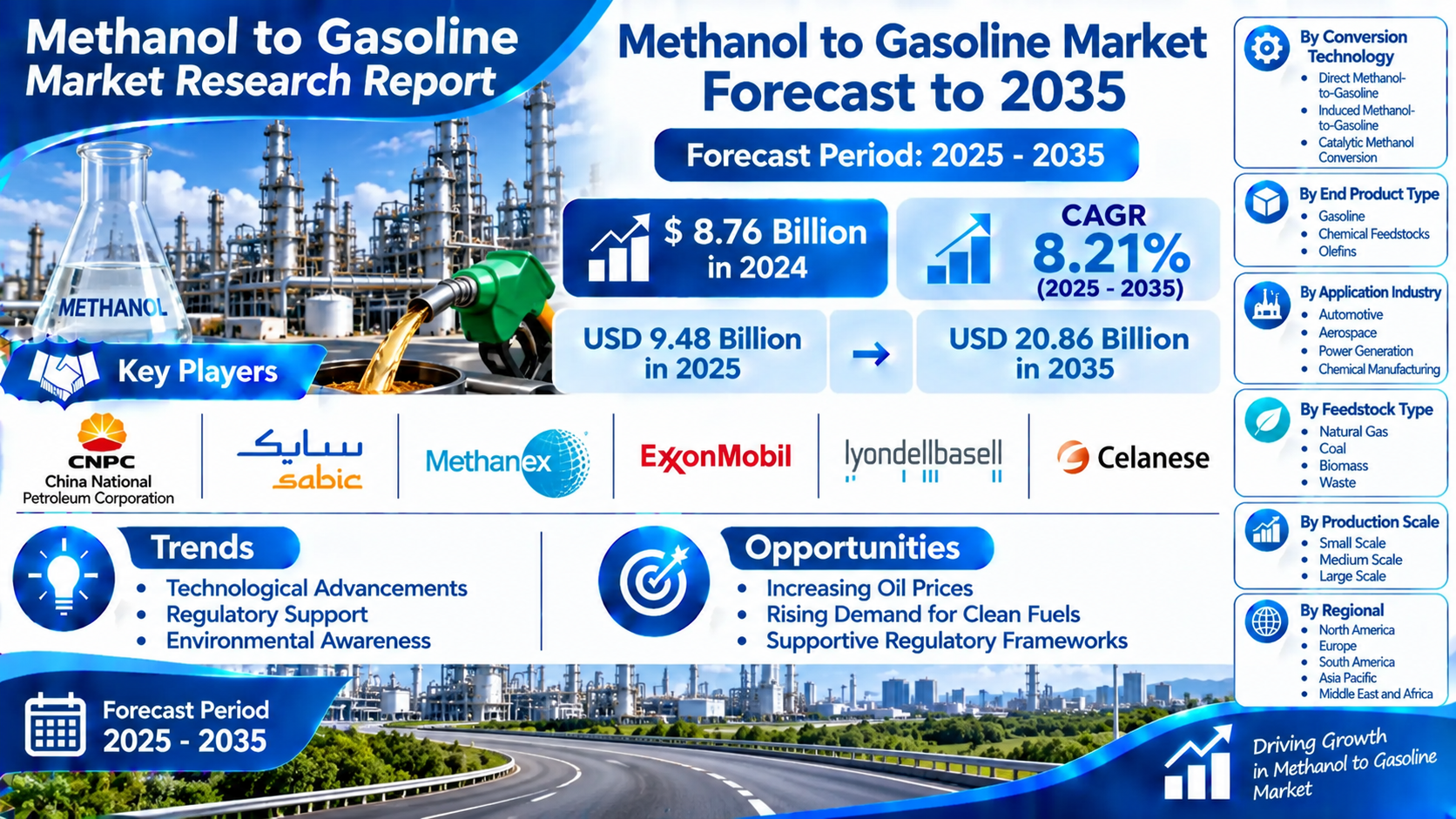

According to Market Research Future® (MRFR), the Methanol to Gasoline Market is projected to expand from USD 9.48 billion in 2025 to USD 20.86 billion by 2035, registering a compound annual growth rate (CAGR) of 8.21% during the forecast period from 2025 to 2035. The market was valued at USD 8.76 billion in 2024. Its development reflects growing interest in alternative fuel production, technological advancements in methanol conversion, and the need to diversify fuel supply options. Increasing oil prices, rising demand for clean fuels, and supportive regulatory frameworks are among the opportunities shaping the industry's outlook.
Market Overview and Growth Prospects
Methanol-to-gasoline technology provides a pathway for converting methanol into gasoline-range products. The process is relevant to energy and chemical industries seeking additional routes for producing liquid fuels and other hydrocarbon outputs. Market expansion is supported by interest in alternative production methods and the potential to use different feedstock categories, including natural gas, coal, biomass, and waste.
The forecast indicates a substantial increase in market value over the coming decade. Growth from USD 9.48 billion in 2025 to USD 20.86 billion in 2035 highlights the commercial attention directed toward methanol conversion technologies. The market's performance will depend on technology development, feedstock availability, regulatory conditions, and demand from industries that consume gasoline and related products.
Conversion Technology and Production Development
The market includes Direct Methanol-to-Gasoline, Induced Methanol-to-Gasoline, and Catalytic Methanol Conversion. These technology categories represent different approaches to converting methanol into useful outputs. Their development is central to the industry's ability to improve production processes and respond to changing fuel requirements.
Technological advancements are an important market trend. Continued progress in conversion processes can support production development and strengthen the role of methanol-based routes within the broader fuel industry. Technology selection may also influence production scale, operating requirements, and the range of outputs that facilities can deliver.
The production-scale segment covers Small Scale, Medium Scale, and Large Scale operations. This classification reflects the different capacities at which methanol-to-gasoline production can be developed. Market participants may assess scale according to project requirements, feedstock access, investment considerations, and intended customers.
End Products and Application Industries
Gasoline is a principal end product within the market, while Chemical Feedstocks and Olefins represent additional output categories. This range connects methanol conversion with both fuel supply and chemical manufacturing. Demand conditions across these product categories can influence investment priorities and the commercial direction of production facilities.
The application industry segment includes Automotive, Aerospace, Power Generation, and Chemical Manufacturing. Automotive demand is directly relevant to gasoline consumption, while aerospace and power generation represent other areas identified in the market segmentation. Chemical manufacturing provides a further connection through the use of chemical feedstocks and olefins.
The presence of several application industries gives the market a diversified demand structure. However, the relative contribution of each industry will depend on its specific requirements, purchasing conditions, and the suitability of methanol-derived products for its operations.
Feedstock Options and Supply Considerations
Natural Gas, Coal, Biomass, and Waste are the feedstock types covered in the market. This variety is significant because feedstock availability and selection influence the development of methanol production and its subsequent conversion into gasoline. Different resource categories also connect the market with broader discussions about energy security, resource utilization, and environmental priorities.
The inclusion of biomass and waste highlights the potential relevance of alternative resource streams, while natural gas and coal remain part of the defined feedstock landscape. Market development will be influenced by access to these inputs, their economics, and the regulatory conditions governing their use.
Key Market Trends and Opportunities
Technological Advancements, Regulatory Support, and Environmental Awareness are the three major trends shaping the market. Improvements in conversion technology can support process development, while regulatory support may influence investment decisions and the adoption of alternative fuel pathways. Environmental awareness is also contributing to interest in fuel-production approaches that respond to changing sustainability expectations.
Increasing Oil Prices create an opportunity for alternative fuel production routes to attract greater commercial attention. Rising Demand for Clean Fuels is another important opportunity, reflecting interest in fuel options that align with evolving energy priorities. Supportive Regulatory Frameworks can further encourage project development by creating conditions that favor investment and technology deployment.
These factors may reinforce one another. Changes in fuel prices can affect the commercial appeal of alternative production, while regulatory measures and environmental priorities can influence the pace at which new facilities and technologies are considered.
Regional Market Landscape
The report segments the market across North America, Europe, South America, Asia Pacific, and the Middle East and Africa. These regions form the geographic framework for assessing market development and industry participation.
Regional prospects may differ according to feedstock availability, energy demand, industrial infrastructure, regulatory policies, and investment conditions. North America and Europe are included alongside developing industrial and energy markets in Asia Pacific, South America, and the Middle East and Africa. The breadth of this coverage reflects the international relevance of methanol-to-gasoline production.
Competitive Landscape
Key companies identified in the market include China National Petroleum Corporation, SABIC, Methanex Corporation, ExxonMobil, LyondellBasell Industries, and Celanese Corporation. These participants form part of the competitive landscape associated with methanol, fuel, and chemical industry activities.
Competition is expected to be influenced by technology development, feedstock strategy, production scale, and the ability to serve different end-product markets. As demand for alternative fuel pathways develops, industry participants will need to assess the commercial and regulatory conditions affecting methanol conversion projects.
Market Outlook Through 2035
The Methanol to Gasoline Market is forecast to grow at a CAGR of 8.21% between 2025 and 2035, reaching USD 20.86 billion by the end of the forecast period. Its outlook is linked to technological advancements, regulatory support, environmental awareness, and opportunities arising from oil prices and clean-fuel demand. The interaction of these factors will shape the market's ability to expand across production technologies, feedstock categories, application industries, and regions.
