

When planning a new deck, most homeowners have a budget in mind. However, browsing different decking products can quickly become confusing when boards that look almost identical come with considerably different price tags.
Is premium composite decking genuinely better, or are you simply paying more for the brand, colour or appearance?
For homeowners exploring composite decking Melbourne options, understanding the differences between budget-friendly and premium products can make choosing the right decking much easier.
The key is knowing which features are worth paying for and which may not make a noticeable difference to your outdoor space.
Why Do Composite Decking Prices Vary So Much?
Composite decking is generally manufactured using a combination of wood fibres, plastic and other additives. However, manufacturers use different material formulations, production methods and board designs.
These differences can influence the manufacturing cost and overall performance of the finished product.
Some of the main factors affecting decking prices include:
-
Quality and consistency of raw materials.
-
Manufacturing processes and quality control.
-
Board thickness, dimensions and internal structure.
-
Protective surface technology.
-
UV and moisture resistance.
-
Surface texture and colour variation.
-
Product testing and warranty coverage.
Although two decking boards may look similar in a showroom, their long-term performance could differ depending on these characteristics.
What Are the Main Differences Between Cheap and Premium Composite Decking?
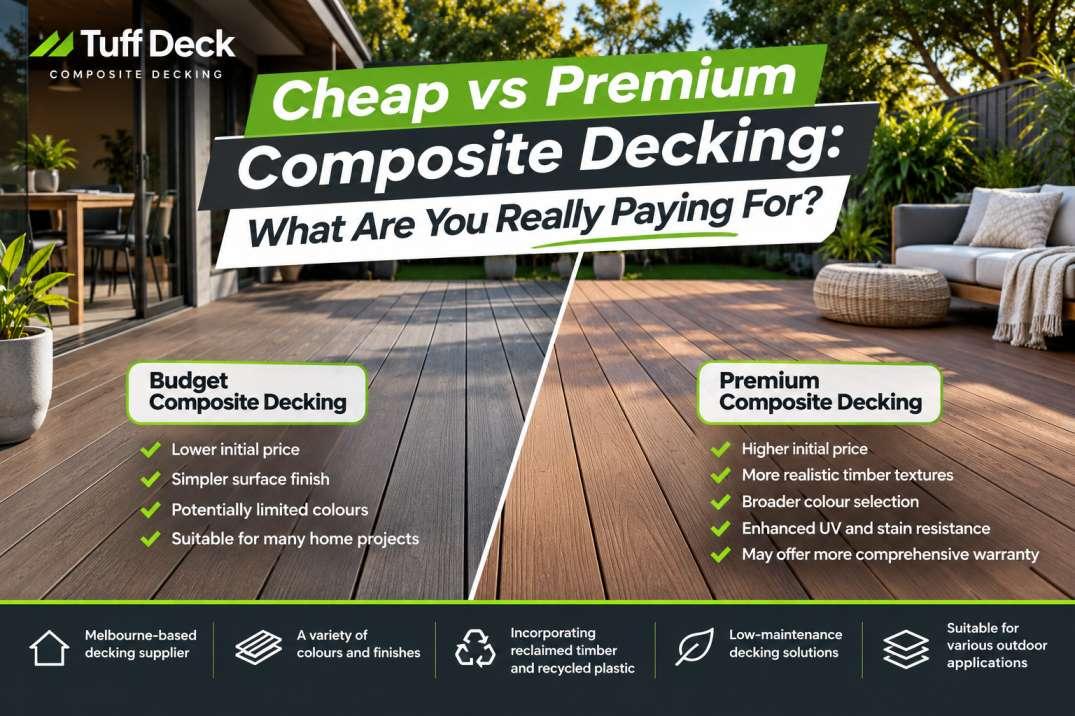
The difference between budget and premium composite decking goes beyond appearance. It can also involve installation requirements, maintenance and suitability for particular outdoor environments.
|
Feature |
Budget Composite Decking |
Premium Composite Decking |
|
Initial price |
Generally lower |
Generally higher |
|
Surface finish |
Often simpler |
May offer more realistic timber textures |
|
Colour selection |
Potentially limited |
Often broader |
|
UV resistance |
Varies by product |
May offer enhanced protection |
|
Stain resistance |
Depends on surface design |
May feature protective capping |
|
Warranty |
Varies by manufacturer |
May offer more comprehensive coverage |
|
Long-term value |
Depends on performance |
Potentially better in demanding environments |
These are general differences rather than guaranteed characteristics. Some affordable products perform well, while an expensive product does not automatically offer superior quality.
Always compare individual product specifications before purchasing.
1. Material Quality and Manufacturing Consistency
One of the less obvious differences between decking products is the quality and consistency of their materials.
Well-manufactured composite decking should have consistent dimensions, surface finishes and structural characteristics within specified tolerances.
Poor manufacturing consistency can make installation more difficult, particularly when boards vary in size or appearance beyond acceptable limits.
When comparing composite decking suppliers, ask for technical specifications, installation instructions and information about the materials used during manufacturing.
A supplier that provides detailed product information makes it easier to evaluate quality rather than relying on price alone.
2. Surface Protection and Weather Resistance
Melbourne's changing weather exposes outdoor decking to rainfall, sunlight, temperature fluctuations and moisture.
The way decking boards respond to these conditions depends on their material composition and protective features.
Capped vs Uncapped Composite Decking
Capped composite decking features an additional protective outer layer around some or all of the board's surfaces. Depending on the product, this layer can improve resistance to staining, fading and moisture penetration.
Uncapped decking does not have the same separate protective layer but can still provide suitable performance when manufactured and installed correctly.
Capped products often cost more because of the additional manufacturing process.
Does Premium Decking Fade Less?
Premium products may incorporate enhanced UV-resistant formulations or protective surface technologies. However, no outdoor decking material should be assumed to remain completely unchanged throughout its lifespan.
Ask for documented colour performance and understand any warranty limitations relating to fading.
3. Appearance, Texture and Design Options
For many homeowners, appearance is an important reason to invest in premium composite decking.
Higher-priced products may feature more detailed woodgrain patterns, natural colour variations and sophisticated surface finishes that resemble traditional timber.
Budget-friendly options may have simpler textures and more uniform colours. However, this does not necessarily make them unattractive.
A straightforward decking finish can work particularly well in modern gardens, courtyards and outdoor entertaining areas.
Before spending extra on a premium finish, request samples and compare them in natural daylight. A less expensive board may complement your home's exterior just as effectively.
4. Installation Costs Can Change the Overall Value
When researching the composite decking Melbourne price, it is easy to concentrate on the cost of individual boards.
However, the total cost of a finished deck also includes the supporting structure, installation accessories, labour, delivery and material wastage.
An Illustrative Cost Comparison
Consider the following hypothetical example for a 20-square-metre decking project.
|
Expense |
Budget Decking |
Premium Decking |
|
Decking boards |
$1,800 |
$2,800 |
|
Fasteners and accessories |
$350 |
$400 |
|
Supporting structure |
$1,500 |
$1,500 |
|
Installation labour |
$2,200 |
$2,200 |
|
Delivery |
$150 |
$150 |
|
Total project cost |
$6,000 |
$7,050 |
These figures are illustrative only and do not represent current Melbourne market prices or Tuff Deck quotations.
In this example, premium decking boards cost $1,000 more, but the difference in the completed project is $1,050. Looking at the entire installation provides a clearer picture of the additional investment.
When Is Budget Composite Decking a Good Choice?
Affordable composite decking can be a sensible option when its specifications meet your project requirements.
It may be particularly suitable for:
-
Small residential courtyards.
-
Outdoor areas with moderate foot traffic.
-
Budget-conscious property renovations.
-
Homeowners who prefer simple colours and finishes.
-
Projects where advanced decorative features are unnecessary.
The important consideration is whether the product meets the structural, environmental and installation requirements of your outdoor area.
When Is Premium Composite Decking Worth the Extra Money?
Spending more may be worthwhile when your outdoor space has demanding conditions or when particular performance features are important.
Premium decking may be worth considering for frequently used entertaining areas, exposed backyards, high-traffic environments and projects where appearance is a major priority.
However, the additional cost should be supported by measurable product benefits, suitable technical specifications and meaningful warranty coverage.
About Tuff Deck
Tuff Deck is a Melbourne-based composite decking specialist offering wood-plastic composite decking solutions incorporating reclaimed timber and recycled plastic.
Its decking range provides homeowners, builders and landscaping professionals with alternatives to traditional timber for various outdoor applications.
Why Choose Tuff Deck?
Tuff Deck offers homeowners the opportunity to explore different decking colours, finishes and practical material options according to their project requirements.
Reasons to consider Tuff Deck include its Melbourne-based supply, range of decking finishes, low-maintenance material options and use of reclaimed and recycled materials.
Choosing decking through a specialist supplier can help homeowners make more informed decisions about product suitability, appearance and overall project costs.
Frequently Asked Questions
Is cheap composite decking worth buying?
Yes, affordable composite decking can provide good value when its technical specifications, installation requirements and performance characteristics suit the intended application.
Does premium composite decking last longer?
Premium decking may offer enhanced durability features, but its actual lifespan depends on material quality, installation, maintenance and environmental conditions.
Is capped composite decking worth the extra cost?
Capped decking may be worth considering when additional stain, moisture or surface protection is important. Compare individual product specifications before deciding.
How can I identify good-quality composite decking?
Review material composition, board consistency, technical documentation, slip-resistance ratings, warranty terms and installation requirements. Requesting physical samples can also help with comparisons.
Final Thoughts
The best composite decking is not necessarily the cheapest or the most expensive option. It is the product that offers the right combination of performance, appearance and affordability for your outdoor space.
Rather than making a decision based solely on the advertised board price, compare material quality, installation expenses, protective features and long-term maintenance requirements.
By understanding exactly what you are paying for, you can invest in composite decking that suits your budget and provides a comfortable, attractive outdoor area for years to come.
