

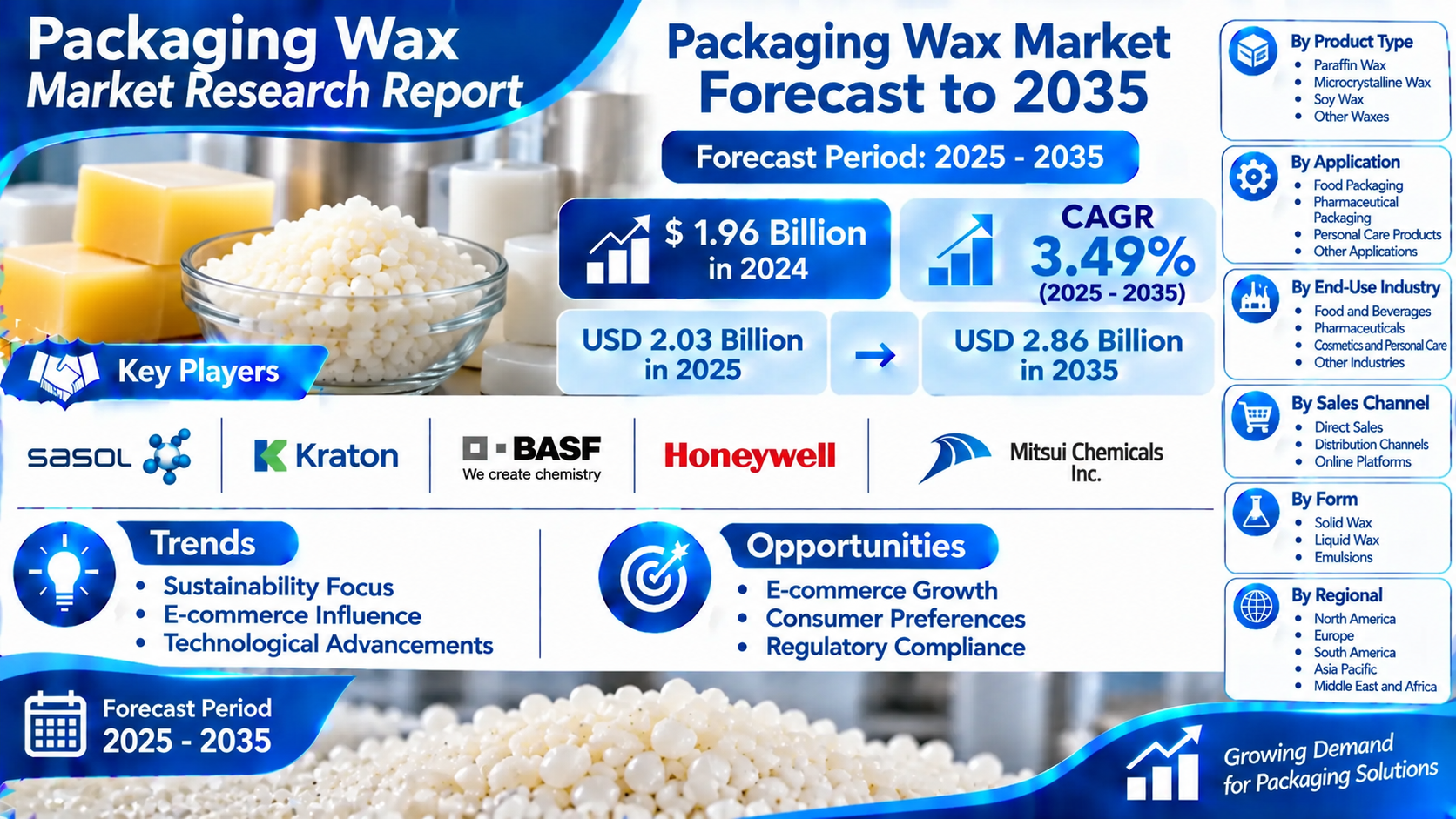

According to Market Research Future® (MRFR), the Packaging Wax Market is projected to grow from USD 2.03 billion in 2025 to USD 2.86 billion by 2035, registering a compound annual growth rate (CAGR) of 3.49% during the forecast period of 2025–2035. The market was valued at USD 1.96 billion in 2024. Its development is influenced by packaging requirements across food and beverages, pharmaceuticals, and personal care, alongside sustainability priorities, e-commerce expansion, and technological advancements. Opportunities linked to evolving consumer preferences and regulatory compliance are also shaping the industry's outlook.
Market Overview and Growth Prospects
Packaging wax serves a role in packaging applications across several consumer and industrial product categories. The market includes different wax formulations, product forms, and distribution channels, reflecting the range of requirements among packaging manufacturers and end users. Food packaging, pharmaceutical packaging, and personal care products are among the application areas covered in the market.
The forecast growth from USD 2.03 billion in 2025 to USD 2.86 billion in 2035 indicates a steady expansion trajectory. A CAGR of 3.49% reflects the expected pace of growth over the decade. Demand will be influenced by packaging activity across the identified end-use industries, changes in purchasing and distribution patterns, and manufacturers' ability to respond to product and regulatory requirements.
Product Types and Material Options
The product-type segment comprises Paraffin Wax, Microcrystalline Wax, Soy Wax, and Other Waxes. These categories represent the different materials available to packaging producers. Each type forms part of the market's product mix, with selection influenced by the intended packaging application and relevant product specifications.
Paraffin wax and microcrystalline wax are included alongside soy wax and other waxes, giving the market a range of material categories. The presence of multiple options allows manufacturers and buyers to evaluate packaging wax according to their requirements. Sustainability Focus is a key market trend, making material selection and the broader environmental considerations associated with packaging important areas of industry attention.
Applications and End-Use Industries
The market's application categories include Food Packaging, Pharmaceutical Packaging, Personal Care Products, and Other Applications. These segments connect packaging wax demand with industries that require packaging solutions for different product types.
Food packaging represents an important application area within the market's segmentation. The broader Food and Beverages end-use industry is also included, reflecting the connection between packaging materials and the handling and distribution of food-related products. Pharmaceutical Packaging is another defined application, while Pharmaceuticals is separately identified as an end-use industry.
Personal care products form an additional application category, supported by demand from the Cosmetics and Personal Care industry. Other Industries complete the end-use segmentation. The diversity of these markets gives packaging wax suppliers exposure to multiple customer groups, although demand patterns may differ according to product requirements and packaging practices.
Product Forms and Packaging Requirements
Packaging wax is segmented by form into Solid Wax, Liquid Wax, and Emulsions. These forms provide different options for manufacturers and users, depending on application needs and processing requirements.
The availability of solid, liquid, and emulsion formats broadens the product offering within the market. Buyers may assess each form according to the intended packaging process, handling requirements, and compatibility with their products. Manufacturers must therefore consider the relationship between formulation, physical form, and customer specifications when developing and supplying packaging wax products.
Technological Advancements are identified as a key market trend. Improvements in product development and manufacturing processes may help suppliers respond to changing packaging requirements. Technology also plays a role in supporting consistency and product development across different forms and applications.
Sales Channels and E-commerce Influence
The sales-channel segmentation includes Direct Sales, Distribution Channels, and Online Platforms. These routes reflect how packaging wax products reach manufacturers and other customers.
Direct sales can support supplier relationships with buyers that have specific procurement requirements. Distribution channels provide another route to market, while online platforms are becoming increasingly relevant as digital purchasing activity expands. E-commerce Influence is identified as a major trend, and E-commerce Growth is listed as an opportunity.
The growing role of online platforms may affect how buyers discover suppliers, compare product offerings, and place orders. Companies may need to assess their sales strategies as purchasing behavior evolves. The relative importance of each channel will depend on customer preferences, order requirements, and the nature of supplier relationships.
Sustainability and Regulatory Considerations
Sustainability Focus is one of the key trends shaping the packaging wax market. Environmental considerations are becoming increasingly relevant to packaging decisions, encouraging manufacturers and buyers to evaluate materials and product options in relation to their broader sustainability priorities.
Regulatory Compliance is identified as an opportunity. Packaging suppliers and end users must consider the regulatory requirements applicable to their products and markets. Compliance can influence material selection, product specifications, and manufacturing practices. Companies that monitor regulatory developments and adapt their offerings accordingly may be better positioned to serve customers with changing requirements.
Consumer Preferences also provide an opportunity for market development. As buyers and end users evaluate packaging choices, their expectations can influence the types of materials and products selected by manufacturers. These preferences may interact with sustainability considerations and regulatory requirements.
Regional Market Landscape
The market is segmented across North America, Europe, South America, Asia Pacific, and the Middle East and Africa. These regions provide the geographic framework for assessing packaging wax demand and industry participation.
Regional market conditions may differ according to food and beverage production, pharmaceutical activity, cosmetics and personal care manufacturing, and the development of distribution networks. E-commerce adoption and regulatory requirements can also influence regional demand. These factors create varied operating environments for suppliers across the five regions.
Competitive Landscape
The key players identified in the Packaging Wax Market include Sasol, Kraton Corporation, BASF, Honeywell International Inc., and Mitsui Chemicals, Inc. These companies form part of the competitive landscape for packaging wax and related materials.
Competition is influenced by product portfolios, manufacturing capabilities, distribution networks, and the ability to respond to customer requirements. Sustainability priorities, technological advancements, and digital sales channels may also shape competitive strategies as the market develops.
Market Outlook Through 2035
The Packaging Wax Market is projected to reach USD 2.86 billion by 2035, growing at a CAGR of 3.49% between 2025 and 2035. Sustainability Focus, E-commerce Influence, and Technological Advancements are important trends shaping the sector. E-commerce Growth, Consumer Preferences, and Regulatory Compliance provide additional opportunities. The market's future development will depend on packaging demand across food, pharmaceutical, and personal care industries, alongside evolving sales channels and product requirements.
