

Dosimeter Market Growth Supported by Increasing Radiation Safety Awareness

Dosimeter Market
Market Overview
The global Dosimeter Market is experiencing steady growth due to increasing awareness of radiation safety across healthcare, nuclear energy, industrial manufacturing, research, and defense sectors. A dosimeter is a specialized device used to measure the amount of ionizing radiation absorbed by an individual, equipment, or surrounding environment. These devices play an important role in monitoring occupational radiation exposure and ensuring compliance with safety regulations.
Dosimeters are widely used in hospitals, diagnostic imaging centers, nuclear power plants, laboratories, oil and gas facilities, and industrial environments where radiation exposure is a potential risk. Technological advancements have improved the accuracy, portability, and monitoring capabilities of modern dosimeters. Electronic personal dosimeters provide real-time radiation measurements and warning alerts, while passive dosimeters are commonly used for long-term exposure monitoring. Growing investments in nuclear infrastructure and medical radiation technologies are creating new opportunities for market participants.
Download Free PDF Brochure-https://www.maximizemarketresearch.com/request-sample/112547/
Market Size and Growth
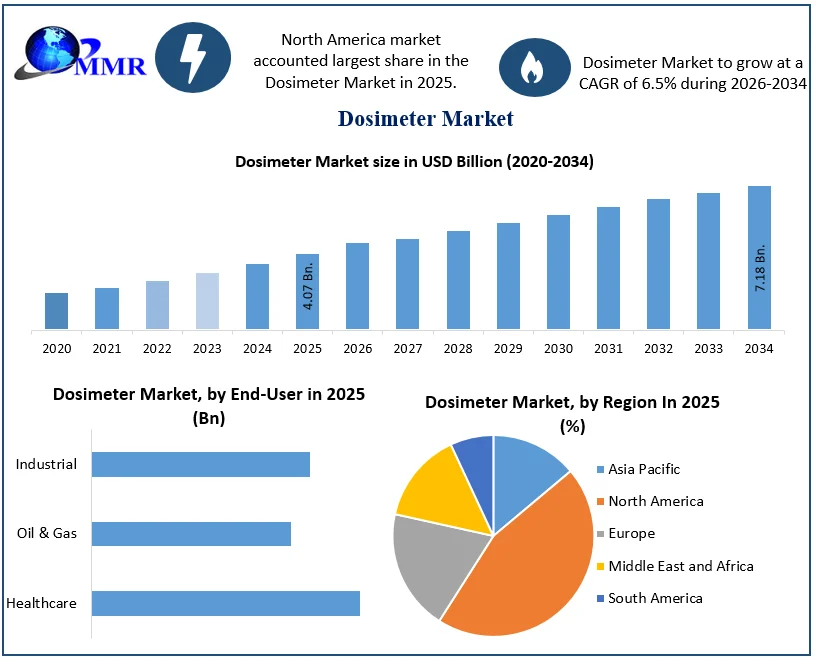
According to Maximize Market Research, the global Dosimeter Market was valued at USD 4.07 billion in 2025 and is projected to reach approximately USD 7.18 billion by 2034, growing at a CAGR of 6.5% during the forecast period from 2026 to 2034.
The market's expansion is primarily supported by increasing applications of radiation-based medical treatments, diagnostic imaging, nuclear energy generation, and scientific research. The rising number of cancer cases worldwide has increased the demand for radiation therapy, creating a greater need for accurate radiation measurement and monitoring equipment.
Additionally, the expansion of nuclear power generation and industrial sterilization facilities is increasing the requirement for reliable dosimetry solutions. Growing awareness of occupational health and safety standards is also encouraging organizations to adopt advanced radiation monitoring technologies.
Key Market Segmentation
The Dosimeter Market is segmented by type, application, end-user, and region.
Based on type, the market includes Electronic Personal Dosimeters, Thermoluminescent Dosimeters (TLD), and Optically Stimulated Luminescence Dosimeters (OSL). Electronic personal dosimeters are gaining popularity because they provide immediate radiation readings, continuous monitoring, and alarm notifications. Thermoluminescent dosimeters are widely used for measuring accumulated radiation exposure over a specific period. OSL dosimeters are preferred in applications requiring accurate dose measurement and reliable long-term monitoring.
By application, the market is divided into active and passive dosimeters. Active dosimeters provide real-time exposure measurements and are commonly used in nuclear facilities, emergency response operations, and high-radiation environments. Passive dosimeters record accumulated radiation exposure and are frequently used by healthcare professionals, laboratory employees, and industrial workers.
Based on end-user, the market includes healthcare, oil and gas, and industrial sectors. Healthcare represents an important application area due to the extensive use of radiation in diagnostic imaging, radiotherapy, and nuclear medicine. Industrial applications include nuclear energy, manufacturing, research, and radiation-based sterilization facilities.
Geographically, the market covers North America, Europe, Asia Pacific, the Middle East and Africa, and South America.
Growth Drivers
Increasing utilization of radiation-based medical procedures is a major factor driving the Dosimeter Market. Hospitals and healthcare facilities use radiation technologies for cancer treatment, medical imaging, and diagnostic examinations. Healthcare professionals working with radiation equipment require reliable monitoring solutions to minimize occupational exposure.
The expansion of nuclear power generation is another important growth driver. Nuclear facilities require continuous radiation monitoring to protect employees and maintain operational safety. Increasing investments in nuclear infrastructure and the construction of new power reactors are supporting demand for personal dosimeters.
Furthermore, rising awareness of workplace safety regulations is encouraging industries to implement radiation monitoring programs. Research laboratories, defense organizations, and industrial facilities are increasingly adopting advanced dosimeters to improve employee protection and operational efficiency.
Emerging Trends
Technological innovation is transforming the global Dosimeter Market. One of the major trends is the development of digital and electronic personal dosimeters with real-time monitoring capabilities. These devices provide immediate exposure readings, alarm notifications, and improved data management.
Wireless connectivity and cloud-based monitoring are also gaining attention. Advanced dosimetry systems can support centralized exposure tracking, allowing organizations to monitor radiation levels across multiple employees and facilities.
Another emerging trend is the increasing adoption of compact, lightweight, and wearable dosimeters. Manufacturers are focusing on improving device comfort, measurement accuracy, battery performance, and durability. The integration of advanced sensors and automated reporting systems is further improving radiation safety management.
Regional Analysis
North America holds the largest share of the global Dosimeter Market in 2025. The region's leadership is supported by increasing demand from healthcare facilities, nuclear power plants, industrial organizations, and defense applications. The United States represents a major market due to its established healthcare infrastructure, radiation safety regulations, and investments in nuclear energy.
Europe represents another significant market, supported by advanced medical technologies, established nuclear infrastructure, and strict occupational radiation protection standards. Countries such as Germany, France, and the United Kingdom contribute to regional demand through healthcare, research, and industrial applications.
Asia Pacific is expected to offer substantial growth opportunities due to expanding healthcare infrastructure, increasing investments in nuclear energy, and growing industrial development. China, India, Japan, and South Korea are important markets for radiation monitoring equipment.
The Middle East and Africa market is supported by increasing healthcare investments, industrial activities, and nuclear energy initiatives. South America is also witnessing demand from healthcare, industrial manufacturing, and research applications.
Competitive Landscape
The global Dosimeter Market is characterized by the presence of established radiation monitoring equipment manufacturers, specialized technology providers, and dosimetry service companies. Market participants compete through product innovation, measurement accuracy, technological capabilities, distribution networks, and customer support.
Key companies operating in the market include Landauer, Mirion Technologies, ATOMTEX, Aloka, Fuji Electric, Thermo Fisher Scientific, IBA Dosimetry, Unfors RaySafe, Tracerco, Panasonic, Ludlum Measurements, Radiation Detection Company, Canberra, Polimaster, Arrow-Tech, Radiation Monitoring Devices, Biodex Medical Systems, and Laurus.
These companies focus on developing advanced electronic dosimeters, improving radiation detection technologies, expanding product portfolios, and strengthening their global distribution networks. Strategic partnerships, acquisitions, collaborations, and product launches are important competitive strategies.
Download Free PDF Brochure-https://www.maximizemarketresearch.com/request-sample/112547/
Recent Developments
In March 2026, Mirion Technologies announced that its Crew Active Dosimeters would be worn by astronauts during NASA's upcoming Artemis II mission. This development highlights the application of advanced personal dosimetry technology in demanding space environments.
In February 2026, ADM Nuclear Technologies highlighted operational changes favoring lower upfront costs in radiation monitoring systems, supporting the continued importance of passive dosimetry solutions.
In June 2025, IBA secured a contract with Steri-Tek to install its integrated Be Wide X-ray Solution equipment suite. This development supports industrial sterilization applications and increases the importance of accurate radiation dose monitoring.
In May 2025, Sterigenics announced an expansion of its X-ray sterilization facility in Haw River, North Carolina, supporting the growing industrial demand for radiation processing and monitoring technologies.
Future Outlook
The Dosimeter Market is expected to maintain a positive growth trajectory through 2034. Increasing adoption of radiation-based healthcare procedures, nuclear energy development, and industrial applications will continue to create demand for advanced dosimetry equipment.
Technological developments in wearable devices, wireless monitoring, digital data management, and real-time exposure measurement are expected to create new business opportunities. Emerging economies are also likely to contribute to market expansion through investments in healthcare infrastructure, research facilities, and nuclear power generation.
However, high costs associated with advanced electronic dosimeters may restrict adoption among smaller healthcare facilities and research organizations. Manufacturers focusing on affordable, accurate, and user-friendly products are expected to gain competitive advantages.
For full access to the comprehensive strategic report, visit:https://www.maximizemarketresearch.com/market-report/global-dosimeter-market/112547/
Conclusion
The global Dosimeter Market plays an essential role in radiation protection across healthcare, nuclear energy, industrial manufacturing, and scientific research. Increasing awareness of occupational safety, expanding medical radiation applications, and investments in nuclear infrastructure are supporting market growth. Continuous technological advancements in electronic, thermoluminescent, and optically stimulated luminescence dosimeters are further strengthening industry development. With a projected CAGR of 6.5% from 2026 to 2034, the market is expected to offer significant opportunities for manufacturers and technology providers worldwide.
About Maximize Market Research
Maximize Market Research is a multifaceted market research and consulting company with professionals from several industries. Some of the industries we cover include medical devices, pharmaceutical manufacturers, science and engineering, electronic components, industrial equipment, technology and communication, cars and automobiles, chemical products and substances, general merchandise, beverages, personal care, and automated systems. To mention a few, we provide market-verified industry estimations, technical trend analysis, crucial market research, strategic advice, competition analysis, production and demand analysis, and client impact studies.
Contact Maximize Market Research
3rd Floor, Navale IT Park, Phase 2
Pune Bangalore Highway, Narhe,
Pune, Maharashtra 411041, India
[email protected]
+91 96071 95908, +91 9607365656
