

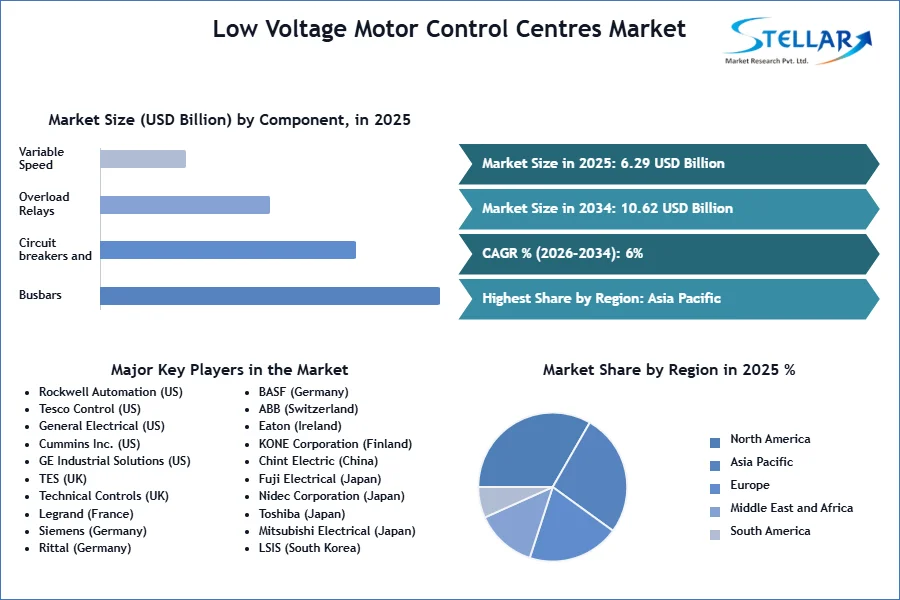

The global Low Voltage Motor Control Centres Market is entering a high-stakes modernization phase as industrial operators overhaul aging electrical distribution panels to cut energy waste and prevent unplanned downtime, according to new market research from Stellar Market Research. Valued at USD 6.29 billion in 2025 and projected to grow at a 6% compound annual growth rate (CAGR) from 2026 to 2034 to reach nearly USD 10.62 billion, low voltage motor control centres (LVMCCs) sit at the center of factory automation, grid reliability, and industrial decarbonization.
Factory floors and utility substations are moving away from standalone electromechanical switchgear toward connected, modular control architectures that tie power protection directly into plant-level analytics. Because electric motor-driven systems account for a large share of industrial electricity consumption, even incremental gains in speed regulation, load balancing, and fault detection translate into measurable operating cost savings.
Key Findings from the Report
-
Market Trajectory: Stellar Market Research places the Low Voltage Motor Control Centres Market at USD 6.29 billion in 2025, forecasting expansion at a 6% CAGR across 2026–2034 to nearly USD 10.62 billion by 2034.
-
Type & Component Shift: Conventional enclosures still anchor large installed bases, while intelligent MCCs, variable frequency drives (VFDs), and motor starters drive value growth through remote diagnostics, load modulation, and consolidated protection.
-
End-User & Installation Dynamics: Manufacturing, utilities, water and wastewater, and process industries sustain steady demand, with retrofit upgrades accelerating alongside new facility builds and data center cooling and power expansion.
-
Regional Leadership: Developed markets sustain 5–7% annual automation investment growth focused on infrastructure modernization, while Asia-Pacific anchors major industrial and grid expansion.
-
Demand-Supply & Buyer Relevance: Factory-tested modular designs shorten commissioning schedules and lower field-wiring errors, giving EPC contractors, plant operators, and industrial investors clearer capital payback and higher uptime.
For further information, click the following link:https://www.stellarmr.com/report/req_sample/low-voltage-motor-control-centres-market/2851
Market Drivers and Restraints
Key Drivers
-
Industrial Automation and Infrastructure Modernization: Manufacturers, utilities, and process plants are expanding automation and upgrading legacy electrical panels to improve throughput, safety, and centralized motor control across complex facilities.
-
Smart Diagnostics and Energy Efficiency: Embedding variable frequency drives, microprocessors, and IIoT telemetry into low voltage motor control centres helps operators trim motor energy draw, detect faults earlier, and schedule maintenance around real operating conditions.
-
Grid Resilience and Decarbonization Mandates: Tighter motor efficiency standards, renewable and grid-upgrade programs, and utility demand-response incentives push industrial facilities to modernize motor control hardware.
Key Restraints
-
Crude Oil Price Volatility and Oil & Gas CAPEX Swings: Fluctuations in crude oil prices can squeeze upstream and downstream capital budgets—sometimes cutting oil and gas CAPEX by 30–40% during downturns—causing operators to delay new motor control projects in favor of basic maintenance.
-
Raw Material Volatility and Alternative Control Architectures: Price swings in metals and electrical components, alongside competition from decentralized or distributed motor control setups, can pressure project margins and slow traditional panel orders.
Technology, Regulation, and Sustainability Trends
Industrial motor control is shifting from isolated hardwired panels to software-connected nodes integrated with PLCs, SCADA, and cloud analytics. Single Pair Ethernet, digital twins, and condition analytics allow engineers to monitor motor health and simulate layouts before physical installation, while industrial cybersecurity standards such as IEC 62443 increasingly shape connected switchgear specifications.
At the same time, stricter efficiency benchmarks—including updated IEC motor efficiency classifications and regional ecodesign rules—reinforce sustainability goals by pairing higher-efficiency motors and drives with smarter control logic to cut electricity consumption and emissions.
Regional Insights
Developed economies across North America and Europe remain key demand centers for automation upgrades, grid modernization, and regulatory-driven retrofits across manufacturing, utilities, and industrial facilities, though labor bottlenecks and permitting timelines can lengthen project execution.
Across Asia-Pacific, countries including India and China—alongside expanding Southeast Asian manufacturing hubs—are gaining strong traction due to industrial expansion, domestic manufacturing incentives, power and grid investments, and large-scale infrastructure builds. Rapid industrial electrification and localized production hubs in the region are shortening equipment delivery cycles and attracting sustained capital deployment.
Recent Industry Developments
-
ABB (2026): Announced an approximately USD 75 million investment in India across manufacturing and R&D—including expanding low-voltage drives capacity in Peenya, Bengaluru—to support localized production and high-growth sectors such as data centers, rail and metro transit, and renewables.
-
ABB (2026): Announced plans to acquire Ziehl-Abegg in a USD 2.65 billion deal to expand fan, motor, and control capabilities for cooling, ventilation, and data center applications, strengthening its position in energy-intensive thermal and motor systems.
-
Eaton (2026): Launched motor analytics software integrated with its Brightlayer platform that uses motor current signature analysis and machine learning to detect motor and pump faults earlier without adding motor-mounted sensors, targeting mining, oil and gas, and manufacturing uptime.
-
Siemens (2026): Unveiled Digital Twin Composer to build large-scale industrial metaverse environments combining simulation, industrial AI, and real-time operational data, helping manufacturers validate plant electrical and mechanical layouts before physical builds.
-
Siemens Limited (2026): Closed the INR 2,200 crore sale of its Low Voltage Motors and Geared Motors business to Innomotics India, sharpening portfolio focus while creating a dedicated low-voltage motor specialist in a key growth market.
Competitive Landscape
The competitive landscape features established global electrical and automation leaders—including ABB, Siemens, Schneider Electric, Rockwell Automation, and Eaton—alongside regional switchgear and panel manufacturers. Leading vendors compete on modular panel architecture, integrated variable speed drives, predictive diagnostics software, and regional manufacturing localization. Rather than competing solely on cabinet hardware, top players increasingly bundle motor protection and control assemblies with digital monitoring, lifecycle services, and software ecosystems to lock in recurring industrial accounts.
Analyst Commentary
"Industrial buyers are no longer buying low voltage motor control centres just to switch and protect motors; they are treating them as data and energy-control hubs that keep critical processes running while trimming power waste," said a Senior Research Analyst at Stellar Market Research. "Suppliers that pair modular factory-built designs and regional localization with practical diagnostics will capture the strongest share as plants modernize through 2034."
Future Outlook
Through 2034, demand for low voltage motor control centres is expected to expand steadily at a 6% CAGR as industrial operators balance brownfield retrofits with new capacity in manufacturing, utilities, and energy-intensive facilities. Capital investment will favor intelligent, modular, and energy-saving configurations that reduce commissioning friction and lower lifecycle operating costs. Regulatory pressure around energy efficiency and grid interaction, paired with advances in connected diagnostics, will continue to raise the technical bar—rewarding vendors with strong supply-chain agility and software integration.
For further information, click the following link:https://www.stellarmr.com/report/req_sample/low-voltage-motor-control-centres-market/2851
About Stellar Market Research
Stellar Market Research is a multifaceted market research and consulting company with professionals from several industries. Some of the industries we cover include medical devices, pharmaceutical manufacturers, science and engineering, electronic components, industrial equipment, technology and communication, cars and automobiles, chemical products and substances, general merchandise, beverages, personal care, and automated systems. To mention a few, we provide market-verified industry estimations, technical trend analysis, crucial market research, strategic advice, competition analysis, production and demand analysis, and client impact studies.
Address
Phase 3, Navale IT Zone, S.No. 51/2A/2, Office No. 202, 2nd floor, Near, Navale Brg, Narhe, Pune, Maharashtra 411041
Email
[email protected]
Mobile
+91 9607365656
