

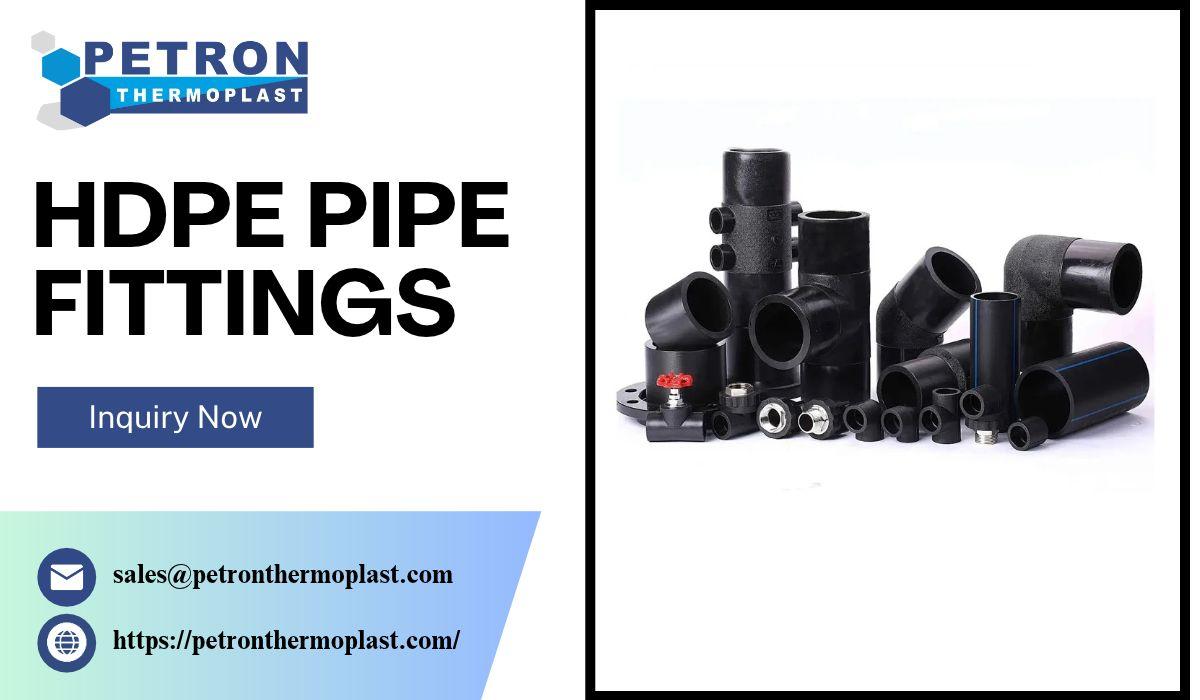

HDPE pipe fittings are widely used in industrial pipeline systems because of their flexibility, durability, and resistance to corrosion. They help connect pipes, change flow direction, create branch lines, and link pipelines with equipment. Proper installation and jointing are essential for maintaining the performance and reliability of an HDPE piping system.
HDPE (High-Density Polyethylene) pipe fittings are used in water distribution, chemical handling, industrial processing, wastewater management, and infrastructure projects. Depending on the pipeline design, these fittings may be connected through butt fusion, electrofusion, mechanical joints, or flange connections.
Petron Thermoplast manufactures industrial thermoplastic piping products and supports HDPE pipe fitting requirements for customized pipeline projects. This guide explains the common HDPE pipe fittings installation and jointing methods, along with important precautions for industrial applications.
What Are HDPE Pipe Fittings?
HDPE pipe fittings are components designed to connect and control the arrangement of HDPE pipelines. They are available in different shapes, sizes, and configurations to meet the requirements of industrial piping systems.
Common HDPE pipe fittings include:
- HDPE Elbow
- HDPE Tee
- HDPE Reducer
- HDPE Flange
- HDPE Coupling
- HDPE End Cap
- HDPE Manifold
- HDPE Fabricated Fittings
- HDPE Y Tee and custom fittings
Importance of Proper HDPE Pipe Fittings Installation
Correct installation helps maintain the structural integrity of the pipeline and reduces the possibility of leakage or joint failure.
Poor installation may result in misalignment, weak fusion joints, damaged fitting surfaces, or unnecessary stress on the pipeline.
A proper installation process helps:
- Maintain secure pipe connections
- Reduce leakage risks
- Support consistent fluid flow
- Improve pipeline reliability
- Reduce maintenance requirements
- Extend the service life of the piping system
Common HDPE Pipe Fittings Jointing Methods
Different jointing methods are used for HDPE piping systems. The suitable method depends on the fitting design, pipe dimensions, installation conditions, and project requirements.
- Butt Fusion Jointing
HDPE pipe butt fusion welding machine industrial pipe jointing equipment
Butt fusion is a commonly used method for joining compatible HDPE pipes and fittings. It creates a joint by heating the prepared pipe and fitting ends and pressing them together under controlled conditions.
Basic butt fusion procedure:
- Check that the pipe and fitting are compatible for butt fusion.
- Inspect the ends for damage, contamination, or irregularities.
- Secure the pipe and fitting in the fusion machine.
- Align the components correctly.
- Face the ends using the approved facing tool.
- Clean the prepared surfaces according to the procedure.
- Heat the ends using the specified heating plate and process settings.
- Join the heated ends under the required fusion pressure.
- Allow the joint to cool without disturbing it.
Butt fusion is commonly used for suitable HDPE fittings such as elbows, tees, reducers, and fabricated components with compatible fusion ends.
The fusion parameters must be selected according to the pipe and fitting dimensions, material, equipment, and applicable jointing procedure.
- Electrofusion Jointing
HDPE electrofusion coupler fitting with electrofusion welding control unit industrial
Electrofusion is a jointing method that uses specially designed HDPE fittings containing embedded electrical heating elements.
When connected to a compatible electrofusion control unit, the heating elements generate heat and fuse the fitting with the prepared pipe surface.
Basic electrofusion procedure:
- Confirm that the electrofusion fitting matches the pipe size and material.
- Cut the pipe end squarely.
- Mark the required insertion depth.
- Scrape the pipe surface as specified by the fitting manufacturer.
- Clean the prepared surface using the approved cleaning method.
- Insert the pipe into the fitting without contamination.
- Secure the joint using suitable alignment and clamping equipment.
- Connect the electrofusion control unit.
- Run the prescribed fusion cycle.
- Allow the joint to cool for the specified period before handling or testing.
- Flange Jointing Method
HDPE pipe stub end backing ring flange industrial pipe connection. Flange connections are used when a pipeline needs to connect with valves, pumps, tanks, equipment, or another flanged piping component. An HDPE flange assembly commonly includes a compatible stub end or flange adaptor and a backing ring.
Basic flange installation procedure:
- Confirm the flange dimensions and pressure requirements.
- Check that the mating flanges are compatible.
- Position the gasket correctly.
- Align the flange faces without forcing the pipeline.
- Insert the required bolts and nuts.
- Tighten the bolts gradually in a suitable sequence.
- Follow the specified torque and installation procedure.
Flanged connections are useful where dismantling or maintenance access is required. Avoid excessive bolt tightening, as it may damage the flange assembly or create uneven loading.
- Mechanical Jointing Method
Mechanical joints use compatible connection components to connect HDPE pipes or fittings without directly fusing the joint.
Depending on the product design, mechanical connections may use compression fittings, adaptors, or other approved joining arrangements.
These connections can be useful for selected smaller-diameter pipelines, temporary arrangements, maintenance work, or installations where fusion equipment is not practical.
Before installation, verify the fitting's pressure rating, pipe compatibility, and manufacturer's assembly instructions.
Preparation Before Installing HDPE Pipe Fittings
Preparation is an important part of the installation process. Before jointing begins, the installation team should inspect the materials and confirm the project requirements.
Check Pipe and Fitting Compatibility
Confirm that the pipe and fitting are compatible in terms of material grade, dimensions, SDR, and jointing method.
Inspect the Product
Check for cracks, deformation, scratches, contamination, or other visible damage. Damaged components should not be installed without proper technical evaluation.
Prepare the Installation Area
Keep the jointing area clean and organized. Protect prepared surfaces from dust, moisture, oil, and other contaminants.
Verify Equipment
Use suitable fusion machines, facing tools, clamps, cleaning materials, and alignment equipment. Equipment should be maintained and operated according to its instructions.
Important Installation Precautions
For reliable HDPE pipe fittings installation, follow these precautions:
- Use compatible pipes and fittings.
- Follow the approved fusion procedure.
- Keep jointing surfaces clean.
- Avoid incorrect pipe alignment.
- Do not disturb fusion joints during cooling.
- Prevent excessive stress on the fitting.
- Support the pipeline properly.
- Avoid forcing fittings into position.
- Follow the manufacturer's installation instructions.
- Inspect completed joints before commissioning.
For chemical or industrial applications, confirm that the HDPE material is suitable for the fluid, concentration, temperature, and operating pressure.
Quality Inspection After Jointing
After installation, inspect the joints to confirm that they meet the project requirements.
Quality checks may include:
- Visual inspection of the joint
- Alignment and dimensional checks
- Review of fusion records, where applicable
- Verification of cooling time
- Inspection for visible defects
- Pressure or leak testing according to the approved project procedure
Testing should be carried out using the applicable standards and engineering requirements. The test pressure and duration must not be selected without considering the pipeline design and component ratings.
Industrial Applications of HDPE Pipe Fittings
HDPE pipe fittings are used in various industrial and infrastructure applications, including:
Water Supply Systems
HDPE fittings connect pipelines used for water distribution and infrastructure networks.
Wastewater Treatment
Suitable HDPE components are used in wastewater collection and treatment systems.
Chemical Processing
HDPE fittings may be used in selected chemical transfer applications where material compatibility has been confirmed.
Industrial Manufacturing
They connect process pipelines, equipment, and utility systems within manufacturing facilities.
Infrastructure Projects
HDPE fittings support pipeline layouts for large-scale industrial and infrastructure installations.
Why Choose Petron Thermoplast for HDPE Pipe Fittings?
Petron Thermoplast focuses on industrial thermoplastic piping products and customized project requirements.
Customers can discuss their HDPE pipe fitting requirements, including:
- Industrial HDPE pipe fittings
- Fabricated fitting configurations
- Project-specific dimensions
- Bulk quantity requirements
- Technical specification-based selection
- Worldwide delivery and export support
For customized or bulk orders, sharing the fitting type, pipe size, SDR, connection method, quantity, and application details helps ensure accurate product evaluation.
Conclusion
HDPE pipe fittings installation and jointing methods play an important role in the reliability of industrial pipeline systems. Butt fusion, electrofusion, flange connections, and mechanical jointing are commonly used methods, each suited to specific product designs and installation conditions.
Selecting the correct jointing method and following proper preparation, alignment, fusion, cooling, and inspection procedures can help reduce installation problems and support dependable pipeline performance. Petron Thermoplast manufactures industrial thermoplastic piping products and supports HDPE pipe fitting requirements for customized and bulk industrial projects. Contact Petron Thermoplast with your technical specifications and project requirements.
Frequently Asked Questions
- What are the common HDPE pipe fittings jointing methods?
Common methods include butt fusion, electrofusion, flange connections, and mechanical jointing. The suitable method depends on the fitting design and project requirements.
- What is butt fusion in HDPE piping?
Butt fusion joins compatible HDPE pipe and fitting ends by heating the prepared surfaces and joining them under controlled conditions.
- When is electrofusion used for HDPE pipe fittings?
Electrofusion is often used for compatible fittings in pipeline repairs, branch connections, and installations where access for butt fusion equipment is limited.
- Can HDPE pipe fittings be connected using flanges?
Yes. Compatible HDPE flange adaptors or stub ends with backing rings can be used to connect HDPE piping with suitable flanged equipment or components.
- Why is surface preparation important in HDPE jointing?
Proper preparation helps remove contamination and supports a reliable fusion interface. Incorrect preparation can affect joint quality and performance.
