

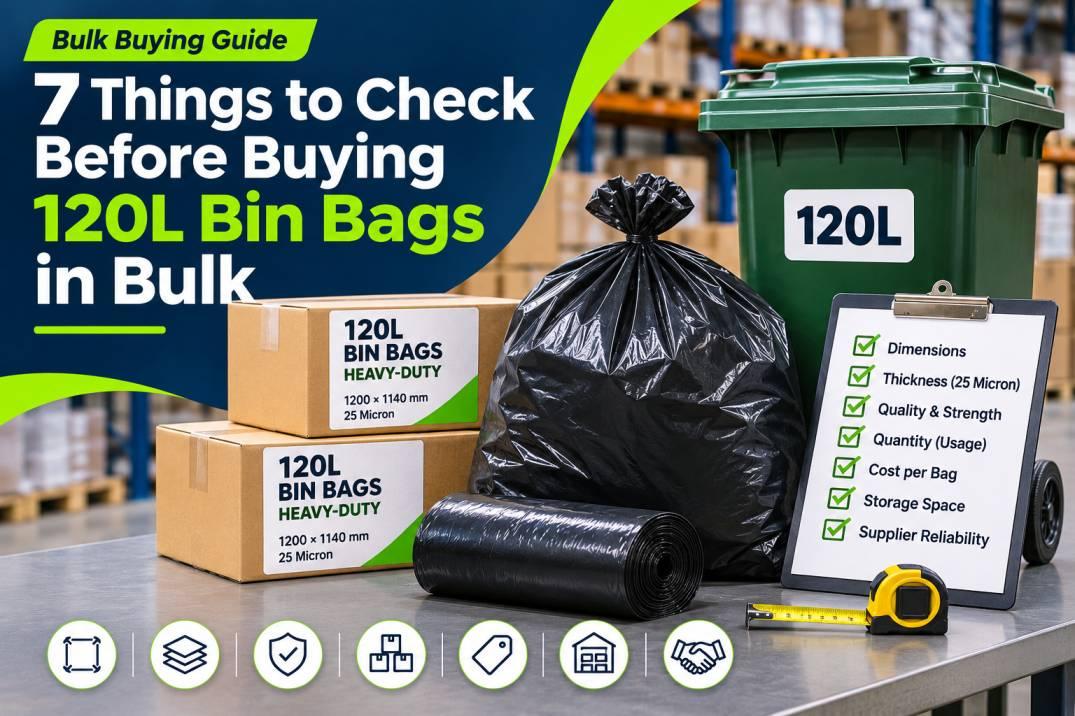

For businesses that generate significant amounts of waste every day, purchasing bin bags in bulk makes practical and financial sense. It helps maintain consistent stock levels, reduces frequent purchasing and supports uninterrupted cleaning operations.
However, buying the wrong bin bags in large quantities can create more problems than it solves. Poorly fitting liners, insufficient thickness and unreliable bag construction can result in waste spills, additional labour and unnecessary expenses.
Whether you manage a commercial cleaning company, warehouse, restaurant, childcare centre or office building, choosing suitable 120l bin bags requires careful consideration.
Here are seven important things businesses should check before placing a bulk order.
1. Check the Actual Bin Liner Dimensions
One of the most common purchasing mistakes is assuming that every 120-litre bin bag has the same dimensions.
Although the capacity rating provides a useful starting point, manufacturers may produce liners with different widths, lengths and construction styles.
Before ordering, measure your existing waste containers and check the following:
-
Width and depth of the bin opening.
-
Internal height of the bin.
-
Additional material required to fold over the rim.
-
Sufficient length for securing the bag after use.
For example, Turnstone Products offers heavy-duty 120-litre bin liners measuring 1200 × 1140 mm.
Checking these measurements before purchasing can help prevent bags from slipping inside bins, stretching excessively or failing to reach the bottom.
2. Choose the Right Thickness for Your Waste
Bin liner thickness is an important consideration when purchasing commercial waste management supplies.
Thickness is typically measured in microns. However, a higher micron rating does not automatically guarantee better performance, as material quality and manufacturing methods also influence durability.
Different workplaces generate different types of waste.
|
Waste type |
Recommended liner characteristics |
|
Paper and lightweight packaging |
Suitable for light general waste |
|
Everyday commercial waste |
Reliable strength and flexibility |
|
Food scraps and damp waste |
Good tear resistance and reliable seals |
|
Warehouse general waste |
Improved puncture and tear resistance |
|
Mixed workplace rubbish |
Suitable durability for varied contents |
Heavy-duty liners with a thickness of 25 microns can be a practical option for many everyday commercial waste applications.
Businesses should assess the actual weight and nature of their waste before selecting a particular thickness.
3. Assess Material Quality and Bag Strength
Two bin bags with identical dimensions and thickness may perform differently.
Material quality, flexibility, manufacturing consistency and seal construction all contribute to overall performance.
When comparing 120l bin liners, consider whether the bags can withstand normal workplace handling without splitting or stretching excessively.
What Should Businesses Look For?
-
Consistent material thickness.
-
Reliable bottom seals.
-
Suitable flexibility during installation.
-
Resistance to everyday tearing and punctures.
-
Consistent quality between individual bags.
Low-quality liners may initially appear more economical. However, frequent bag replacements, double bagging and additional cleaning can increase the overall cost of waste management.
Testing a sample before purchasing in bulk can help identify these potential problems.
4. Calculate Your Actual Monthly Bin Bag Requirements
Bulk purchasing can help businesses manage costs, but ordering excessive quantities may create unnecessary storage requirements and tie up working capital.
Before placing an order, review how many bins your workplace uses and how frequently each liner is replaced.
Consider factors such as:
-
Number of active waste bins.
-
Daily liner replacement frequency.
-
Operating days per month.
-
Seasonal increases in waste generation.
-
Unexpected replacements and emergency stock requirements.
Example of Monthly Bin Liner Consumption
|
Requirement |
Quantity |
|
Number of bins |
15 |
|
Liner changes per bin per day |
2 |
|
Operating days per month |
26 |
|
Monthly consumption |
780 bags |
|
Additional 10% reserve stock |
78 bags |
|
Estimated monthly requirement |
858 bags |
Calculating consumption helps businesses maintain appropriate inventory levels without regularly overordering or running out of essential supplies.
5. Compare the Cost Per Bag, Not Just the Carton Price
When comparing wholesale bin liner suppliers, businesses should look beyond the advertised carton price.
Different suppliers may offer different quantities per carton, making direct price comparisons misleading.
Example of Bulk Bin Bag Pricing
|
Purchasing factor |
Supplier A |
Supplier B |
|
Carton price |
$60 |
$75 |
|
Bags per carton |
100 |
150 |
|
Cost per bag |
$0.60 |
$0.50 |
|
Cost per 1,000 bags |
$600 |
$500 |
Prices are illustrative examples in Australian dollars.
Although Supplier B has a higher carton price, the individual bag cost is lower.
However, businesses should also consider delivery charges, product durability, replacement frequency and the potential labour costs associated with bag failures.
The lowest purchase price does not always represent the lowest operating cost.
6. Check Packaging, Storage and Stock Availability
Bulk orders require appropriate storage and reliable inventory management.
Before purchasing, businesses should confirm how the bin liners are packaged and whether the quantities are suitable for their available storage space.
When ordering 120 litre bin liners, check whether the supplier provides clear information about carton quantities, product specifications and stock availability.
Best Practices for Storing Bulk Bin Bags
-
Store cartons in a clean, dry location.
-
Keep liners away from direct sunlight and excessive heat.
-
Rotate older inventory before opening new cartons.
-
Avoid storing products near sharp objects.
-
Maintain a minimum reserve stock level.
Businesses operating across multiple locations should also consider how bulk supplies will be distributed between facilities.
Effective inventory management can reduce emergency purchases and prevent interruptions to daily cleaning activities.
7. Evaluate Supplier Reliability and Delivery Services
A dependable cleaning supplier is particularly important for businesses that rely on consistent waste management supplies.
Unexpected stock shortages, delayed deliveries or inconsistent product quality can disrupt routine cleaning schedules.
Before choosing a supplier, ask the following questions:
-
Are product specifications clearly available?
-
Can the supplier accommodate regular bulk orders?
-
Are delivery areas and estimated delivery times clearly communicated?
-
Can the supplier support changing purchasing requirements?
-
Are other commercial cleaning supplies available from the same supplier?
Working with a reliable supplier can simplify purchasing, reduce administrative work and support more predictable inventory management.
Why Choose Turnstone Products for Bulk Bin Bags?
Turnstone Products understands that commercial businesses need dependable cleaning and waste management supplies to keep their operations running smoothly.
Businesses can benefit from:
-
Heavy-duty 120-litre bin liners with clearly defined specifications.
-
Bulk purchasing options for commercial requirements.
-
A comprehensive range of cleaning and hygiene supplies.
-
Next-day delivery across eligible Perth locations, from Yanchep to Mandurah.
-
Australia-wide delivery options.
-
Support with ongoing commercial supply requirements.
Sourcing multiple cleaning essentials from one supplier can also help businesses streamline procurement and reduce the complexity of managing separate orders.
Frequently Asked Questions
Is it cheaper to buy 120L bin bags in bulk?
Bulk purchasing can reduce the individual bag cost and the frequency of ordering. However, businesses should compare carton quantities, delivery charges and product performance before purchasing.
Are 25-micron bin liners suitable for commercial use?
Heavy-duty 25-micron liners can be suitable for many general commercial waste applications. Suitability depends on waste weight, material quality and the presence of sharp objects.
How many bin bags should a business keep in stock?
Stock requirements depend on the number of bins, replacement frequency, delivery lead times and expected waste volumes. Maintaining a reasonable reserve can help prevent unexpected shortages.
Should I test bin bags before placing a bulk order?
Yes. Testing a sample helps confirm the correct fit, material strength and suitability for your workplace's waste management requirements.
Conclusion
Buying 120L bin bags in bulk is an effective way to simplify commercial waste management when purchasing decisions are based on actual operational requirements.
Checking bag dimensions, thickness, material quality, consumption levels, unit pricing, storage requirements and supplier reliability can help businesses avoid unnecessary expenses.
The right bin liner should provide consistent performance, practical handling and good long-term value rather than simply offering the lowest upfront price.
About Turnstone Products
Turnstone Products is a Perth-based commercial cleaning supplies provider supporting businesses across hospitality, childcare, healthcare, education, warehousing, property management and other industries.
With a focus on practical cleaning solutions, dependable bulk supply and efficient delivery services, Turnstone Products helps businesses maintain consistent access to essential cleaning, hygiene and waste management products across Australia.
