

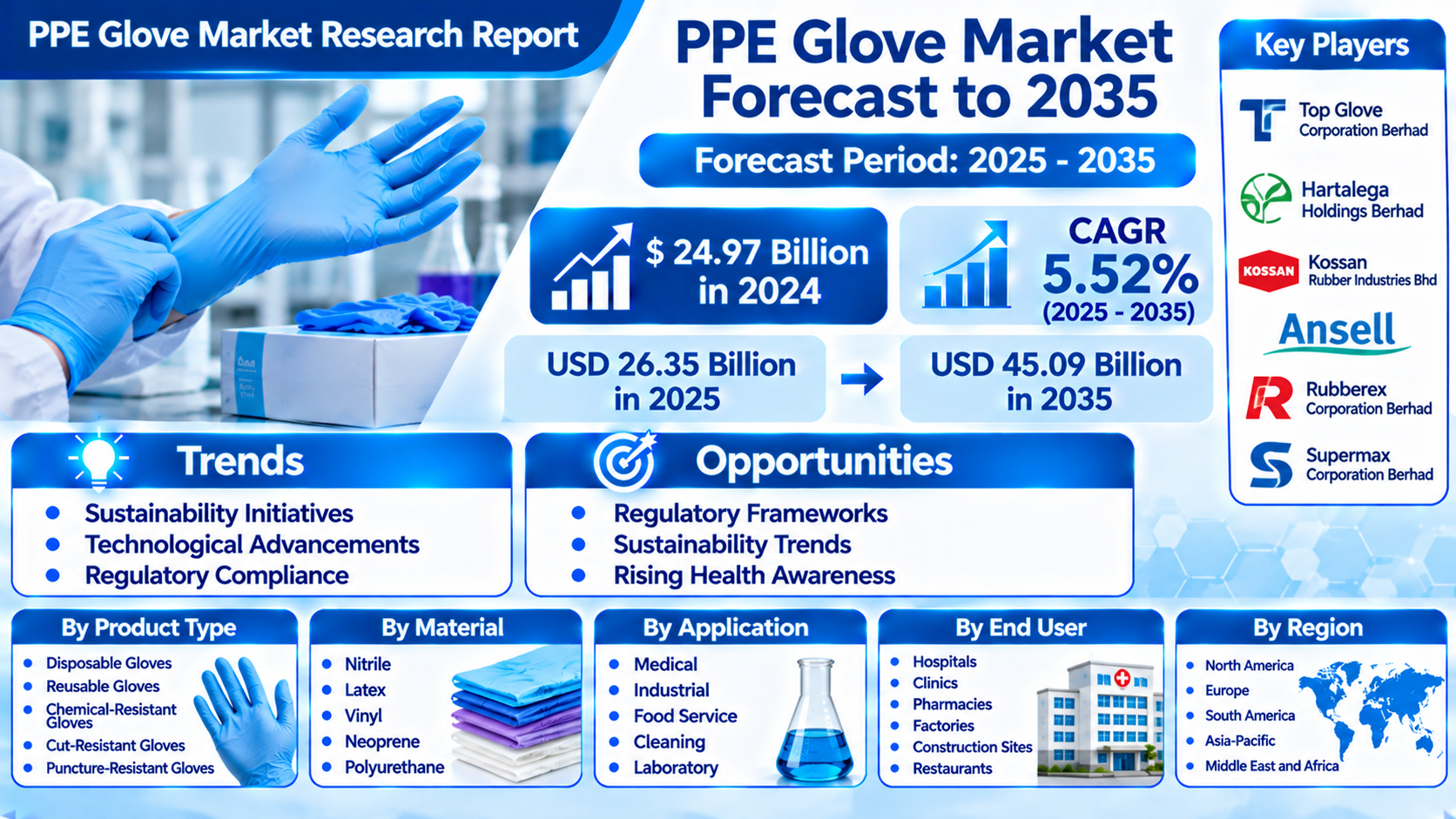

According to Market Research Future® (MRFR), the PPE Glove Market is projected to grow from USD 26.35 Billion in 2025 to USD 45.09 Billion by 2035, registering a compound annual growth rate (CAGR) of 5.52% during the forecast period from 2025 to 2035. The market was valued at USD 24.97 Billion in 2024, reflecting the importance of protective hand equipment across medical, industrial, food service, cleaning and laboratory environments. Demand is supported by workplace safety requirements, regulatory compliance, rising health awareness and the continued need for protective equipment across different end-user settings.
PPE Glove Market Overview
PPE gloves are used to provide hand protection in environments where workers and other users may encounter occupational, operational or hygiene-related risks. Their role across healthcare facilities, factories, construction sites, restaurants and other workplaces makes them an important category within the broader personal protective equipment industry. The market includes disposable and reusable products as well as gloves designed for specific protective requirements, including chemical resistance, cut resistance and puncture resistance.
The expansion from USD 26.35 Billion in 2025 to USD 45.09 Billion by 2035 indicates sustained demand over the forecast period. The projected 5.52% CAGR reflects the continued relevance of protective gloves across industries with different operating conditions. Requirements vary by application, which supports demand for multiple product types and material options rather than a single standardized glove category.
Market Drivers and Industry Trends
Regulatory compliance is an important factor influencing the PPE glove market. Organizations operating in healthcare, manufacturing, construction, food service and laboratory environments must consider applicable safety requirements when selecting protective equipment. Regulatory frameworks and workplace policies can therefore influence purchasing decisions, product specifications and replacement practices. As businesses maintain attention on employee protection and operational standards, gloves remain a recurring procurement category.
Rising health awareness also contributes to market demand. Healthcare institutions and other facilities place importance on protective products as part of their broader hygiene and safety practices. Hospitals, clinics and pharmacies represent relevant end-user groups, while food service and cleaning applications extend demand into settings where hand protection is part of routine operations.
Sustainability initiatives are another notable market trend. Manufacturers and buyers are increasingly attentive to environmental considerations in product development and procurement. This creates opportunities for the industry to consider material choices, production approaches and product lifecycle requirements. Technological advancements also influence the market by encouraging continued development across glove materials and product categories. Regulatory compliance remains closely connected to these developments, as product requirements and purchasing expectations can vary across applications.
Market Segmentation Analysis
The PPE glove market is segmented by product type, material, application and end user. Product categories include disposable gloves, reusable gloves, chemical-resistant gloves, cut-resistant gloves and puncture-resistant gloves. Disposable and reusable options address different usage requirements, while specialized protective gloves serve applications in which resistance to particular workplace hazards is a consideration.
Material segmentation includes nitrile, latex, vinyl, neoprene and polyurethane. The availability of several material categories allows buyers to evaluate gloves according to their intended application and operational requirements. Material selection is relevant across medical, industrial, food service, cleaning and laboratory settings, where purchasing criteria may differ.
By application, the market covers medical, industrial, food service, cleaning and laboratory uses. Medical applications include demand from healthcare environments, while industrial applications extend across workplaces where protective equipment forms part of occupational safety practices. Food service, cleaning and laboratory settings provide additional areas of use.
The end-user categories comprise hospitals, clinics, pharmacies, factories, construction sites and restaurants. These users have different purchasing needs and operating conditions, creating demand for a broad range of glove products. The diversity of end users also contributes to the market's varied product and material structure.
Regional Market Outlook
The market is analyzed across North America, Europe, South America, Asia-Pacific, and the Middle East and Africa. These regions represent diverse healthcare systems, industrial activities, workplace environments and regulatory frameworks. Demand conditions can therefore vary according to local industry composition, safety requirements and purchasing practices.
North America and Europe form part of the established regional landscape for protective equipment, while South America, Asia-Pacific, and the Middle East and Africa provide additional markets across healthcare and industrial applications. Regional demand is influenced by the presence of relevant end-user industries and the extent to which organizations prioritize workplace protection and regulatory compliance. The available market outlook identifies these five regions without specifying individual regional market shares or rankings.
Key Companies in the PPE Glove Market
The competitive landscape includes Top Glove Corporation Berhad, Hartalega Holdings Berhad, Kossan Rubber Industries Bhd, Ansell Limited, Rubberex Corporation Berhad and Supermax Corporation Berhad. These companies are identified among the key market participants.
Competition takes place across product categories and material offerings, with manufacturers serving a range of applications and end-user groups. Sustainability initiatives, technological advancements and regulatory compliance are relevant industry considerations that can shape product development and market positioning. Companies operating in this environment must address varied requirements across disposable, reusable and specialized protective gloves.
Growth Opportunities and Future Outlook
The PPE glove market presents opportunities associated with regulatory frameworks, sustainability trends and rising health awareness. Regulatory developments can reinforce the importance of protective equipment across workplaces, while greater attention to health and safety can support continued demand from healthcare and non-healthcare users.
Sustainability trends provide another area for market development as manufacturers and buyers consider environmental priorities alongside product requirements. Technological advancements may also support changes in material development and product offerings. With demand spread across medical, industrial, food service, cleaning and laboratory applications, suppliers operate in a market serving a wide range of protective needs.
The market's projected increase to USD 45.09 Billion by 2035, supported by a 5.52% CAGR from 2025 to 2035, reflects the continuing role of protective gloves across workplaces. Regulatory compliance, health awareness, sustainability initiatives and technological advancements are expected to remain important considerations shaping the industry's development.
