


How Rising Pet Ownership and Growing Awareness of Parasite Prevention Are Driving the Pet Insect Repellent Market
Overview of the Pet Insect Repellent Market
The global Pet Insect Repellent Market is gaining importance as pet owners increasingly prioritize animal health, hygiene, and protection against insects and external parasites. Fleas, ticks, mosquitoes, flies, and other insects can cause skin irritation, allergic reactions, discomfort, and, in some cases, transmit diseases to companion animals.
Growing awareness of preventive pet healthcare is encouraging demand for insect repellent products designed for dogs, cats, and other companion animals. Manufacturers are expanding their portfolios with sprays, collars, shampoos, spot-on formulations, powders, and other topical solutions to address different pet care requirements.
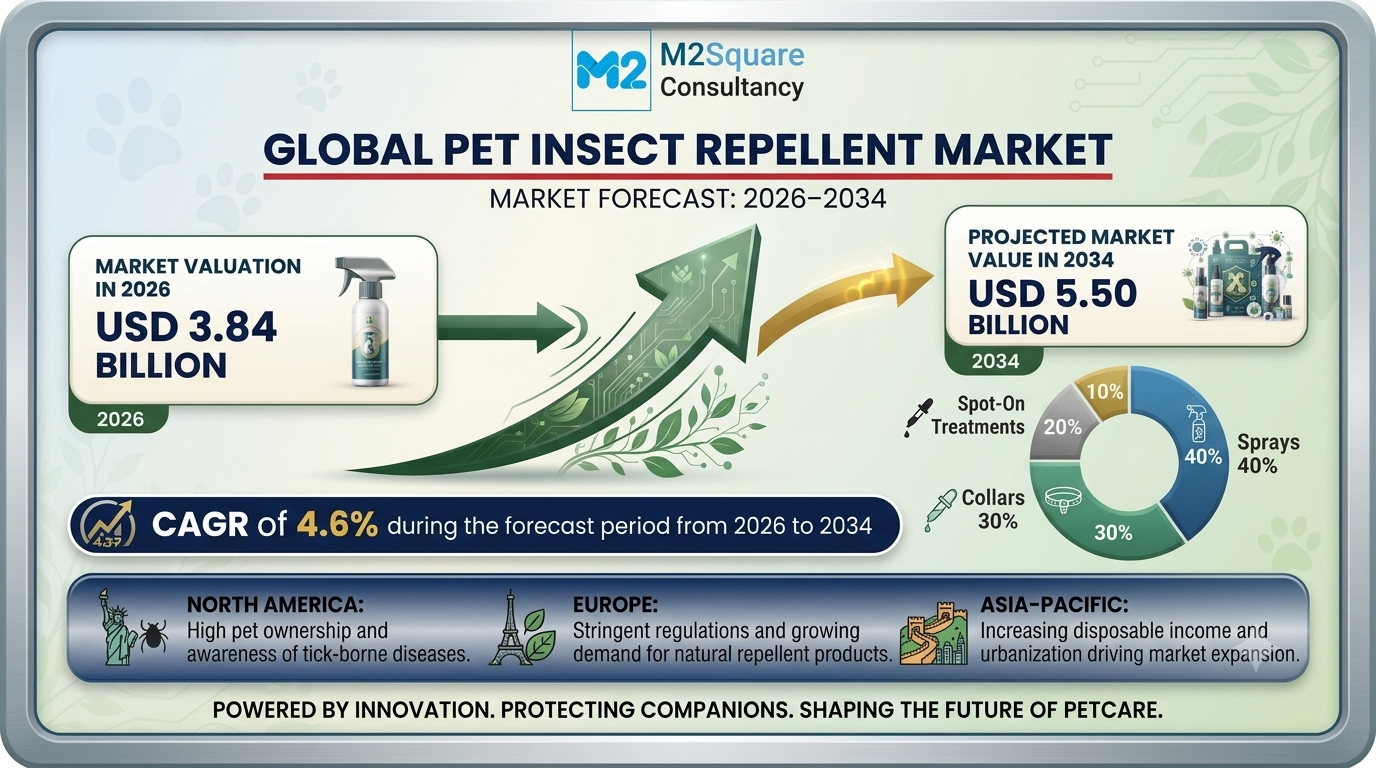
According to market estimates, the global Pet Insect Repellent Market was valued at USD 3.84 billion in 2026 and is projected to reach USD 5.50 billion by 2034, registering a CAGR of 4.6% during 2026–2034.
Increasing pet adoption, rising spending on companion animal healthcare, expanding veterinary services, and demand for convenient parasite prevention solutions are supporting market development. Product innovation and growing availability through online and offline retail channels are also creating opportunities for manufacturers.
For businesses seeking deeper insights into consumer demand, competitive positioning, and industry developments, market research and business intelligence can support strategic planning across the global pet care industry.
Pet Insect Repellent Market Snapshot
|
Market Parameter |
Details |
|---|---|
|
Market |
Pet Insect Repellent Market |
|
Market Size (2026) |
USD 3.84 Billion |
|
Projected Market Size (2034) |
USD 5.50 Billion |
|
CAGR (2026–2034) |
4.6% |
|
Forecast Period |
2026–2034 |
|
Industry |
Pet Care and Animal Health |
|
Key Products |
Sprays, collars, shampoos, spot-on treatments and powders |
Request Sample:
https://m2squareconsultancy.com/request-sample/pet-insect-repellent-market/1024
Key Growth Drivers of the Pet Insect Repellent Market
1. Increasing Pet Ownership Worldwide
The growing adoption of dogs, cats, and other companion animals is expanding the customer base for pet care products. Pet owners are increasingly treating animals as family members and investing in their health, comfort, and daily care.
This shift is supporting demand for preventive products, including insect repellents that help protect pets from fleas, ticks, mosquitoes, and other pests.
2. Growing Awareness of Flea and Tick Prevention
External parasites can affect animal health and create discomfort for pets. Fleas and ticks may cause irritation, allergic skin conditions, and transmit certain diseases.
As awareness of these risks increases, pet owners are paying greater attention to regular parasite prevention. Veterinary recommendations and educational campaigns are also encouraging the use of appropriate insect-control products.
3. Rising Spending on Preventive Pet Healthcare
Pet owners are increasingly spending on preventive healthcare rather than relying only on treatment after health problems develop.
This trend is supporting demand for easy-to-use repellent products, particularly formulations that fit into regular grooming and pet care routines. Veterinary clinics, pet pharmacies, and specialty retailers play an important role in product awareness and distribution.
4. Expansion of E-commerce and Pet Specialty Retail
Online platforms provide consumers with access to a wider range of pet insect repellent products. Product comparisons, customer reviews, subscription services, and home delivery are improving purchasing convenience.
Specialty pet stores and veterinary retail channels are also strengthening product accessibility, helping established brands and emerging manufacturers reach new customer groups.
Emerging Trends Shaping the Pet Insect Repellent Market
Growing Interest in Plant-based and Naturally Positioned Products
Some pet owners are showing interest in products marketed with botanical ingredients and naturally derived formulations. Manufacturers are exploring plant-based ingredients and alternative product positioning to address this demand.
However, natural ingredients are not automatically safe for every animal. Product suitability and application instructions remain important, particularly for cats and other sensitive pets.
Innovation in Long-lasting Repellent Products
Convenience is influencing product development. Manufacturers are focusing on formulations and delivery formats designed to provide consistent protection and reduce the need for frequent application, while following product-specific safety and usage requirements.
Increasing Focus on Pet-safe Formulations
Safety is a major purchasing consideration. Companies are emphasizing appropriate ingredient selection, clear labeling, dosage guidance, and veterinary compatibility.
Products designed specifically for dogs should not automatically be assumed safe for cats. Species-specific formulations and label instructions are essential.
Growth of Integrated Pet Care Solutions
Pet care companies are increasingly connecting grooming, hygiene, parasite prevention, and veterinary services. This creates opportunities for brands to offer complementary products and build stronger customer relationships.
Market Segmentation
The Pet Insect Repellent Market can be analyzed across several major categories:
|
Segmentation |
Key Categories |
|---|---|
|
By Pet Type |
Dogs, cats, other companion animals |
|
By Product Type |
Sprays, collars, shampoos, spot-on products, powders and other formulations |
|
By Ingredient Type |
Synthetic-based and plant-derived formulations |
|
By Distribution Channel |
Veterinary clinics, pet specialty stores, supermarkets, online retail |
|
By Application |
Flea, tick, mosquito, fly and other insect protection |
Demand patterns vary according to pet species, local insect exposure, climate, product preferences, and veterinary recommendations.
Regional Outlook
North America: Strong pet ownership, established veterinary care networks, and consumer spending on companion animal health support demand for pet insect repellent products.
Europe: Growing attention to pet welfare, product quality, and preventive animal healthcare is contributing to market development.
Asia-Pacific: Urbanization, increasing disposable incomes, rising pet adoption, and expanding online pet product distribution are creating growth opportunities.
Latin America: Wider access to pet healthcare products and growing awareness of parasite prevention are supporting market expansion.
Middle East & Africa: Developing pet care retail networks, increasing availability of veterinary services, and changing consumer preferences are creating opportunities for manufacturers.
Competitive Landscape and Key Companies
The competitive landscape includes animal health companies, veterinary pharmaceutical manufacturers, and specialized pet care brands. Companies compete through product innovation, distribution expansion, brand trust, and investments in animal health research.
Notable companies operating in the broader pet health and parasite-control landscape include:
-
Elanco Animal Health Incorporated
-
Zoetis Inc.
-
Boehringer Ingelheim International GmbH
-
Merck & Co., Inc. (Animal Health)
-
Central Garden & Pet Company
-
PetIQ, Inc.
-
Beaphar B.V.
-
Virbac
-
Sergeant's Pet Care Products
-
The Hartz Mountain Corporation
These companies participate in different areas of animal health and pet care. This list is illustrative and does not represent a verified ranking of market share or confirm that every company derives revenue specifically from insect repellents.
Challenges in the Pet Insect Repellent Market
Despite steady growth prospects, manufacturers face several challenges:
-
Product safety requirements: Formulations must be suitable for the intended animal species and comply with applicable regulations.
-
Consumer awareness: Pet owners need clear information about ingredients, application methods, and product limitations.
-
Regulatory compliance: Product registration, labeling, and efficacy requirements can differ across countries and product categories.
-
Competition: Established brands and new market entrants create pressure on pricing and differentiation.
-
Ingredient and manufacturing costs: Sourcing suitable ingredients and maintaining consistent product quality can affect profitability.
Future Opportunities in the Pet Insect Repellent Market
The market offers opportunities for manufacturers that focus on safety, innovation, and changing pet owner preferences.
Key opportunities include:
-
Developing species-specific insect repellent formulations.
-
Expanding convenient sprays, collars, and topical product formats.
-
Investing in research on effective plant-derived ingredients.
-
Strengthening partnerships with veterinary clinics and pet specialty retailers.
-
Expanding e-commerce distribution and subscription-based purchasing.
-
Improving product education through transparent labeling and usage guidance.
-
Developing products for different climates and regional parasite-control requirements.
Companies that combine reliable product performance, responsible formulation practices, and strong distribution networks may be better positioned to capture future market opportunities.
Frequently Asked Questions (FAQs)
1. What is the projected size of the Pet Insect Repellent Market by 2034?
The global Pet Insect Repellent Market is projected to reach USD 5.50 billion by 2034.
2. What is the expected CAGR of the Pet Insect Repellent Market?
The market is expected to register a CAGR of 4.6% from 2026 to 2034.
3. What factors are driving the Pet Insect Repellent Market?
Increasing pet ownership, rising awareness of flea and tick prevention, higher spending on preventive pet healthcare, and expanding online retail are key growth drivers.
4. Which products are included in the market?
Major product categories include insect repellent sprays, collars, shampoos, spot-on formulations, powders, and other pet protection products.
5. Which animals are covered by pet insect repellent products?
Products are primarily developed for dogs and cats, with certain formulations also designed for other companion animals. Product suitability depends on the specific formulation and label instructions.
6. What are the major opportunities in this market?
Species-specific formulations, convenient delivery formats, plant-derived ingredients, veterinary partnerships, and e-commerce expansion represent important opportunities.
Explore the Pet Insect Repellent Market Report
https://m2squareconsultancy.com/reports/pet-insect-repellent-market
Conclusion
The global Pet Insect Repellent Market is expected to experience steady growth as pet owners increasingly prioritize preventive healthcare, parasite protection, and animal hygiene. Its projected expansion from USD 3.84 billion in 2026 to USD 5.50 billion by 2034 reflects the growing importance of specialized pet care products.
Innovation in product formulations, increasing veterinary awareness, and wider access through online and specialty retail channels are expected to influence the industry's development. Manufacturers that prioritize product safety, clear labeling, and effective parasite prevention solutions can strengthen their position in this evolving market.
About M2Square Consultancy
M2Square Consultancy is a market research and business intelligence company providing syndicated reports, custom research, competitive intelligence, market sizing, trend analysis, and strategic insights across multiple industries.
At M2Square, we don’t just study markets — we decode them.
Author: Shubham
Senior Market Research Analyst | M2Square Consultancy
Contact:
Email: [email protected]
Phone (India): +91 80978 74280
Phone (US): +1 929 447 0100
Explore More Related Topics:
Satellite Data Services Market
Artificial Intelligence Market
