

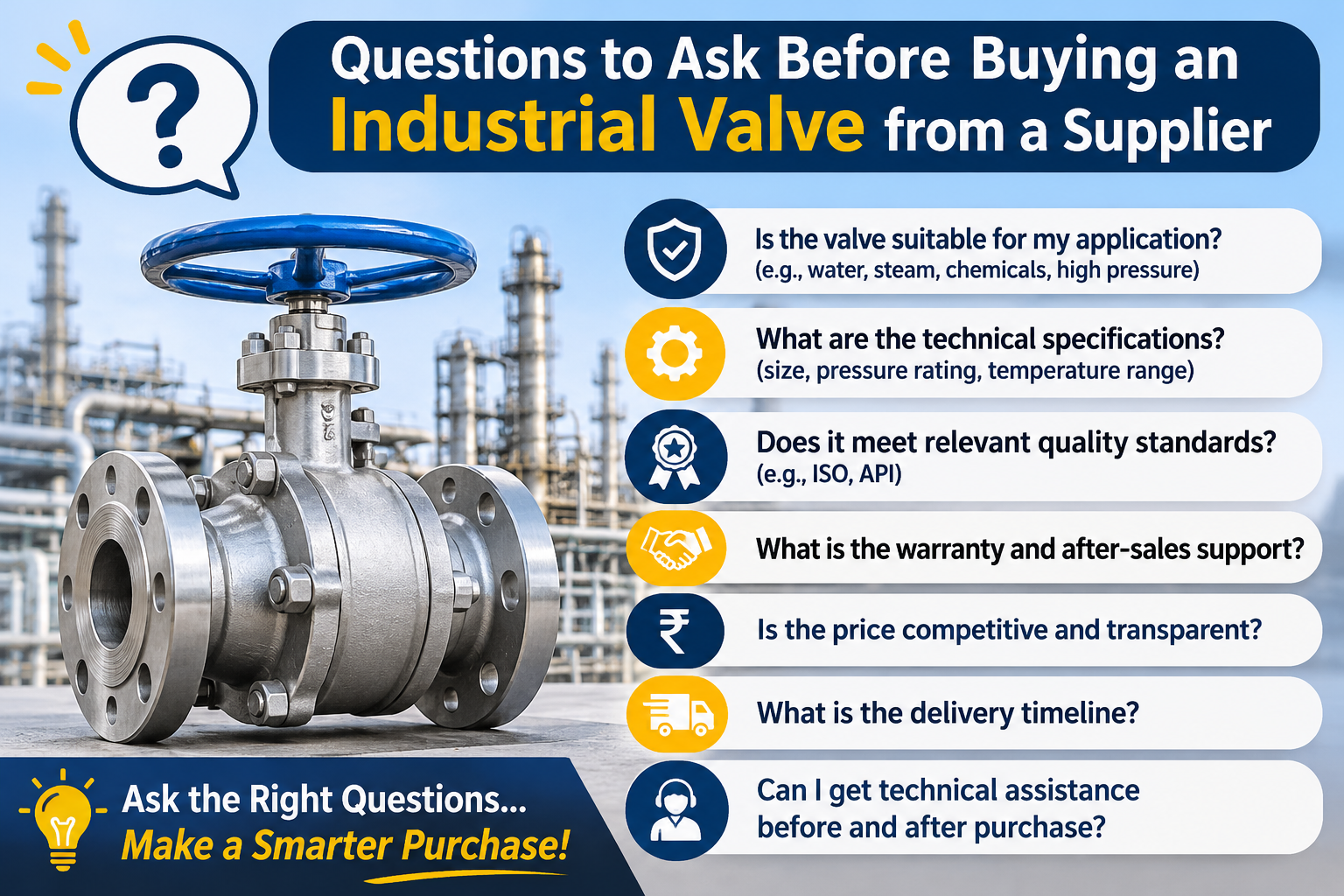

Industrial valves play an important role in controlling the flow of liquids, gases, and other materials in industrial piping systems. They are widely used in manufacturing plants, construction projects, water treatment facilities, chemical industries, power plants, and oil and gas operations.
However, choosing the right industrial valve is not always easy. Different applications require different valve types, materials, sizes, and pressure ratings. Selecting an unsuitable valve can lead to leakage, maintenance problems, flow restrictions, and unexpected replacement costs.
This is why asking the right questions before purchasing is important.
If you are searching for a reliable industrial valve supplier in Pune, understanding your requirements and checking the supplier's product specifications can help you make a better purchasing decision.
In this blog, we will discuss 10 important questions you should ask before buying industrial valves, along with practical tips to help you select the right product for your application.
Why Is Choosing the Right Industrial Valve Important?
An industrial valve controls the movement of fluids through pipelines. Depending on its design, it can start or stop flow, regulate pressure, control flow direction, or prevent backflow.
Different industries use different types of valves according to their operating conditions.
For example:
- Water treatment plants use valves to control water flow through pipelines.
- Chemical industries require valves suitable for the chemicals being handled.
- Oil and gas facilities use valves for controlling fluid movement under specified operating conditions.
- Manufacturing plants use valves in different production and utility systems.
- Firefighting systems use valves to manage water supply and distribution.
Choosing the correct valve helps maintain system performance, supports safe operation, and reduces unnecessary maintenance.
10 Important Questions to Ask Before Buying an Industrial Valve
Before finalising your purchase, discuss the following questions with your industrial valve supplier.
1. Which Type of Industrial Valve Is Suitable for My Application?
The first question should be about the type of valve required for your application.
Different valves perform different functions. Selecting a valve based only on its price or appearance may result in an unsuitable purchase.
Some commonly used industrial valves include:
Ball Valve: Uses a rotating ball to start or stop fluid flow. It is commonly selected for applications requiring quick shut-off.
Gate Valve: Uses a gate mechanism to open or close the flow path. It is generally used for isolation rather than regular flow regulation.
Butterfly Valve: Uses a rotating disc to control flow. Its compact design makes it useful in different industrial piping systems.
Globe Valve: Designed for applications where flow regulation is required.
Check Valve or Non-Return Valve (NRV): Allows flow in one direction and helps prevent reverse flow.
Sluice Valve: Commonly used in water supply and distribution systems for controlling flow.
Ask your supplier which valve type is suitable for your intended application, operating conditions, and piping arrangement.
Explore the different industrial valve types offered by Maniyar Steels.
2. What Material Is the Valve Made From?
Valve material is another important factor to consider before purchasing.
The material should be compatible with the fluid, operating temperature, pressure, and surrounding environment.
Common industrial valve materials include:
- Mild Steel (MS): Used in various general industrial and piping applications.
- Stainless Steel (SS): Often selected where corrosion resistance is important.
- Cast Steel (CS): Used in different industrial applications requiring suitable strength and pressure-handling properties.
Before placing an order, ask your supplier about the valve body, internal components, seat, and sealing materials.
For example, a valve used in a chemical processing system may require different material properties compared with one used in a general water supply pipeline.
Always confirm material compatibility with your project specifications.
3. What Pressure Rating Does the Valve Support?
Pressure rating is one of the most important specifications when buying industrial valves.
It indicates the pressure conditions for which a valve is designed, subject to its material, size, temperature, and applicable standards.
Industrial valves are available with different pressure classes, such as:
- Class 150
- Class 300
- Class 600
- Class 900
- Class 1500
- Class 2500
However, not every valve type or model is available in every pressure class.
Ask your supplier:
- What is the required pressure rating for my application?
- What pressure class is available?
- Is the pressure-temperature rating suitable for my operating conditions?
- Can you provide the relevant technical specifications?
Never select a valve based only on its nominal pressure class. Check the applicable pressure-temperature rating before purchasing.
4. Which Valve Size Should I Choose?
Choosing the correct valve size is essential for proper installation and system performance.
Industrial valves are available in different nominal sizes depending on their type and application.
Before ordering, confirm:
- Required valve size.
- Pipeline nominal diameter.
- Connection dimensions.
- Face-to-face dimensions, where applicable.
- Available installation space.
For example, if your pipeline requires a 4-inch valve, selecting the correct nominal size and matching end connections is important.
Also, remember that the valve size should be selected according to the piping design and flow requirements, not simply by matching the outside diameter of the pipe.
5. What Type of End Connection Is Available?
End connections determine how the valve connects to the pipeline.
The correct connection type helps ensure proper installation and compatibility with existing piping equipment.
Common industrial valve connections include:
Flanged Connection: Uses flanges and bolts to connect the valve to the pipeline. It is commonly used in industrial piping systems.
Threaded Connection: Uses threaded ends to connect the valve with compatible pipe fittings.
Socket Weld Connection: The pipe is inserted into a socket and welded around the connection.
Butt Weld Connection: The valve ends are welded directly to the pipeline.
Wafer and Lug Connections: Commonly used with butterfly valves and selected other valve designs.
Before purchasing, ask the supplier which connection types are available and whether they match your existing pipeline and installation requirements.
6. Does the Valve Meet the Required Quality Standards?
Quality is an important consideration when purchasing industrial equipment.
A valve should meet the technical and quality requirements specified for its intended application.
Ask your supplier about:
- Applicable manufacturing or design standards.
- Pressure and leakage testing requirements.
- Material specifications.
- Inspection reports.
- Relevant product certifications.
- Traceability documents, where required.
Depending on the valve type and application, standards such as ASME, API, and other applicable national or international standards may be relevant.
Do not assume that every valve follows the same standard. Confirm the specific standard required by your project.
7. Can You Provide Technical Documents and Test Certificates?
Technical documents help buyers verify whether the supplied valve matches the purchase specification.
Before placing a bulk order or purchasing valves for an industrial project, ask about the availability of:
- Technical Data Sheet (TDS).
- Material Test Certificate (MTC), where applicable.
- Pressure test report.
- Inspection certificate.
- Product catalogue.
- Warranty information, where applicable.
These documents can be particularly important for projects involving industrial plants, water treatment, chemical processing, and infrastructure.
Always confirm documentation requirements before finalising the quotation.
8. What Is the Delivery Time and Stock Availability?
A good purchasing decision also depends on product availability and delivery coordination.
Industrial projects often work according to fixed installation and maintenance schedules. Delayed material supply can affect project progress.
Ask your supplier:
- Is the required valve currently available?
- What is the expected delivery time?
- Can you supply the required quantity?
- Are different sizes and specifications available?
- What transportation arrangements are provided?
If you need multiple valves for a project, share your complete material requirement in advance.
This helps the supplier check availability and provide a more accurate quotation.
9. What Is the Total Price and What Does It Include?
Price is an important factor, but the cheapest product is not always the most suitable choice.
When comparing quotations from different industrial valve suppliers, check whether the quoted products have matching specifications.
Compare:
- Valve type and design.
- Material.
- Size.
- Pressure class.
- End connection.
- Applicable standards.
- Testing and documentation.
- GST and transportation charges.
For example, two ball valves may look similar but have different body materials, pressure ratings, and internal components.
Therefore, compare the complete specifications instead of comparing only the quoted price.
10. Does the Supplier Offer Other Industrial Piping Products?
Buying multiple piping products from one supplier can simplify procurement and communication.
Depending on your project, you may also require:
- MS Pipe Fittings.
- MS Flanges.
- MS Pipes.
- Industrial Strainers.
- Structural Steel Products.
Ask whether the supplier can support these additional requirements.
This can make purchasing coordination easier, particularly when your project involves several connected piping components.
Different Types of Industrial Valves You Should Know About
Understanding basic valve functions can help you communicate your requirements more clearly to a supplier.
|
Valve type |
Primary function |
|
Ball Valve |
Quick opening and closing of flow |
|
Gate Valve |
Pipeline isolation |
|
Butterfly Valve |
Flow control and isolation |
|
Globe Valve |
Flow regulation |
|
Check Valve / NRV |
Prevents reverse flow |
|
Sluice Valve |
Flow isolation in water systems |
The correct valve depends on your application, fluid characteristics, pressure, temperature, and piping design.
How to Choose a Reliable Industrial Valve Supplier in Pune
Finding an industrial valve supplier is easy, but selecting a suitable supplier requires some research.
Here are five practical points to consider.
Check the Supplier's Product Range
Look for a supplier who offers the valve types and specifications required for your project.
A wider product range can be useful when you need different valve categories and related piping materials.
Verify Technical Specifications
Ask for product details before confirming the order. Check the material, size, pressure rating, end connection, and applicable standards.
Compare Quotations
Collect quotations based on the same specifications. This helps you make a fair comparison between suppliers.
Check Business Experience
Consider the supplier's experience in industrial products, understanding of customer requirements, and ability to coordinate orders.
Confirm Location and Delivery Arrangements
If your project is in Pune, PCMC, Chakan, or nearby industrial areas, consider the supplier's location and delivery arrangements.
Working with a conveniently located supplier may make communication, coordination, and material collection easier.
Why Consider Maniyar Steels for Industrial Valves in Pune?
If you are looking for an industrial valve supplier in Pune, Maniyar Steels Pvt. Ltd. is one company you can explore for your industrial piping requirements.
Established in 1994, Maniyar Steels Pvt. Ltd. operates from Bhosari MIDC, Pune, and deals in industrial valves, MS structural steel, MS pipe fittings, and flanges.
The company's published valve range includes:
- Ball Valves
- Butterfly Valves
- Gate Valves
- Globe Valves
- Non-Return Valves (NRVs)
- Strainers
- Traps
- Sluice Valves
Its valve product pages list different material options, including Mild Steel (MS), Stainless Steel (SS), and Cast Steel (CS), along with different sizes, pressure ratings, and connection options depending on the valve type.
These products are listed for applications across industries such as oil and gas, petrochemicals, chemical processing, water and wastewater treatment, power generation, and HVAC.
Maniyar Steels also deals in related industrial products such as MS pipes, flanges, and pipe fittings.
You can explore its industrial valve product range to understand the available options.
For product specifications, stock availability, and pricing, contact the company directly.
Frequently Asked Questions (FAQs)
1. What should I check before buying an industrial valve?
Check the valve type, material, size, pressure rating, temperature requirements, end connection, applicable standards, and technical documents. Also confirm product availability and delivery timelines.
2. Which industrial valve is best for water supply applications?
The suitable valve depends on the purpose of the application. Gate or sluice valves are commonly used for pipeline isolation, butterfly valves for flow control and isolation, and check valves for preventing reverse flow.
3. What are the different types of industrial valves?
Common types include ball valves, gate valves, butterfly valves, globe valves, check valves, sluice valves, and other specialised valves. Each type serves a different function in a piping system.
4. Which materials are commonly used in industrial valves?
Common valve materials include Mild Steel, Stainless Steel, and Cast Steel. The correct material depends on the fluid, operating pressure, temperature, and environmental conditions.
5. What is the difference between a ball valve and a gate valve?
A ball valve uses a rotating ball to control flow and generally provides quick shut-off. A gate valve uses a movable gate to open or close the pipeline. Gate valves are generally intended for isolation rather than regular throttling.
6. Why is pressure rating important when selecting an industrial valve?
Pressure rating helps determine whether a valve is suitable for the operating conditions of a piping system. Buyers should also consider temperature, valve material, and the applicable pressure-temperature rating.
7. Where can I find an industrial valve supplier in Pune?
You can explore industrial valve suppliers in Pune and compare their product range, specifications, quality documents, and pricing. Maniyar Steels Pvt. Ltd., located in Bhosari MIDC, Pune, lists different industrial valve categories on its website.
8. What documents should I ask for when purchasing industrial valves?
Depending on your project requirements, ask for technical data sheets, material test certificates, pressure test reports, inspection documents, and applicable product certifications.
9. Can I purchase different types of industrial valves from one supplier?
Yes, some suppliers offer multiple valve categories, including ball, gate, butterfly, globe, check, and sluice valves. Confirm the required specifications and availability before placing your order.
10. Why should I compare industrial valve suppliers before purchasing?
Comparing suppliers helps you evaluate product quality, technical specifications, pricing, documentation, delivery timelines, and overall purchasing value.
Conclusion
Buying the right industrial valve requires more than simply selecting a product from a catalogue. You need to understand your application, choose the correct valve type, check material compatibility, verify pressure ratings, and confirm the required specifications.
Asking these 10 questions before purchasing can help you avoid common selection mistakes and make a more informed buying decision.
Whether you need ball valves, gate valves, butterfly valves, globe valves, NRVs, or sluice valves, choose a supplier who can clearly explain the available specifications and help you identify suitable products.
If you are searching for an industrial valve supplier in Pune, explore the product range offered by Maniyar Steels Pvt. Ltd.
Looking for industrial valves for your next project?
Contact Maniyar Steels today to discuss your requirements, check product availability, and request a quotation.
Company: Maniyar Steels Pvt. Ltd.
Location: Shop No. G-33, Bashweshwar Industrial Premises, Vishweshwar Chowk, Sector No. 10, PCNTDA, Bhosari, Pune – 411026.
Phone: +91 96995 69698 / +91 88888 88136
Email: [email protected]
Website: https://www.maniyarsteels.com/
