


Storage Benches With Back Support: The Best Options for Comfort and Style
Let's be honest — a storage bench without back support is fine for a quick sit while you tie your shoes, but nobody's lingering on one for more than a few minutes. The moment you add a backrest, the whole experience changes. Suddenly it's not just functional furniture; it's somewhere you might actually want to spend time.
Storage benches with back support occupy a genuinely interesting category. They have to solve two problems simultaneously: they need to be comfortable enough for real, extended sitting, and they need to manage storage in a way that still works despite the backrest. That's a design challenge, and the solutions out there vary a lot in how well they pull it off.
What Makes a Storage Bench With Back Support Actually Comfortable?
The Importance of Seat Height
Comfort starts with height. A bench that's too low forces your knees up awkwardly and puts strain on your lower back. Too high and your feet dangle, which gets uncomfortable quickly. The ergonomic sweet spot for most adults is somewhere between 17 and 19 inches from floor to seat surface.
If you're buying for a household with children, or for a hallway where shorter adults will use it, lean toward the lower end of that range. If it's primarily for tall adults, go higher. Some manufacturers make adjustable-height options, which sounds ideal on paper but can feel a bit clinical in practice.
Backrest Angle and Height
The backrest is where a lot of otherwise decent benches fall short. A perfectly vertical back is actually less comfortable than one with a slight recline — even a few degrees of backward angle makes a significant difference. Aim for a backrest that angles back at about 95 to 100 degrees relative to the seat.
Height matters too. A backrest that only reaches mid-back leaves your shoulders with nowhere to rest and creates fatigue surprisingly quickly. For real lounging comfort, you want the backrest to reach at least to shoulder blade height — roughly 20 to 24 inches above the seat.
Seat Depth and Cushioning
Deep seats feel luxurious until you realize you can't reach the back support without sliding backward, at which point your legs are no longer at a comfortable angle. For a bench specifically, a seat depth of 16 to 18 inches tends to work well — deep enough to be comfortable, not so deep that shorter people can't sit back properly.
Cushioning density matters more than cushioning thickness. A thin, dense foam cushion will outlast and outperform a thick, cheap foam one. If the bench you're looking at has cushions that feel great on day one but compress to almost nothing under your weight, that's a sign the foam quality is poor.
Storage Design Considerations
Lift-Top vs. Front-Access
This is the central design question for back-supported benches. With a standard lift-top storage bench, the backrest gets in the way of fully accessing the interior — you can't lift the seat and have the lid rest against a backrest at the same time. Manufacturers solve this in a few ways.
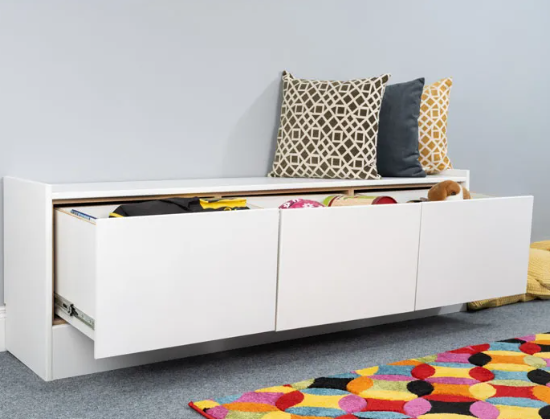
Some use a split lid design where only the front portion of the seat lifts, angling forward away from the backrest. Others use a lid that slides out toward the front rather than lifting. Some opt for drawers built into the front of the bench below the seat, sidestepping the lid issue entirely.
Each solution has trade-offs. Drawers offer the easiest access but typically provide less total storage volume. Split lids work well but can look a bit clunky. Front-sliding lids are clever but require more clearance in front of the bench.
Bench Chests vs. Built-In Back Supports
Another approach is separating the storage function from the back support function. A storage bench chest is positioned against a wall, and the wall itself, fitted with a padded panel or just by nature of being there, provides the back support. This is common in mudroom and entryway settings where a bench is built against a wall with hooks above.
It's not a true backrest in the furniture sense, but for casual sitting it works surprisingly well and removes all the design complications of combining storage with an attached backrest.
Material and Frame Quality
Solid Wood Frames
For a storage bench with back support, the frame bears more stress than a simple box bench. The backrest creates leverage — when someone leans back, it puts rotational force on the joints that connect back to seat. Solid wood joinery, ideally with mortise-and-tenon or dowel construction, handles this far better than stapled or glued-only joints.
Hardwoods like oak, maple, and walnut are the most durable. Pine and rubberwood are more affordable and still decent, but they'll show wear and are more prone to scratching. Always check how the backrest attaches to the seat — this joint gets the most stress and is often where cheaper benches fail first.
Upholstered Frames
Many storage benches with back support are fully or partially upholstered. The upholstery can hide a lot of structural mediocrity, which is why it's worth checking the frame underneath if you can. Good retailers will describe the frame construction; if that information isn't available, be skeptical.
Kiln-dried hardwood frames covered in high-resilience foam and wrapped in fabric are the standard for quality upholstered pieces. Corner blocking — small triangular pieces of wood at the frame corners — is a sign of better construction. If a bench wobbles side to side when you push on the backrest, walk away.
Style Options Worth Knowing
Tufted Back Benches
The tufted upholstered bench is a classic for good reason. The button tufting creates visual depth and texture, and when done well, it has a timeless quality that works in traditional, transitional, and even some modern spaces. It's a particularly good choice for bedrooms and living rooms where the bench plays a decorative role as much as a functional one.
Slatted Wood Backs
A slatted wooden backrest on a storage bench reads as more casual and relaxed — it suits farmhouse, Scandinavian, and coastal aesthetics especially well. The gaps between slats keep the piece from feeling visually heavy, which matters in smaller spaces. The downside is slightly less comfort for long sitting compared to a padded back, though adding a tied-on cushion solves that.
Panel Backs
A solid panel back — whether wood, upholstered, or cane — gives the bench a furniture-forward look. It tends to feel more formal and deliberate, which works beautifully in an entryway where you want to make an impression, or in a bedroom where you want the bench to read as a real piece of furniture rather than an afterthought.
Top Picks by Room
For an entryway, look for a bench with a back support tall enough to be useful for adults, drawers or a front-access compartment for shoes and accessories, and a durable fabric that resists dirt. Anything with hooks attached above is a bonus.
For a living room, an upholstered bench with storage below adds seating without consuming a lot of square footage. A tufted or nailhead-trim style keeps the piece looking intentional. Position it behind a sofa or against a wall as an accent piece.
For a bedroom, back support is especially valuable — you want somewhere comfortable to sit while getting dressed. A bench at the foot of the bed with a padded back is the perfect combination of function and comfort.
What to Watch Out For
Cheap staple-gun construction hidden under upholstery is the most common quality issue. Push on the backrest firmly before buying — it should feel completely solid. Any wobble, creak, or flex is a warning sign.
Foam that compresses more than halfway under your full body weight is too soft and will feel flat within months. Press down on the seat cushion with your hand to get a rough sense of density.
Weight capacity is also worth checking. Some decorative benches are rated surprisingly low — 200 lbs or less. If multiple people might sit on it, or if you have heavier household members, verify the rating.
The Bottom Line
A storage bench with proper back support is genuinely versatile furniture — useful enough to justify its footprint, comfortable enough to actually sit on, and attractive enough to work in almost any room. The key is not cutting corners on frame quality or cushion density, and making sure the storage solution doesn't feel like an afterthought.
Take your time, sit on whatever you're considering before you buy, and think hard about how the storage will actually work for your everyday life. Get those things right, and a backed storage bench will be one of the most-used pieces of furniture in your home.

 Bangla