


The Eyes of Safety: How Radar and Camera-Based Detection Systems See the Road Ahead
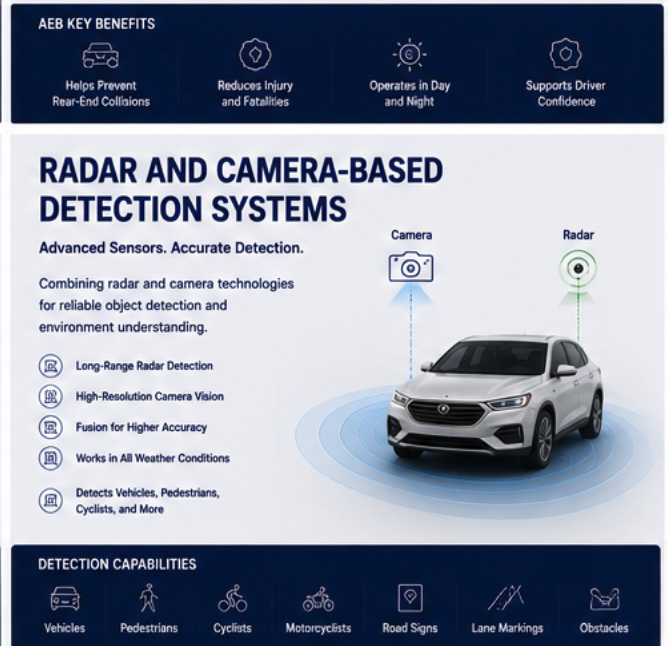
A self-driving car's ability to avoid collisions depends entirely on its ability to see the world. Radar and Camera-Based Detection Systems are the primary sensors that provide this vision, each offering unique strengths that complement the other's weaknesses. Radar sees through rain, fog, and darkness but lacks resolution. Cameras provide rich visual detail but fail in poor lighting and weather. Together, they create a robust, redundant perception system that enables Intelligent Driver Assistance Solutions to function reliably in all conditions.
The Complementary Nature of Radar and Cameras
No single sensor is sufficient for reliable collision mitigation. Each technology has inherent limitations:
| Aspect | Radar | Camera |
|---|---|---|
| Weather immunity | Excellent (penetrates rain, fog, snow) | Poor (lens obscured, reduced contrast) |
| Lighting immunity | Excellent (operates in total darkness) | Poor (needs light; glare is problematic) |
| Resolution | Low (cannot read signs or identify objects) | High (can read text, distinguish colors) |
| Velocity measurement | Direct (Doppler effect) | Indirect (requires multiple frames) |
| Distance measurement | Direct (time-of-flight) | Indirect (stereo or motion estimation) |
| Object classification | Limited (can distinguish size, not type) | Excellent (can identify make, model, type) |
| Cost | Moderate | Low |
Sensor Fusion: Creating a Complete Picture
Radar and Camera-Based Detection Systems use sensor fusion to combine their respective strengths:
How Fusion Works:
-
Camera detects an object (e.g., "there is a shape that looks like a car").
-
Radar measures distance and velocity (e.g., "object is 50 meters away, closing at 10 m/s").
-
Fusion algorithm matches the camera object to the radar object.
-
Fused output: "Vehicle ahead at 50 meters, closing speed 10 m/s. Confidence: 98%."
When to Trust Each Sensor:
| Condition | Primary Sensor | Secondary Sensor | Notes |
|---|---|---|---|
| Bright daylight, clear weather | Camera (high confidence) | Radar (confirmation) | Camera sees all details |
| Night, well-lit streets | Camera (medium confidence) | Radar (primary distance) | Camera may miss dark objects |
| Night, unlit streets | Radar (only) | None | Camera may fail entirely |
| Heavy rain or fog | Radar (only) | None | Camera obscured |
| Direct sun glare | Radar (only) | None | Camera blinded |
| Low sun (horizontal) | Radar (primary) | Camera (with filters) | Glare reduces camera confidence |
Radar Technology: The All-Weather Workhorse
Automotive radar operates in the 76-81 GHz frequency band (millimeter wave). Key characteristics:
Radar Types by Range:
| Type | Range | Field of View | Applications |
|---|---|---|---|
| Long-range radar (LRR) | 150-250 meters | Narrow (20-30°) | AEB, ACC, FCW |
| Medium-range radar (MRR) | 80-120 meters | Medium (60-90°) | Cross-traffic alert |
| Short-range radar (SRR) | 30-50 meters | Wide (120-180°) | Blind spot monitoring |
How Radar Measures Velocity (Doppler Effect):
When a radio wave reflects off a moving object, its frequency shifts. The radar measures this shift and calculates relative velocity directly—without needing multiple measurements.
Advantages of Doppler Radar:
-
Instantaneous velocity measurement: No waiting for multiple frames.
-
Discrimination of stationary objects: Moving objects have a Doppler shift; stationary objects (signs, bridges) do not. This helps AEB ignore overpasses and signs.
Radar Limitations:
-
Low angular resolution: Radar cannot distinguish two closely spaced objects.
-
No object classification: Radar knows an object is there but cannot tell if it is a car, truck, pedestrian, or motorcycle.
-
Stationary object filtering: Radars often filter out stationary objects to avoid false positives—but this means they may ignore a stopped vehicle on the highway.
Camera Technology: The Semantic Sensor
Cameras provide rich visual information that radar cannot. Key specifications:
Camera Configurations:
| Type | Depth Perception | Cost | Applications |
|---|---|---|---|
| Monocular (single camera) | Indirect (from motion or AI) | Low | LDW, TSR, basic FCW |
| Stereo (two cameras) | Direct (disparity calculation) | Medium | AEB, pedestrian detection |
| Trifocal (three cameras) | Direct, with varying fields of view | High | Premium ADAS |
What Cameras See:
-
Lane markings: Solid, dashed, double, colored.
-
Traffic signs: Speed limits, stop signs, yield signs, warning signs.
-
Traffic lights: Red, yellow, green; arrow states.
-
Objects: Cars, trucks, pedestrians, cyclists, animals.
-
Road surface conditions: Wet, dry, snow-covered (estimated).
-
Weather conditions: Rain, fog, snow (estimated).
Camera Limitations:
-
Lighting sensitivity: Low-light performance varies; direct sun causes glare.
-
Weather sensitivity: Rain, snow, and fog on the lens obscure the view.
-
Depth estimation (monocular): Requires motion or AI, less accurate than radar.
-
Frame rate limited: Typically 30-60 fps (fast moving objects may be blurred).
The Fusion Architecture: How Sensors Talk to Each Other
Intelligent Driver Assistance Solutions integrate radar and camera data at multiple levels:
Low-Level Fusion (Early Fusion):
Raw sensor data (camera pixels, radar points) is combined before object detection. Used in some premium systems but computationally intensive.
Object-Level Fusion (Late Fusion):
Each sensor detects objects independently. The fusion algorithm then matches objects from both sensors. Most common architecture.
Feature-Level Fusion (Mid Fusion):
Sensor-specific features (e.g., camera edges, radar points) are combined before final object detection. A balance of performance and complexity.
Typical Fusion Pipeline:
-
Camera processing: Detect objects, lane markings, signs. Assign confidence scores.
-
Radar processing: Detect objects, measure distance and velocity.
-
Matching: Associate camera objects with radar objects (using position and motion).
-
Fusion: Combine attributes (camera classification + radar distance/velocity).
-
Tracking: Maintain object identity across frames (Kalman filter).
-
Threat assessment: Calculate time-to-collision, decide if warning or braking is needed.
Real-World Performance: Sensor Fusion in Action
Scenario 1: Highway, Clear Day
-
Camera: Detects vehicle ahead, classifies as "sedan," reads license plate (for tracking).
-
Radar: Measures distance (50 meters) and closing speed (0 m/s—matched speed).
-
Fused output: ACC maintains following distance.
Scenario 2: Highway, Heavy Rain
-
Camera: Lens is wet, image degraded. Low confidence in detection.
-
Radar: Unaffected, continues to track vehicle ahead.
-
Fused output: ACC continues to function (relying on radar). Camera may be ignored.
Scenario 3: Urban Intersection, Night
-
Camera: Detects pedestrian shape (medium confidence, darkness reduces visibility).
-
Radar: Detects object moving toward crosswalk, measures velocity (2 mph).
-
Fused output: "Pedestrian at 20 meters, moving toward crosswalk. Confidence: 85%." FCW alerts driver.
Scenario 4: Direct Sun Glare
-
Camera: Blinded by sun (no output). Confidence = 0%.
-
Radar: Continues to track vehicles ahead.
-
Fused output: AEB remains active (radar only). Warning: "Camera blocked" alert.
False Positive Reduction through Fusion
Fusion dramatically reduces false positives (alerts when no threat exists):
| Scenario | Camera Alone | Radar Alone | Fused System |
|---|---|---|---|
| Metal plate in road | False positive (mistakes for obstacle) | Correctly ignores (no Doppler) | No alert |
| Overhead sign | False positive (mistakes for vehicle) | Correctly ignores (stationary) | No alert |
| Vehicle in adjacent curve | Correctly ignores (lateral position) | May false-positive (no lateral resolution) | No alert (camera overrides) |
| Sharp shadow | False positive (mistakes for obstacle) | Correctly ignores (no radar return) | No alert |
The Future of Radar and Camera Fusion
-
4D imaging radar: Adds elevation measurement (height) to traditional 3D radar. Approaches LiDAR resolution at radar prices.
-
Higher resolution cameras: 5-8 megapixel sensors see farther and in greater detail.
-
Deep learning fusion: Neural networks that accept both camera and radar inputs directly (instead of separate detection + rule-based fusion).
-
Thermal cameras: Infrared imaging for night and fog, providing a third modality.
Conclusion
The safest vehicles on the road see with multiple eyes. Radar and Camera-Based Detection Systems provide complementary strengths—radar's all-weather reliability and camera's semantic richness. Fused together, they create a complete, redundant perception system that far exceeds the capabilities of any single sensor. As Intelligent Driver Assistance Solutions continue to evolve, sensor fusion will become even more sophisticated, bringing us closer to the goal of zero collisions.

 Bangla