


Mobility as a Service Market: Ride-Hailing and Micro-Mobility
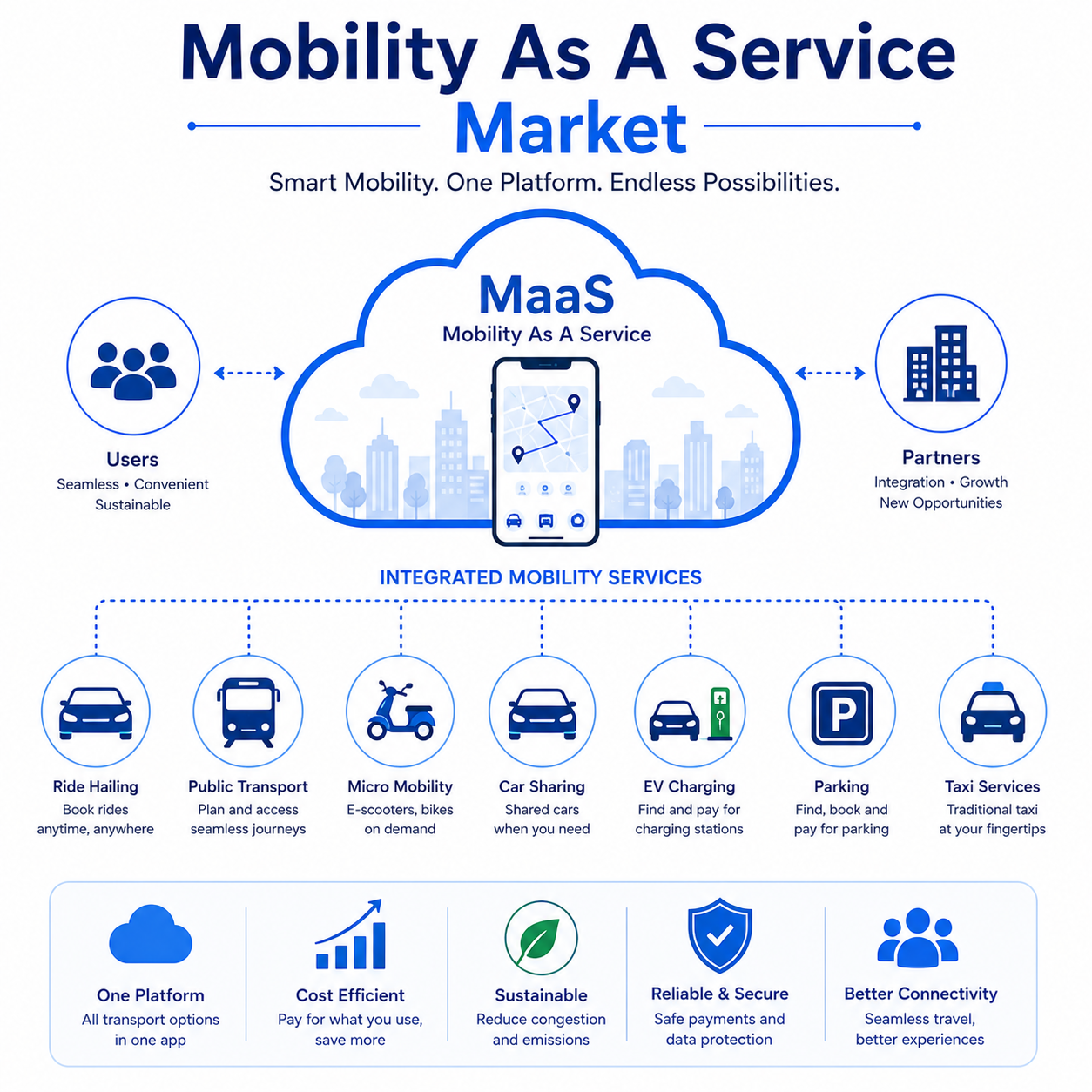
Ride-Hailing: The Dominant Service Type
The Mobility as a Service Market finds its largest service type in Ride-Hailing, which captured approximately 48.7% of revenue in 2025. Ride-hailing reflects deep consumer penetration of on-demand mobility platforms in urban centers. Uber and Didi collectively process over 30 million daily trips globally, benefiting from deep consumer habituation.
The segment benefits from increasingly sophisticated on-demand mobility platforms that match drivers with riders in under 90 seconds in dense urban areas. Ride-hailing remains the revenue cornerstone of the MaaS market. Its dominance reflects the widespread adoption of app-based transportation.
Micro-Mobility: The Fastest-Growing Service Type
Micro-mobility services are forecast to expand at a 20.5% CAGR through 2035, the fastest among all service categories. This growth is driven by last-mile connectivity needs and smart transportation apps for e-scooters and bikes. E-scooter and e-bike deployments have tripled since 2021, driven by smart transportation apps that integrate seamlessly into multimodal journey planners.
Cities like Paris, Berlin, and Austin have embedded micro-mobility docking into public transit stations, cementing their role in integrated transport solutions ecosystems. Micro-mobility is the segment to watch for its rapid expansion and integration with other transport modes.
Car Sharing and Bike Sharing
Car Sharing is a significant service type, growing at a 13.80% CAGR, driven by cost-conscious urban commuters and fleet electrification. Car-sharing services provide flexible, short-term vehicle access without ownership costs. The segment is benefiting from the shift away from private car ownership.
Bike Sharing is valued at $18.50 billion in 2025, driven by municipal investment and health/sustainability trends. Bike-sharing programs are increasingly integrated with public transit systems. These services are essential for completing the first and last mile of urban journeys.
Others and Emerging Services
Other service types, including shuttle services and ferry integration, represent approximately 8% of the market in 2025. These services are expanding the scope of MaaS beyond traditional urban transport. The integration of diverse transport options is a key trend in the market.
Emerging services such as autonomous shuttles and on-demand public transit are gaining traction. These services are supported by public-private partnerships and technology innovation. The MaaS market is continuously evolving to include new forms of mobility.

 Bangla