


Why Human-in-the-Loop Still Matters in Image and 3D Annotation
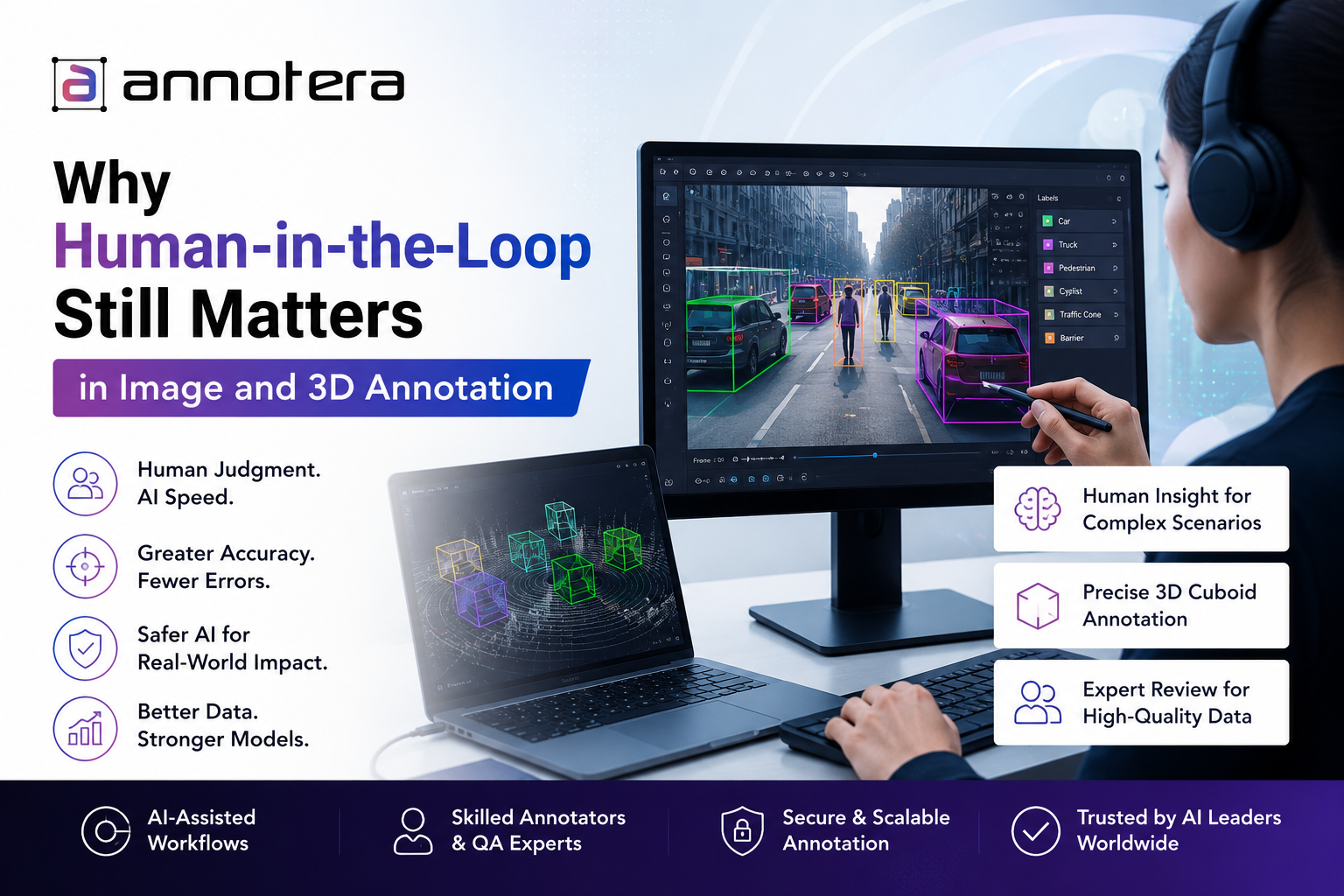
Artificial intelligence has made remarkable progress in automating data labeling, enabling organizations to process millions of images and sensor data faster than ever before. Automated annotation tools powered by computer vision and machine learning can now detect common objects, generate bounding boxes, and even create initial segmentation masks with minimal human intervention. While these advancements have accelerated AI development, they have not eliminated the need for human expertise.
As AI systems move into safety-critical applications such as autonomous vehicles, robotics, smart cities, healthcare, and industrial automation, annotation quality has become more important than annotation speed. A single labeling error can propagate through an entire model, resulting in inaccurate predictions and costly operational failures.
This is precisely why Human-in-the-Loop (HITL) remains a cornerstone of modern AI development. By combining automation with expert human validation, organizations achieve higher accuracy, improved consistency, and greater trust in their training datasets.
The Growing Demand for High-Quality Annotation
The success of any AI model depends on the quality of the data used to train it. Even the most sophisticated algorithms cannot compensate for poor-quality labels.
As computer vision models become increasingly sophisticated, annotation requirements have expanded beyond simple image labeling to include:
-
Object detection
-
Instance segmentation
-
Semantic segmentation
-
Keypoint annotation
-
Polygon annotation
-
LiDAR labeling
-
Sensor fusion
-
3D cuboid annotation
These tasks require contextual understanding that automated systems still struggle to achieve consistently.
Why Automation Alone Isn't Enough
Auto-labeling tools excel at repetitive tasks involving familiar scenarios. However, real-world datasets rarely follow ideal conditions.
AI frequently encounters challenges such as:
-
Heavy occlusion
-
Motion blur
-
Low-light environments
-
Rain, fog, and snow
-
Rare object classes
-
Complex object interactions
-
Construction zones
-
Unusual camera perspectives
For example, an autonomous vehicle may need to distinguish between:
-
A pedestrian pushing a bicycle
-
A cyclist riding normally
-
A child emerging from behind a parked vehicle
-
Temporary road barriers
Although an AI model can generate an initial prediction, human annotators provide the contextual judgment needed to ensure accurate labeling.
This combination of machine efficiency and human expertise forms the foundation of Human-in-the-Loop annotation.
Human-in-the-Loop Improves Image Annotation Accuracy
Modern image annotation platforms increasingly use AI-assisted pre-labeling to accelerate workflows.
Rather than drawing every annotation manually, human annotators:
-
Review AI-generated labels
-
Correct incorrect predictions
-
Refine segmentation boundaries
-
Resolve ambiguous scenes
-
Validate edge cases
-
Ensure annotation consistency
This review process significantly improves dataset quality while reducing annotation time.
Instead of replacing annotators, AI transforms them into quality experts responsible for maintaining high-confidence training data.
Why Human Oversight Is Critical for 3D Cuboid Annotation
Compared to traditional image labeling, 3D cuboid annotation introduces an entirely different level of complexity.
Autonomous systems rely on accurately positioned 3D cuboids to estimate:
-
Object dimensions
-
Vehicle orientation
-
Distance estimation
-
Motion prediction
-
Spatial relationships
-
Collision avoidance
Small errors in cuboid placement can distort depth perception, negatively affecting downstream perception models.
Human annotators play a vital role by:
-
Correcting inaccurate cuboid alignment
-
Verifying object orientation
-
Resolving partial occlusions
-
Handling overlapping objects
-
Validating temporal consistency across video frames
-
Ensuring precise annotations across multiple sensor views
These quality checks remain difficult for automated systems, particularly in crowded urban environments.
Human-in-the-Loop Reduces Bias in Training Data
Bias is one of the biggest challenges facing modern AI.
Automated labeling models often inherit biases from previously trained datasets. Without human review, these biases can become amplified over time.
Human reviewers help identify:
-
Missing object classes
-
Demerging or merging errors
-
Class imbalance
-
Geographic bias
-
Environmental bias
-
Incorrect edge-case labeling
This additional validation creates more balanced datasets capable of supporting robust AI performance across diverse operating conditions.
Human Review Supports Continuous Model Improvement
Annotation is no longer a one-time activity.
Leading AI organizations now adopt continuous learning pipelines where models are regularly retrained using newly collected data.
Human reviewers identify:
-
Model failures
-
Low-confidence predictions
-
Novel scenarios
-
Difficult edge cases
These corrected annotations become high-value training examples that continuously improve future model performance.
This feedback loop enables AI systems to become increasingly accurate over time while minimizing model drift.
Why Enterprises Continue Choosing Data Annotation Outsourcing
Building an internal annotation team requires significant investments in:
-
Recruitment
-
Infrastructure
-
Annotation platforms
-
Quality assurance
-
Workforce management
-
Training programs
As datasets grow larger and more complex, many enterprises choose data annotation outsourcing to access experienced annotation specialists without increasing internal operational costs.
Working with an experienced data annotation company offers several advantages:
-
Scalable annotation teams
-
Faster project turnaround
-
Domain-specific expertise
-
Multi-level quality assurance
-
Secure data handling
-
Flexible workforce capacity
Organizations also increasingly adopt image annotation outsourcing for computer vision projects that require consistent, high-quality labeling across millions of images and video frames.
This hybrid approach allows internal AI teams to focus on model development while annotation experts manage dataset preparation.
Human Expertise Will Continue Powering the Next Generation of AI
Generative AI, foundation models, and self-supervised learning have significantly reduced manual labeling requirements. However, they have not eliminated the need for human validation.
Instead, the role of annotators is evolving.
Today's annotation professionals increasingly act as:
-
AI quality reviewers
-
Edge-case specialists
-
Domain experts
-
Safety validators
-
Dataset auditors
-
Model improvement partners
Rather than drawing every annotation manually, they ensure that AI-generated labels meet the accuracy standards required for production-grade AI systems.
As autonomous technologies continue expanding into transportation, robotics, manufacturing, retail, agriculture, and healthcare, Human-in-the-Loop workflows will remain essential for delivering trustworthy AI.
Why Annotera Is Your Trusted Human-in-the-Loop Annotation Partner
At Annotera, we combine advanced AI-assisted annotation workflows with experienced human reviewers to deliver datasets that power reliable computer vision and autonomous AI systems. Our experts specialize in image annotation, 3D cuboid annotation, semantic segmentation, polygon annotation, LiDAR labeling, and multi-sensor data annotation, backed by rigorous multi-level quality assurance processes.
Whether you're seeking a dependable data annotation company for enterprise-scale projects or exploring data annotation outsourcing and image annotation outsourcing to accelerate AI development, Annotera provides scalable, secure, and high-accuracy annotation services tailored to your industry's needs. By blending automation with human expertise, we help organizations build AI models that perform confidently in real-world environments.

 Bangla