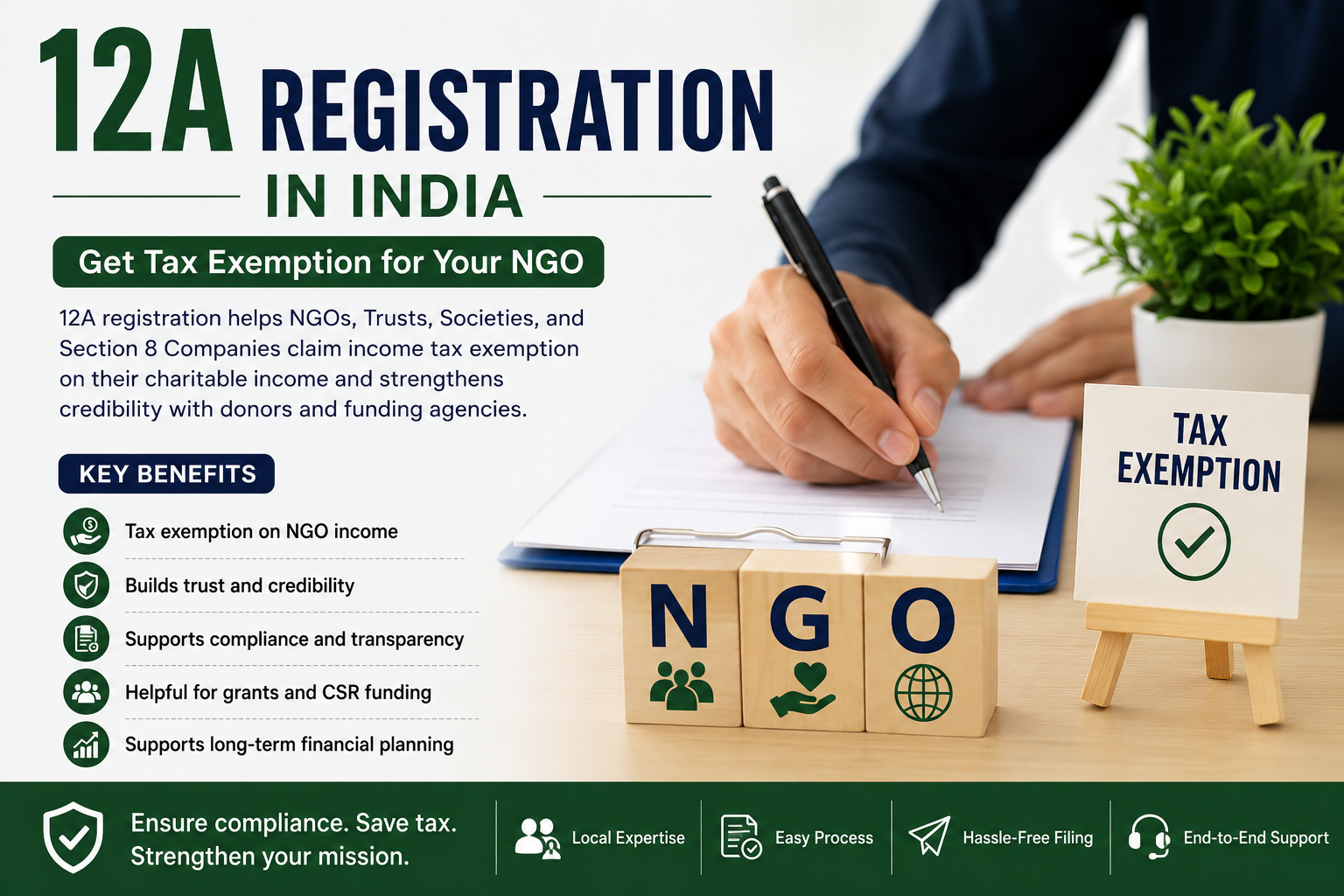
12A registration is one of the most important tax registrations for NGOs, Trusts, Societies, and Section 8 Companies in India. It helps a charitable organisation claim income tax exemption on its income, subject to proper compliance under the Income Tax Act. Without 12A registration, an NGO may have to pay tax on its surplus income, even if the money is used for charitable work.
For NGOs that want expert help with documentation, online filing, and compliance, 12A registration can help make the process more organised and error-free.
What Is 12A Registration?
12A registration is a tax registration granted to charitable or religious organisations. It allows eligible NGOs to claim exemption on income used for charitable purposes. This registration is useful for organisations working in education, healthcare, poverty relief, women empowerment, environment protection, animal welfare, skill development, and other public welfare activities.
The Income Tax Department states that a trust is required to apply for registration in Form No. 10A, and it also lists supporting documents like the trust/institution instrument, registration certificate, and documents related to objects.
Why Is 12A Registration Important?
12A registration gives financial strength and credibility to an NGO. It helps the organisation save tax legally and use more funds for social activities.
Key Benefits of 12A Registration
Helps NGOs claim income tax exemption.
Improves trust among donors and funding agencies.
Supports long-term financial planning.
Helps maintain transparent records.
Builds credibility for grant and CSR discussions.
Encourages proper accounting and compliance.
Supports future registration planning like 80G and CSR-1.
12A Registration vs 80G Registration
Many founders confuse 12A and 80G. Both are important, but their purpose is different.
Basis
12A Registration
80G Registration
Main Benefit
Tax exemption for NGO income
Tax deduction benefit for donors
Beneficiary
NGO or charitable organisation
Donor giving donation
Purpose
Saves tax on eligible charitable income
Encourages donations
Useful For
NGO compliance and tax planning
Fundraising and donor trust
Applied By
NGO, Trust, Society, Section 8 Company
NGO, Trust, Society, Section 8 Company
In simple words, 12A helps the NGO, while 80G helps the donor. A serious NGO should usually plan both registrations because they support compliance and fundraising together.
Who Can Apply for 12A Registration?
The following organisations can generally apply for 12A registration:
Registered charitable Trusts.
Registered Societies.
Section 8 Companies.
Religious or charitable institutions.
NGOs working for public welfare.
Organisations with non-profit objectives.
The organisation should not work for private profit. Its income should be used for its stated charitable or religious objectives.
Documents Required for 12A Registration
Proper documents are very important because incomplete papers may lead to notice or rejection.
Document
Purpose
PAN of NGO
Identity of the organisation
Registration certificate
Proof of legal existence
Trust Deed / MOA / AOA / Rules
Main governing document
Details of trustees/directors/members
Management verification
Address proof
Registered office confirmation
Activity report
Proof of charitable work
Financial statements
Income and expense verification
Bank details
Financial record support
Object clause
Shows charitable purpose
The Income Tax Department also mentions that documents furnished with Form No. 10A may include the instrument creating the trust or institution, proof of registration with the Registrar of Companies, Registrar of Firms and Societies, or Registrar of Public Trusts, and documents showing adoption or modification of objects, if any.
12A Registration Process Online
12A registration is generally completed online through the Income Tax e-filing system. The process should be handled carefully because the details submitted in the form must match the legal documents of the NGO.
Step 1: Prepare Documents
Collect PAN, registration certificate, Trust Deed or MOA/AOA, office proof, financial statements, and activity details.
Step 2: Login to Income Tax Portal
Login using the NGO’s credentials and access the relevant income tax form section.
Step 3: File Form 10A
Fill the application details carefully and upload the required documents. The form should clearly reflect the NGO’s objectives, registration details, and activities.
Step 4: Verification and Submission
Submit the application using the applicable verification method, such as DSC or EVC, depending on the case.
Step 5: Track Application and Certificate
After submission, the application should be tracked regularly. The Income Tax e-filing team explains that once Form 10A is filed and approval or provisional approval is issued, Form 10AC can be downloaded from “View Filed Forms” on the Income Tax e-filing portal.
Common Mistakes to Avoid
Many NGOs face delays because of small mistakes in the application.
Avoid these errors:
Filing before proper NGO registration.
Uploading unclear or incomplete documents.
Using objects that look commercial.
Mismatch in PAN, name, or address.
Not maintaining proper accounts.
Ignoring notices from the department.
Not keeping activity proof ready.
Confusing 12A with 80G benefits.
Why 12A Registration Supports NGO Growth
12A registration helps NGOs build a stronger financial base. When an NGO has tax-exempt status, it can use more of its funds for activities instead of tax payments. It also improves credibility before donors, grant agencies, and institutional partners.
For new NGOs, 12A registration also creates a compliance mindset from the beginning. It encourages proper books, activity records, donation records, and financial transparency.
Final Words
12A registration is a key compliance step for every NGO that wants tax exemption, donor confidence, and long-term credibility. It helps charitable organisations use their income for social welfare without unnecessary tax burden, subject to proper compliance. Before applying, founders should prepare accurate documents, review the object clause, maintain proper accounts, and file the application carefully. A well-prepared 12A application can save time, reduce notices, and help the NGO grow with better financial stability.




 Bangla