


Machine Learning Services in Dubai: Real-World Business Applications
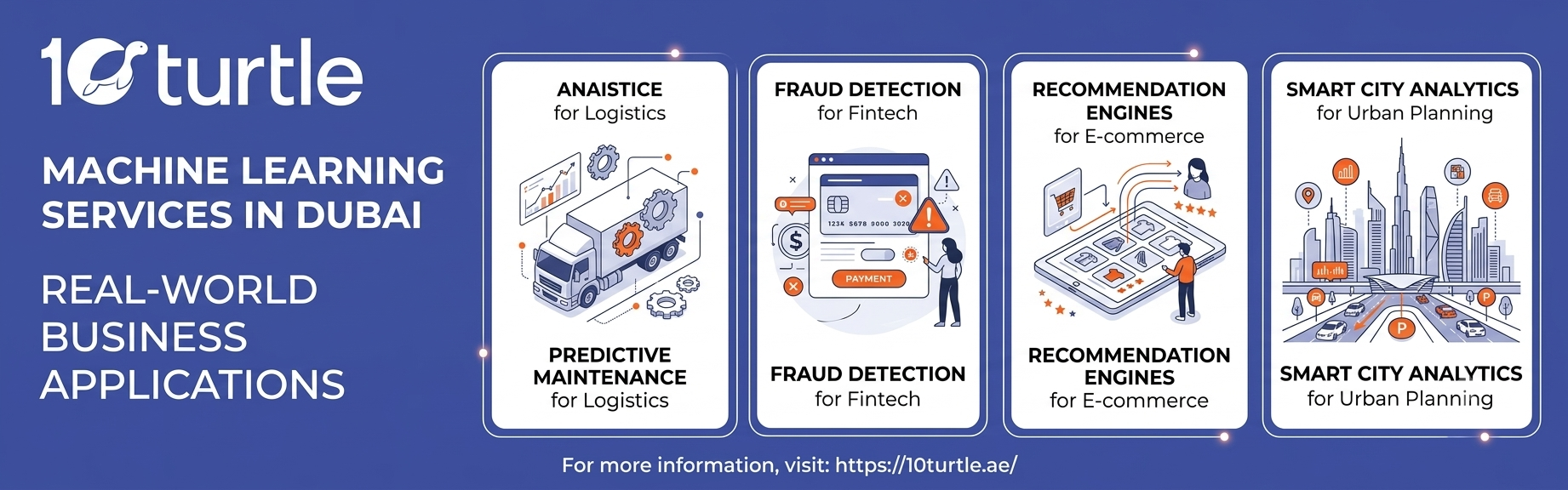
Dubai's economy is shifting fast, and companies across banking, retail, healthcare, and logistics are turning to data-driven decision-making to stay ahead. If your business is exploring how intelligent systems can cut costs and improve accuracy, working with a specialist machine learning development company in Dubai can help you move from raw data to real business outcomes without the trial-and-error that usually slows internal teams down. This blog breaks down where machine learning is already delivering measurable results across the UAE, and how your business can start applying it today.
Why UAE Businesses Are Investing in Machine Learning
The UAE government's push toward a knowledge-based economy, backed by initiatives like the UAE National AI Strategy 2031, has created strong momentum for private companies to adopt predictive analytics, computer vision, and natural language processing. Dubai in particular has positioned itself as a regional hub for applied AI, with free zones such as Dubai Internet City and DIFC actively supporting fintech and retail firms building intelligent products. For local businesses, this means access to better infrastructure, a growing talent pool, and government-backed incentives for automation projects.
Real-World Applications Across UAE Industries
Retail and E-commerce: Dubai's retail sector uses machine learning models for demand forecasting, personalized product recommendations, and dynamic pricing. Malls and e-commerce platforms analyze footfall and purchase history to predict inventory needs during peak shopping seasons like DSF (Dubai Shopping Festival), reducing overstock and stockouts simultaneously.
Banking and Financial Services: UAE banks rely heavily on fraud detection models that flag unusual transaction patterns in real time. Credit scoring algorithms also help financial institutions assess loan applications for residents and expats with limited local credit history, speeding up approvals while managing risk.
Healthcare: Dubai Health Authority-affiliated hospitals and private clinics are piloting diagnostic imaging tools that use computer vision to detect anomalies in X-rays and MRIs faster than manual review alone. Predictive models are also being used to manage patient flow and reduce emergency room wait times.
Logistics and Supply Chain: Given Dubai's role as a global trade and re-export hub, logistics companies use route optimization algorithms to cut fuel costs and delivery times across Jebel Ali Port and DXB cargo operations. Predictive maintenance models also help fleet operators anticipate vehicle breakdowns before they cause delays.
Real Estate: Property valuation tools now use machine learning to price listings based on location, historical transaction data, and market trends across Dubai Marina, Downtown, and emerging communities like Dubai South, giving buyers and investors more transparent pricing.
Government and Smart City Initiatives: Dubai Police and RTA have both deployed predictive systems for traffic management and public safety, part of the broader Smart Dubai vision to make the city one of the most technologically advanced urban environments globally.
What This Means for Your Business
Whether you run a mid-sized retail chain in Deira or a fintech startup in DIFC, the barrier to adopting machine learning has dropped significantly. You no longer need an in-house data science team to get started many UAE businesses now partner with an external AI and automation partner to build custom models, integrate them into existing systems, and maintain them over time. This approach is particularly useful for companies that want predictive analytics for UAE businesses without the overhead of hiring full-time specialists.
Choosing the Right Approach
Before starting a machine learning project, it helps to define a clear business problem rather than adopting the technology for its own sake. Common starting points for UAE companies include customer churn prediction, inventory forecasting, and automated document processing all of which offer measurable ROI within a few months of deployment. Working with a team experienced in machine learning solutions for UAE companies also reduces the risk of building models that don't scale or integrate poorly with existing CRM and ERP systems.
FAQs
1. What industries in Dubai benefit most from machine learning?
Banking, retail, healthcare, logistics, and real estate currently show the strongest adoption, largely due to high transaction volumes and data availability in these sectors.
2. How much does a machine learning project cost in the UAE?
Costs vary widely depending on scope a simple predictive model may start in the low thousands of dirhams, while enterprise-grade systems with ongoing maintenance can run significantly higher. Most providers offer a discovery phase to scope costs before development begins.
3. Do I need a large dataset to start a machine learning project?
Not necessarily. Many UAE businesses start with smaller, well-structured datasets and expand data collection as the model proves value, rather than waiting to gather years of historical data first.
4. Is machine learning different from general AI automation?
Yes. Machine learning is a subset of AI focused specifically on models that learn patterns from data to make predictions, while broader AI automation can include rule-based workflows that don't require training data at all.
5. How long does it take to deploy a machine learning model?
A focused pilot project can typically go from concept to a working prototype in six to ten weeks, depending on data readiness and integration complexity with existing systems.
Final Thoughts
Machine learning is no longer an experimental technology for UAE businesses it's actively shaping how companies in Dubai forecast demand, detect fraud, manage logistics, and serve customers. The businesses seeing the strongest results are the ones treating ML as a practical tool tied to specific outcomes, not a buzzword. If you're evaluating where to start, focus on one high-impact use case, measure results, and scale from there.

 Bangla