


Does Your Breathing Air System Actually Clear All Seven Stages?
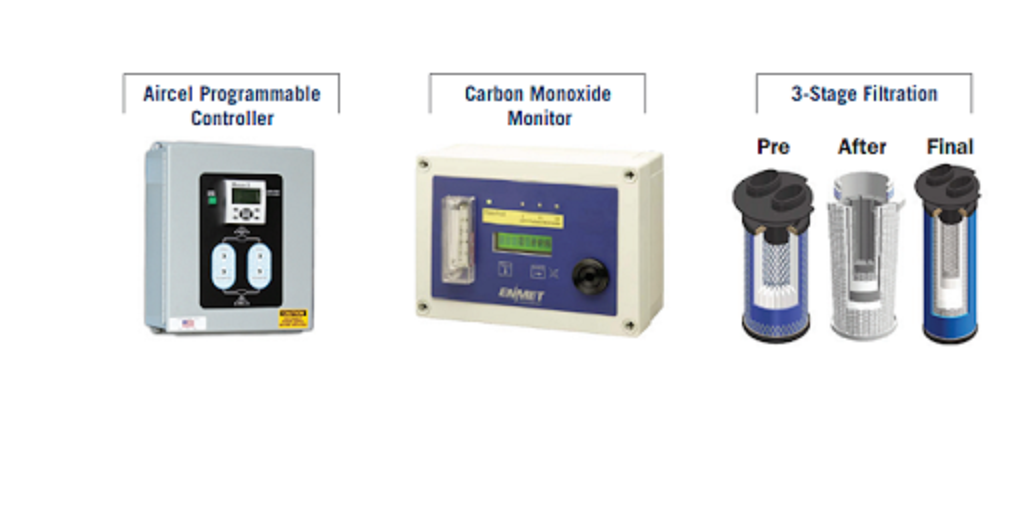
Most facilities managers evaluating a breathing air system for a university or research lab start with the compliance question: does it meet OSHA standards? That's the right starting point, but the number of purification stages a system runs tells you more about its real-world reliability than any certification label. Not every design addresses every contaminant class, and some skip steps entirely. When they do, something passes through that shouldn't.
What a Breathing Air System Does Across Seven Stages
Compressed air from a standard breathing air compressor carries a mix of contaminants: moisture, oil mist, hydrocarbon vapors, particulates, and sometimes carbon monoxide from compressor overheating. No single filtration medium handles all of these.
Stage one is a coalescing pre-filter that removes particulates, water aerosols, and oil mist before air enters the towers. A degraded element here fouls the downstream adsorbent media and shortens the overall service life.
A full breathing air system sequences stages two through five inside dual towers alternating between adsorption and regeneration. The first adsorbent layer is 13X molecular sieve, targeting volatile organic compounds, acid-forming gases, and moisture. Activated alumina follows, driving dewpoint down to -40°F or lower at line pressure. The carulite catalyst layer converts CO to CO2 and oxidizes residual hydrocarbon vapors, a step compressed air filtration alone can't replicate, with a second activated alumina layer above it to capture what remains.
Stage six is an activated carbon after-filter dropping residual oil vapor below 0.003 ppm. Stage seven is a sub-micron final filter removing fine aerosols and particulates generated internally. CO monitoring runs continuously at the outlet, alarming when concentration crosses a preset threshold.
Remove any stage and you're not missing a technicality. You're leaving a specific gap for a specific class of contaminants.
Where a Breathing Air System Falls Short Without Every Stage
Several competing designs route air through three separate purification vessels, treating the added complexity as a sign of capability. Three vessels don't mean better performance. That extra vessel is often a workaround for a media configuration that can't cover the full contaminant range in fewer stages.
The contaminant that matters most when stages are missing is carbon monoxide. A complete breathing air system built to OSHA 29 CFR 1910.134 must keep CO at or below 10 ppm. CSA standards set that at 5 ppm. The carulite catalyst stage is what enables consistent compliance. Grade D breathing air requirements also cover hydrocarbon condensate, CO2 concentration, and oxygen content, and a respirator air supply without catalyst treatment has no way to address CO generated downstream during compression.
Air quality standards govern all of these categories. An incomplete air supply system may pass one or two and still fall short of the full standard.
What EHS Coordinators Should Be Asking Before the Next Audit
Auditing breathing air purification equipment should start with documentation, not a visual inspection. Ask for a stage-by-stage process breakdown. If the vendor can't explain what each media layer targets, that's worth noting before any renewal or procurement decision.
Air quality testing at the outlet should be scheduled and documented. CO monitoring should be continuous, not periodic. Pre-filter condition directly affects downstream media life, so documented replacement intervals matter as much as the original system spec.
Is Your Breathing Air System Running Every Stage It Should?
Not every breathing air system on the market runs all seven stages, and some that don't still carry compliance-sounding language. Facilities managers and EHS coordinators at universities and research labs should ask for a stage-by-stage process explanation before any purchase or renewal, not just an outlet air quality certificate. Air & Vacuum Process Inc. carries the Aircel BHD Series, a seven-stage breathing air purification system that meets and exceeds both OSHA and CSA standards. Their team can help assess whether your current setup covers every stage.
For more information about Compressed Air Dryer System and Automatic Drain Valves Please visit: Air & Vacuum Process Inc.

 Bangla