


Understanding Cold Work Permits: Turning Routine Tasks into Safer Operations
Understanding Cold Work Permits: Turning Routine Tasks into Safer Operations
Serious workplace injuries rarely stem from dramatic accidents or major equipment failures. More often, they happen during ordinary tasks that employees complete every day without giving them much thought. Activities such as removing machine guards, tightening bolts, adjusting equipment, or carrying out routine inspections gradually become second nature. As familiarity grows, workers naturally become more confident, and that confidence can unintentionally reduce attention to detail. When routine replaces awareness, even minor hazards can remain unnoticed until they lead to an incident.
This is where a Cold Work Permit plays an important role. Rather than adding unnecessary paperwork, it creates an opportunity to stop, assess, and prepare before work begins. The permit requires the activity to be clearly documented, potential hazards to be identified, and appropriate safety measures to be confirmed in advance. That short pause changes the approach from simply completing a task to performing it with planning and control. Instead of depending solely on experience or habit, workers verify that safe conditions exist before proceeding.
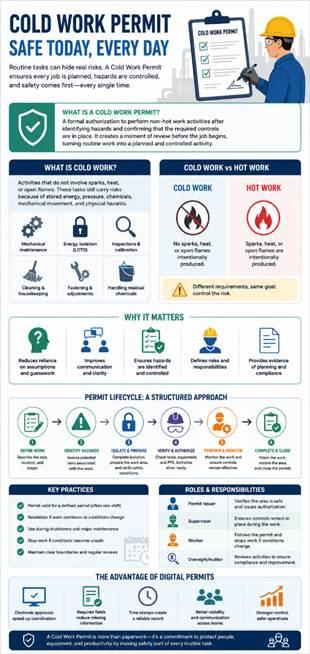
Cold work includes activities that do not intentionally produce heat, sparks, or open flames. Since these jobs do not create ignition sources, they generally do not require the fire protection measures associated with hot work. However, the absence of flames or heat should never be mistaken for the absence of risk.
Many cold work activities are performed on equipment that still contains hidden or stored energy. Mechanical components may remain under load, pressure can still exist inside systems, and chemicals may remain trapped within equipment. Removing fasteners, clamps, or restraints can cause parts to shift unexpectedly, while workers may also encounter pinch points, sharp edges, or sudden equipment movement. Although these hazards may appear less obvious than those associated with hot work, they are fully capable of causing significant injuries when they are not properly controlled.
Typical cold work covers a wide range of maintenance activities, including replacing damaged components, adjusting machinery, servicing mechanical equipment, and installing or removing fasteners. It also includes energy isolation procedures such as shutting down machinery, disconnecting electrical supplies, applying lockout devices, and verifying that all hazardous energy has been eliminated before work starts. Routine inspections, equipment cleaning, calibration, and some housekeeping activities may also fall under cold work whenever they expose personnel to mechanical, physical, or chemical hazards.
The distinction between hot work and cold work is straightforward. Any task that intentionally generates heat, sparks, or flames is classified as hot work. Activities that do not create these ignition sources are considered cold work. Even so, this classification should never be interpreted as meaning the work is low risk. Proper planning and hazard control remain equally important.
Without a formal permit process, routine work often relies on assumptions rather than verification. One person may believe a machine has already been isolated, while another assumes personal protective equipment will automatically be worn. Teams may also expect that everyone nearby knows maintenance is taking place. When these assumptions are left unchecked, communication failures become more likely, increasing the potential for errors and unsafe conditions.
Many workplace incidents, operational interruptions, and compliance issues begin with jobs that seemed too simple to require structured control. A Cold Work Permit eliminates much of this uncertainty by providing a clear, documented process. It records the scope of work, identifies where the activity will occur, highlights the associated hazards, specifies the required safety controls, and assigns responsibilities to the appropriate individuals. By establishing these expectations before work begins, safety becomes an integral part of the job rather than something left to routine practice.
Most Cold Work Permits remain valid only for a defined period, commonly a single work shift. If the task extends beyond that timeframe, the permit must be reviewed and reauthorized before work continues. This review ensures that workplace conditions have not changed and that existing control measures remain suitable. Revalidation also provides an opportunity for teams to discuss the job, reassess risks, and confirm that the work can continue safely.
During large maintenance projects or planned shutdowns, permit systems may be used to manage multiple activities across a broader work scope. Even in these situations, clearly defined work boundaries and periodic permit reviews are essential to ensure documentation accurately reflects current site conditions and operational changes.
Clearly defined responsibilities also contribute to the effectiveness of the permit process. The permit issuer verifies that the work area is safe and formally authorizes the activity. Supervisors monitor the work to ensure required precautions remain in place throughout the task. Workers are expected to stop work immediately if conditions change or new hazards emerge. Additional oversight personnel may also review permit activities to confirm that established procedures and compliance requirements are being followed.
An effective Cold Work Permit follows a logical and structured sequence. The work is first identified and planned, potential hazards are assessed, required isolations are completed, and the work area is prepared. Before authorization is granted, tools, equipment, and personal protective equipment are checked to ensure they are suitable for the task. Work is then monitored while it is being performed, and once all activities are complete, the permit is officially closed. This structured workflow promotes accountability while confirming that identified risks have been properly managed from beginning to end.
Even in situations where regulations do not explicitly require a Cold Work Permit, the process continues to reinforce good safety practices. It demonstrates that hazards were evaluated, appropriate controls were implemented, and responsibilities were clearly assigned before work started. More than a procedural document, the permit reflects an organization's commitment to carrying out routine work safely and consistently.
Digital permit solutions enhance this approach by making the entire process more efficient and transparent. Electronic approvals improve communication between teams, mandatory data fields help prevent missing information, and automated timestamps provide a reliable record of every stage of the permit lifecycle. With greater visibility, improved coordination, and stronger traceability, organizations can maintain better operational control while ensuring that workplace safety remains a priority throughout every cold work activity.
Book a free demo @ https://toolkitx.com/blogsdetails.aspx?title=Cold-work-permit-(2025-guide)%3A-definition%2C-OSHA%2FHSE-mapping-and-checklist

 Bangla