


AI Data Collection for Healthcare: Everything You Need to Know
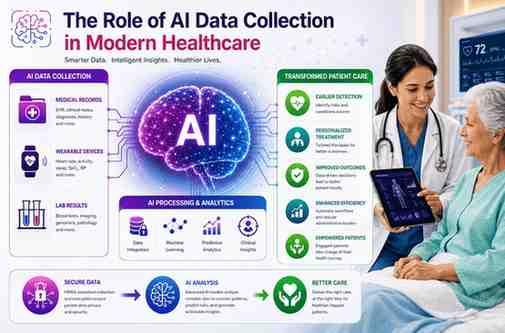
The healthcare industry is undergoing a major digital transformation, and artificial intelligence (AI) is playing a central role in improving patient care, medical research, and operational efficiency. At the heart of this transformation is AI Data Collection for Healthcare, a process that enables healthcare organizations to gather, process, and analyze large volumes of medical data to support smarter decision-making.
From electronic health records (EHRs) and medical imaging to wearable devices and clinical research data, AI-powered data collection is helping healthcare providers deliver faster, more accurate, and personalized services. For U.S. healthcare organizations looking to adopt advanced technologies, understanding how AI data collection works and its benefits is essential.
What Is AI Data Collection for Healthcare?
AI Data Collection for Healthcare refers to the use of artificial intelligence technologies to collect, organize, and analyze healthcare-related information from multiple sources. Unlike traditional data collection methods, AI systems can automatically identify patterns, extract meaningful insights, and manage complex datasets with greater speed and accuracy.
Healthcare data collected through AI systems may include:
-
Patient medical records and health histories
-
Diagnostic images such as X-rays, MRIs, and CT scans
-
Laboratory results
-
Wearable device information
-
Clinical trial data
-
Physician notes and reports
-
Patient feedback and behavioral data
AI-powered solutions help healthcare providers transform raw information into actionable insights that improve diagnosis, treatment planning, and patient outcomes.
Why Is AI Data Collection Important in Healthcare?
Healthcare generates massive amounts of data every day. However, collecting and managing this information manually can be time-consuming, expensive, and prone to errors. AI data collection addresses these challenges by automating important processes and improving data quality.
Improving Patient Care and Diagnosis
One of the biggest advantages of AI data collection is its ability to support better patient care. AI algorithms can analyze medical records, symptoms, and diagnostic information to help healthcare professionals identify health risks and make informed decisions.
For example, AI systems can detect patterns in imaging scans or patient histories that may be difficult for humans to recognize. This allows doctors to diagnose conditions earlier and develop more effective treatment strategies.
Enhancing Medical Research
Medical researchers rely on accurate and diverse datasets to develop new treatments and understand diseases. AI data collection enables researchers to gather and analyze large datasets from various sources, accelerating discoveries in areas such as drug development, genomics, and personalized medicine.
By using AI-driven insights, researchers can identify trends faster and improve the efficiency of clinical studies.
How Does AI Data Collection Work in Healthcare?
AI data collection involves several key steps that allow healthcare organizations to capture and process information effectively.
1. Data Gathering From Multiple Sources
AI systems collect healthcare information from different platforms, including:
-
Electronic health record systems
-
Healthcare applications
-
Medical devices
-
Remote patient monitoring tools
-
Patient surveys
This creates a comprehensive dataset that provides a complete view of patient health.
2. Data Processing and Cleaning
Healthcare data often comes in different formats and may contain missing or inconsistent information. AI technologies help clean and organize data by identifying errors, removing duplicates, and standardizing information.
High-quality data is essential because AI models depend on accurate information to generate reliable results.
3. Data Analysis Using Machine Learning
Once collected and processed, AI algorithms analyze healthcare data to identify patterns and generate predictions. Machine learning models can support tasks such as disease prediction, patient risk assessment, and treatment recommendations.
Common Applications of AI Data Collection in Healthcare
AI data collection is being used across many areas of the healthcare industry.
Medical Imaging Analysis
AI-powered systems analyze medical images to assist radiologists in detecting conditions such as tumors, fractures, and other abnormalities. This improves diagnostic accuracy and reduces the time required for image review.
Remote Patient Monitoring
Wearable devices and connected healthcare technologies collect real-time patient information, including heart rate, blood pressure, and activity levels. AI analyzes this data to monitor patient conditions and alert healthcare providers when intervention may be needed.
Clinical Trials and Research
AI data collection helps pharmaceutical companies and research institutions gather clinical trial information more efficiently. By analyzing participant data, researchers can improve trial design and identify potential treatment outcomes.
Healthcare Automation
AI-driven data collection also supports administrative tasks such as appointment management, insurance processing, and patient communication. Automation reduces workload for healthcare staff and improves operational efficiency.
Benefits of AI Data Collection for Healthcare Organizations
Healthcare providers across the United States are adopting AI data collection because it offers several important benefits.
Better Data Accuracy
AI reduces human errors by automating data entry and validation processes. This ensures healthcare professionals have access to reliable information.
Faster Decision-Making
AI systems can analyze thousands of data points within seconds, helping healthcare providers make quicker decisions and respond faster to patient needs.
Personalized Healthcare
AI enables personalized medicine by analyzing individual patient data and identifying treatments that are more suitable for specific health conditions.
Improved Healthcare Efficiency
Automated data collection reduces administrative burdens and allows healthcare professionals to focus more on patient care.
Challenges of AI Data Collection in Healthcare
Although AI offers significant advantages, healthcare organizations must address several challenges.
Data Privacy and Security
Healthcare data is highly sensitive, and protecting patient information is a top priority. Organizations must follow regulations such as HIPAA and implement strong cybersecurity practices to safeguard medical data.
Data Quality Issues
AI models require accurate and diverse datasets. Poor-quality or incomplete data can affect the reliability of AI-generated insights.
Integration With Existing Systems
Many healthcare organizations still rely on traditional systems. Integrating AI solutions with existing healthcare infrastructure can require significant planning and investment.
The Future of AI Data Collection for Healthcare
The future of AI Data Collection for Healthcare is expected to bring even greater innovation. Advances in machine learning, natural language processing, and predictive analytics will continue improving how healthcare data is collected and used.
Future AI systems may provide more accurate disease predictions, support real-time health monitoring, and enable highly personalized treatment plans. As healthcare organizations continue embracing digital transformation, AI data collection will become an essential component of modern healthcare delivery.
Conclusion
AI Data Collection for Healthcare is transforming how medical information is gathered, analyzed, and applied. By improving data accuracy, accelerating research, and supporting better patient outcomes, AI is helping healthcare organizations create smarter and more efficient systems.
For healthcare companies in the U.S., investing in AI-powered data collection solutions can provide a competitive advantage while improving the quality of care delivered to patients. As technology continues to evolve, AI will remain a key driver of innovation across the healthcare industry.

 Bangla