

Recycled Polypropylene Market Forecast to 2035: Sustainability and Recycling Opportunities

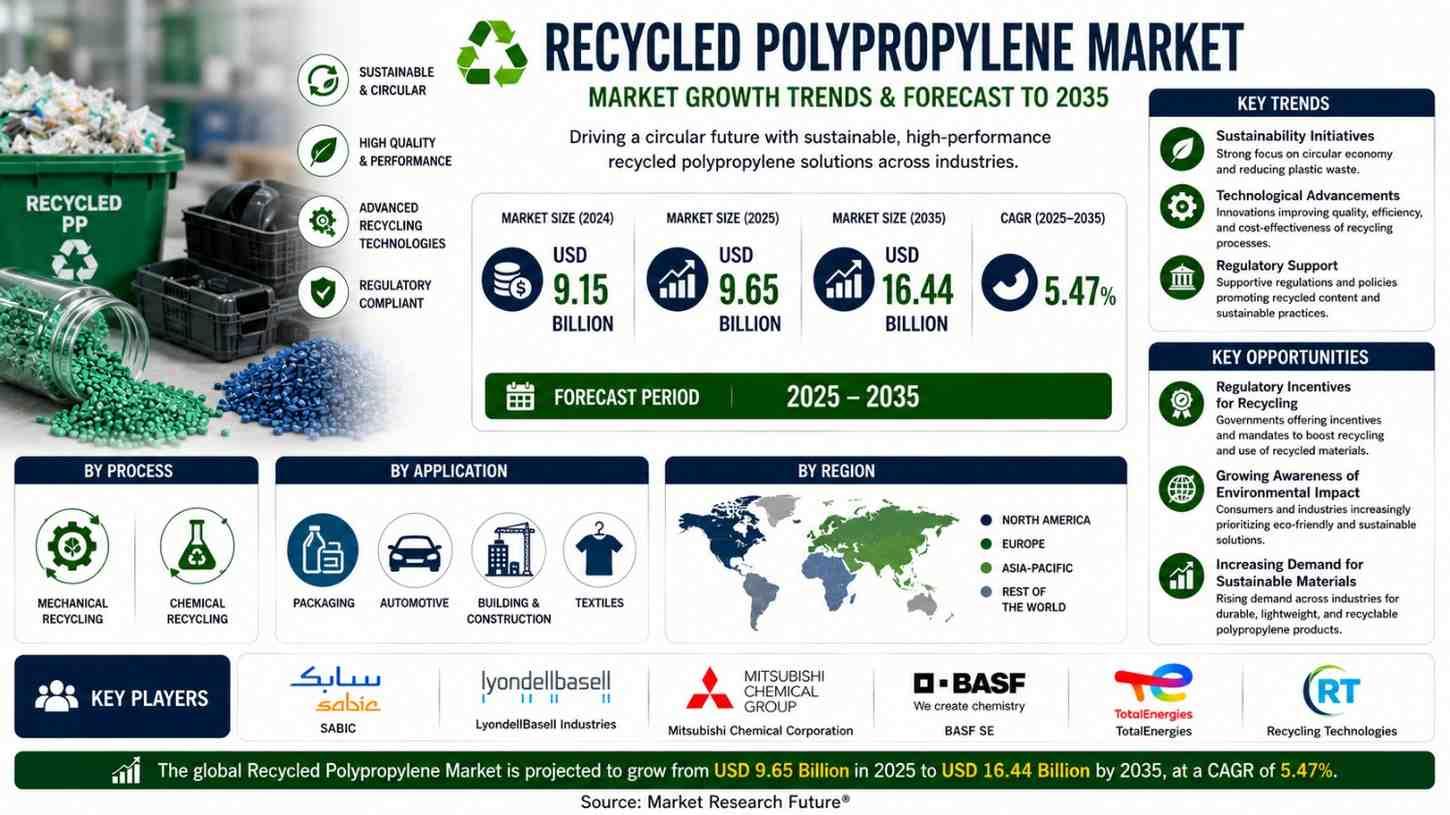
According to Market Research Future®, the Recycled Polypropylene Market Outlook was valued at USD 9.15 billion in 2024 and is projected to grow from USD 9.65 billion in 2025 to USD 16.44 billion by 2035, registering a CAGR of 5.47% during the forecast period.
The recycled polypropylene industry is moving beyond conventional plastic waste management toward a broader circular-materials economy. Manufacturers across packaging, automotive, construction, textiles, and consumer products are increasingly looking to recovered polypropylene as a commercially viable feedstock that can reduce dependence on virgin polymers while supporting corporate sustainability objectives.
Polypropylene is widely used because of its strength, chemical resistance, low density, and processing versatility. Those same characteristics make recovery and reprocessing particularly important as global plastic consumption increases. Improvements in collection systems, sorting technologies, washing, purification, compounding, and quality control are helping recyclers convert post-consumer and post-industrial polypropylene into higher-value secondary materials.
Packaging remains a major demand center because polypropylene is extensively used in rigid containers, caps, closures, films, woven sacks, and consumer products. Automotive manufacturers are also increasing interest in recycled polypropylene for selected interior and exterior components as vehicle producers seek lower-carbon materials and greater recycled content.
Regulatory developments are strengthening the commercial case for recycled polymers. Recycled-content targets, extended producer responsibility programs, plastic-waste reduction policies, and corporate sustainability commitments are encouraging brand owners and converters to integrate recycled polypropylene into their supply chains.
Technological progress is simultaneously widening the potential application base. Mechanical recycling remains the established pathway for suitable waste streams, while chemical recycling is attracting attention for more complex materials that are difficult to process mechanically. Advanced compounding and purification technologies are improving material consistency and expanding opportunities in higher-performance applications.
Major industry participants including SABIC, LyondellBasell Industries, Mitsubishi Chemical Corporation, BASF SE, TotalEnergies, and Recycling Technologies continue investing in recycling infrastructure, circular polymer technologies, sustainable material development, and production expansion.
Get a sample report pdf| https://www.marketresearchfuture.com/sample_request/7502
Market Overview
The recycled polypropylene market represents a significant segment of the circular plastics industry by converting polypropylene waste into reusable polymer feedstock for manufacturing applications.
The market is primarily divided between mechanical and chemical recycling processes. Mechanical recycling generally involves collection, sorting, cleaning, shredding, melting, extrusion, and pelletization. Chemical recycling uses processes capable of converting polymer waste into chemical feedstocks or intermediate materials for subsequent polymer production.
Recycled polypropylene can be supplied in different grades and formulations depending on purity, color, mechanical properties, processing requirements, and end-use specifications. Packaging, automotive, construction, and textiles remain important application areas.
The growing emphasis on circular economy principles is encouraging manufacturers to view plastic waste as a resource rather than solely as a disposal challenge.
Market Size Analysis
The recycled polypropylene market reached USD 9.65 billion in 2025, reflecting increasing demand for recycled polymers across manufacturing industries.
Packaging represents a major consumption segment. Food and consumer-product packaging manufacturers are exploring recycled polypropylene for containers, closures, films, and other products where recycled content can be incorporated while maintaining required functionality.
The automotive sector is another important growth area. Recycled polypropylene can be used in selected vehicle components, interior systems, trim products, and other applications where lightweight construction and material efficiency are important.
Construction applications are developing as recycled polymers find uses in specialized building products, protective components, infrastructure materials, and other polymer-based applications.
Textile manufacturers are also exploring recycled polypropylene fibers and related products as brands increasingly emphasize recycled-content materials and more responsible sourcing.
Market Forecast
The market is projected to reach USD 16.44 billion by 2035, supported by regulatory incentives, expanding recycling infrastructure, increasing corporate sustainability commitments, and growing demand for sustainable polymer materials.
The market's development will increasingly depend on the ability of recyclers to produce consistent-quality materials at competitive costs. Improvements in collection infrastructure and waste sorting will be particularly important for increasing the availability of suitable polypropylene feedstock.
Technology and Innovation
Technological development is becoming a central factor in the commercialization of recycled polypropylene.
Advanced optical and automated sorting systems can improve the separation of polypropylene from mixed plastic waste. Better identification of polymer types, colors, additives, and contaminants helps recyclers improve feedstock quality before processing.
Mechanical recycling technologies continue advancing through improved shredders, washing systems, extrusion equipment, filtration, and pelletization. These improvements can increase throughput while reducing contamination and material losses.
Chemical recycling represents a complementary technology pathway. It has potential to process selected difficult waste streams and generate feedstocks that can be used in the production of polymers with characteristics closer to virgin materials.
Compounding technologies are also becoming increasingly important. Additives, fillers, stabilizers, and reinforcement materials can help improve the mechanical and thermal properties of recycled polypropylene, enabling its use in more demanding applications.
Digitalization is strengthening recycling operations through real-time process monitoring, automated quality control, material traceability, predictive maintenance, and data-driven production optimization.
Industry Trends
Sustainability remains the defining trend across the recycled polypropylene industry. Brand owners and manufacturers are under increasing pressure to reduce virgin plastic consumption and improve the circularity of their products.
Regulatory support is another important catalyst. Recycled-content requirements and extended producer responsibility frameworks are encouraging investment in collection, sorting, recycling, and secondary-polymer supply chains.
The quality gap between recycled and virgin polypropylene is also narrowing as purification, compounding, and process-control technologies improve.
Increasing demand for sustainable packaging is further strengthening market opportunities, particularly among consumer-facing brands seeking to demonstrate measurable progress toward circular-material targets.
Growth Opportunities
Regulatory incentives for recycling are creating a favorable environment for investment in polypropylene recovery and processing facilities. Governments seeking to reduce landfill disposal and plastic leakage are increasingly supporting recycling infrastructure.
Growing awareness of environmental impacts is encouraging manufacturers to adopt recycled materials throughout their product portfolios. Sustainability commitments are increasingly influencing purchasing decisions among both businesses and consumers.
Sustainable packaging demand offers a particularly attractive opportunity. Recycled polypropylene can provide a pathway toward lower-impact packaging while retaining many of the functional advantages associated with polypropylene.
Emerging economies also offer considerable potential. Improvements in municipal waste collection, material recovery facilities, and recycling infrastructure could unlock substantial volumes of polypropylene that are currently under-recovered.
Competitive Landscape
The recycled polypropylene market remains competitive as participants seek to differentiate through feedstock access, recycling technology, material quality, processing scale, and sustainability performance.
Sabic, LyondellBasell Industries, Mitsubishi Chemical Corporation, BASF SE, TotalEnergies, and Recycling Technologies are among the companies investing in circular polymer technologies, recycling capabilities, research and development, and sustainable material solutions.
Large chemical companies benefit from established polymer expertise, customer relationships, and global distribution networks, while specialized recyclers can compete through innovative processing technologies and focused waste-recovery capabilities.
Future competitive advantage will increasingly depend on the ability to combine reliable feedstock sourcing with consistent product specifications, scalable processing, competitive economics, and credible environmental performance.
Recent Industry Developments
The industry is seeing increased investment in advanced sorting and recycling infrastructure as companies seek to improve polypropylene recovery rates and produce higher-quality recycled materials.
Chemical recycling initiatives are also attracting attention as manufacturers investigate pathways for processing more complex plastic waste streams.
At the same time, brand owners and packaging companies are increasing demand for recycled-content polymers, encouraging suppliers to develop materials with more consistent color, purity, mechanical properties, and regulatory compatibility.
Digital traceability is emerging as another important development. Tracking the origin, processing history, and recycled content of polymer materials can improve supply-chain transparency and help companies substantiate sustainability claims.
Future Outlook
The global recycled polypropylene market is expected to maintain steady growth through 2035 as circular economy policies, sustainable packaging requirements, and corporate environmental commitments continue strengthening demand.
Mechanical recycling will remain an important foundation of the industry, particularly for clean and relatively homogeneous polypropylene waste streams. Chemical recycling could complement these systems by addressing selected waste streams that are more difficult to process mechanically.
Future growth will also depend on improvements in collection infrastructure, sorting efficiency, material purification, advanced compounding, and digital traceability. As recycled polypropylene increasingly meets demanding performance requirements, its role will expand from a sustainability-focused alternative toward a mainstream industrial feedstock.
Professional Conclusion
The recycled polypropylene market is becoming an increasingly important link between plastic consumption and circular material management. Its growth is being supported not only by environmental concerns but also by regulatory requirements, corporate sustainability targets, technological progress, and the economic value of recovered polymers.
With the market projected to reach USD 16.44 billion by 2035, opportunities are emerging across packaging, automotive, construction, textiles, and other polymer-intensive industries. Companies capable of improving material quality, securing reliable waste streams, scaling advanced recycling technologies, and demonstrating measurable environmental benefits will be well positioned to participate in the next stage of recycled polypropylene development.

