

India Road Freight Transport Market to Reach USD 401.9 Billion by 2035 Amid Rapid Logistics Modernization

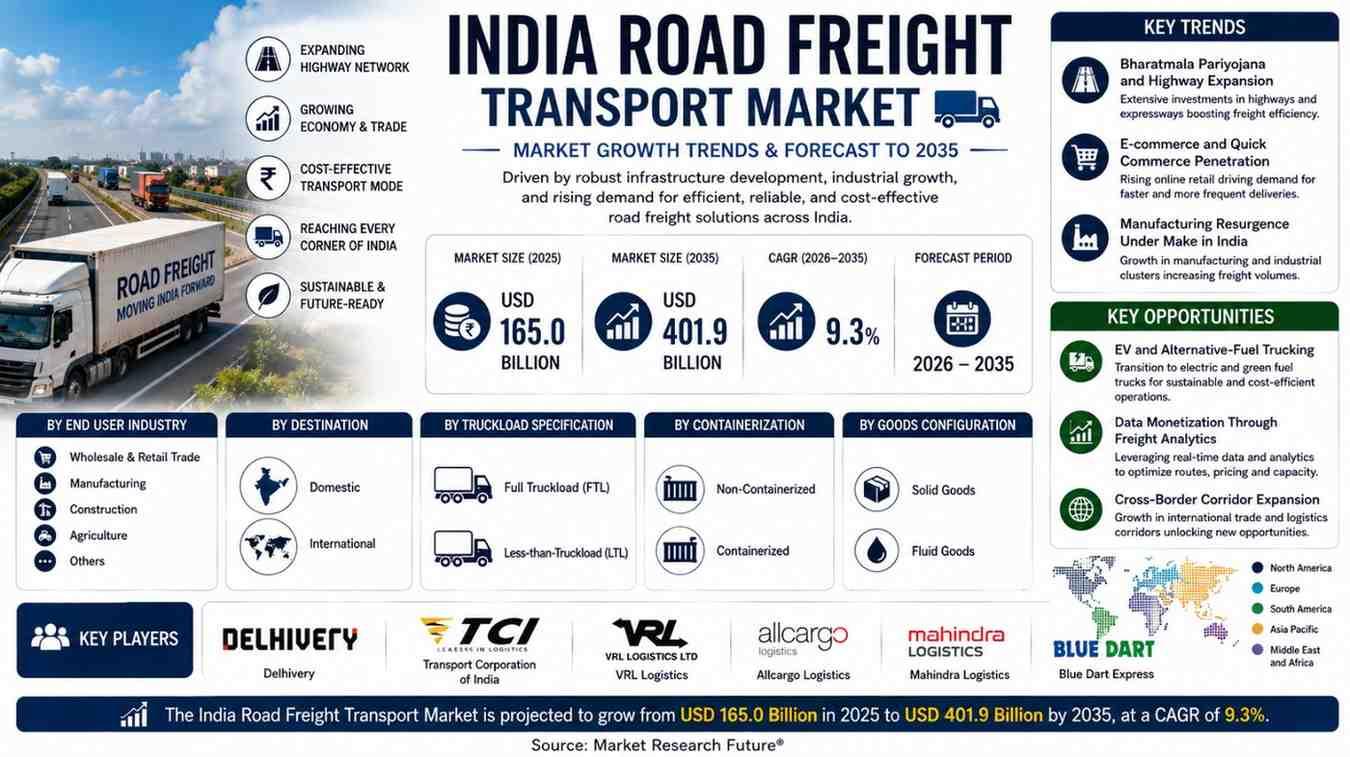
According to Market Research Future®, the India Road Freight Transport Market Outlook is projected to expand from USD 165.0 billion in 2025 to USD 401.9 billion by 2035, registering a CAGR of 9.3% during the forecast period from 2026 to 2035.
India's road freight transport sector is becoming increasingly important to the country's economic and industrial expansion. Road networks connect manufacturing clusters, agricultural production centers, ports, warehouses, wholesale markets, retailers, and consumers, making road freight a fundamental component of domestic commerce and supply-chain operations.
The market is benefiting from simultaneous developments across infrastructure, manufacturing, retail, agriculture, and technology. Highway expansion is improving freight connectivity, while the growth of e-commerce is increasing demand for faster and more flexible delivery services. At the same time, the expansion of domestic manufacturing is creating additional transportation requirements for raw materials, components, intermediate products, and finished goods.
The scale of India's consumer economy provides a particularly strong foundation for road freight growth. Wholesale and retail businesses require extensive distribution networks, while quick-commerce models are increasing shipment frequency and placing greater emphasis on delivery speed and localized fulfillment. These changes are encouraging logistics providers to redesign transportation networks and invest in technology-enabled fleet management.
Manufacturing expansion is another important driver. Initiatives supporting domestic production are encouraging investment in automotive, electronics, pharmaceuticals, machinery, consumer products, and other industries. As production capacity expands, road transportation becomes increasingly important for connecting suppliers with factories and finished products with regional distribution centers.
Agriculture remains an essential part of the freight ecosystem. Road transportation provides connectivity between farms, collection centers, processing facilities, cold-storage locations, wholesale markets, retailers, and consumers. Improved transportation efficiency can support faster movement of agricultural products and reduce supply-chain inefficiencies.
Technology is increasingly defining how freight is managed. Digital freight platforms, GPS tracking, telematics, artificial intelligence, predictive analytics, automated documentation, and route optimization are helping logistics providers improve visibility and operational efficiency. Meanwhile, electric and alternative-fuel trucks are creating a pathway toward more sustainable freight operations.
Major companies including Delhivery, Transport Corporation of India, VRL Logistics, Allcargo Logistics, Mahindra Logistics, and Blue Dart Express continue expanding their networks and strengthening technology-driven transportation capabilities.
Get a sample report pdf| https://www.marketresearchfuture.com/sample_request/21346
Market Overview
The India road freight transport market includes transportation services supporting wholesale and retail trade, manufacturing, construction, agriculture, and other industries.
The market is segmented by destination into domestic and international freight. Domestic transportation accounts for a substantial portion of activity because India's large and geographically dispersed consumer and industrial markets require extensive road connectivity.
Truckload specifications include full truckload and less-than-truckload services. Full truckload transportation is suitable for larger consignments requiring dedicated capacity, while less-than-truckload services provide flexibility for smaller shipments.
Freight can also be classified according to containerization, with both containerized and non-containerized transportation serving different cargo requirements. Goods configuration includes solid and fluid goods, creating demand for specialized transportation equipment and handling capabilities.
Market Size Analysis
The India road freight transport market reached USD 165.0 billion in 2025, reflecting increasing freight requirements across major economic sectors.
Wholesale and retail trade is a major contributor as organized retail, e-commerce, and quick-commerce platforms expand distribution networks. The need for frequent deliveries across urban and regional markets is increasing demand for flexible transportation capacity.
Manufacturing is generating substantial freight volumes as production expands across automotive, electronics, pharmaceuticals, machinery, consumer goods, and other industries. Road freight remains important for both inbound material movement and outbound product distribution.
Construction activity is also creating demand for transportation of steel, cement, aggregates, machinery, equipment, and other construction inputs. Infrastructure development further increases requirements for specialized and heavy freight services.
Agricultural transportation continues supporting the movement of crops, food products, livestock-related goods, and processed agricultural commodities from production areas to markets and distribution facilities.
The increasing use of third-party logistics providers is further strengthening the market as companies seek to outsource transportation and distribution activities while focusing on their core operations.
Market Forecast
The India road freight transport market is expected to reach USD 401.9 billion by 2035, supported by highway expansion, manufacturing growth, e-commerce penetration, organized logistics, and increasing freight volumes.
Improved road connectivity should strengthen the efficiency of major freight corridors and reduce transportation bottlenecks. Greater integration between highways, logistics parks, warehouses, ports, and industrial clusters can further improve supply-chain performance.
Technology adoption will remain another important growth factor. Digital freight platforms and intelligent fleet-management systems can help logistics providers optimize capacity, improve route planning, and provide greater shipment visibility.
The transition toward electric and alternative-fuel vehicles is also expected to create opportunities for fleet modernization, particularly in urban and regional transportation.
2026–2035 Industry Outlook
The market is entering the forecast period with several structural factors supporting expansion.
Highway development and freight-corridor improvements are strengthening road connectivity between major industrial and commercial regions. Better infrastructure can reduce transit times and improve fleet productivity.
E-commerce and quick commerce are changing freight requirements by increasing shipment frequency and creating demand for highly responsive last-mile networks. Logistics companies are therefore expanding localized fulfillment and delivery capabilities.
Manufacturing expansion is generating new freight flows between industrial clusters, suppliers, warehouses, and consumers. The continued development of domestic production capabilities should increase the need for dependable road transportation.
Another important development is the increasing professionalization of the logistics industry. Digital platforms, organized third-party logistics providers, integrated warehousing, and technology-enabled freight management are gradually improving supply-chain visibility.
Sustainability is also becoming more important. Freight operators are examining alternative fuels, electric vehicles, route optimization, fleet efficiency, and other approaches that can reduce operating emissions while controlling costs.
Technology & Innovation
Digitalization is transforming freight transportation across India.
Artificial intelligence and machine learning can analyze traffic, shipment, vehicle, and historical route data to improve dispatch decisions and transportation planning. Predictive analytics can also help logistics companies anticipate demand fluctuations and maintenance requirements.
Fleet telematics provides real-time information about vehicle location, speed, fuel consumption, driver behavior, and operating conditions. This information can improve fleet utilization and strengthen shipment visibility.
Digital freight marketplaces are helping connect shippers with available transportation capacity. These platforms can simplify booking, documentation, tracking, and communication between freight owners and carriers.
Automated documentation and digital proof-of-delivery systems can reduce administrative workloads while improving transparency.
Electric and alternative-fuel trucks represent an emerging area of innovation. Their adoption will depend on vehicle economics, charging or fueling infrastructure, route characteristics, and regulatory developments.
Freight analytics also provides opportunities to extract greater value from transportation data. Logistics providers can use accumulated information to identify inefficient routes, forecast demand, improve asset utilization, and support network planning.
Key Market Trends
Highway Expansion and Freight Connectivity
Continued development of highways and freight corridors is improving connectivity between industrial centers, ports, distribution hubs, and consumer markets.
E-Commerce and Quick Commerce
Online retail is increasing shipment volumes and creating demand for faster, flexible, technology-enabled transportation networks.
Manufacturing Growth
Domestic manufacturing expansion is generating additional movement of raw materials, components, intermediate goods, and finished products.
Digital Freight Management
Telematics, digital freight platforms, AI-based optimization, and real-time tracking are becoming increasingly important for improving transportation efficiency.
Sustainable Transportation
Electric vehicles, alternative fuels, route optimization, and efficient fleet management are gaining attention as companies seek to reduce environmental impact.
Growth Opportunities
EV and alternative-fuel trucking represents a major opportunity for fleet operators and logistics companies. Electric vehicles may gain particular traction in predictable urban and regional routes where charging infrastructure can be efficiently planned.
Freight analytics provides another emerging opportunity. Data collected from vehicles, shipments, customers, and routes can help companies optimize transportation networks and develop value-added logistics services.
Cross-border corridor expansion can strengthen India's connection with neighboring economies and support international trade. Improved road connectivity and logistics infrastructure can facilitate more efficient movement across regional trade routes.
E-commerce will continue creating opportunities for providers capable of combining first-mile collection, middle-mile transportation, warehousing, and last-mile delivery.
Specialized logistics also offers growth potential across pharmaceuticals, electronics, automotive components, agricultural products, and other goods requiring customized transportation solutions.
Competitive Landscape
Competition in India's road freight sector is increasingly centered on network coverage, delivery reliability, fleet efficiency, technology, pricing, and customer experience.
Delhivery, Transport Corporation of India, VRL Logistics, Allcargo Logistics, Mahindra Logistics, and Blue Dart Express continue strengthening their capabilities through network expansion, technology investments, fleet management, and integrated logistics services.
Companies with extensive regional coverage and strong digital platforms can improve shipment visibility and customer engagement. Fleet operators capable of optimizing capacity and reducing empty miles can also improve cost efficiency.
Strategic partnerships among carriers, e-commerce companies, manufacturers, warehouse operators, and technology providers are expected to become increasingly important as supply chains become more integrated.
Future Outlook
The India road freight transport market is expected to maintain strong momentum through 2035 as infrastructure development, e-commerce, manufacturing expansion, organized logistics, and agricultural distribution continue increasing demand.
Future growth will increasingly depend on the integration of physical transportation networks with digital technologies. AI-based route optimization, predictive maintenance, connected fleets, automated documentation, and real-time freight visibility can improve efficiency across the transportation ecosystem.
The transition toward electric and alternative-fuel vehicles will gradually influence fleet strategies, particularly as charging infrastructure and vehicle technologies develop.
Cross-border connectivity and improved logistics corridors can also expand India's role in regional trade, while manufacturing and e-commerce will continue generating substantial domestic freight volumes.
Professional Conclusion
The India road freight transport market is evolving into a more integrated, technology-driven, and sustainability-focused logistics ecosystem. With the market projected to increase from USD 165.0 billion in 2025 to USD 401.9 billion by 2035, road freight is positioned to remain a critical component of India's economic and supply-chain infrastructure.
Highway expansion, e-commerce, manufacturing growth, agricultural distribution, EV and alternative-fuel trucking, freight analytics, and cross-border connectivity will create the strongest opportunities over the coming decade. Logistics companies that combine extensive networks with digital visibility, efficient fleet management, specialized services, and sustainable transportation solutions will be best positioned to capture India's expanding freight opportunity.
