


How Can Gangnammould Double Layer Pallet Mold Support Stable Production
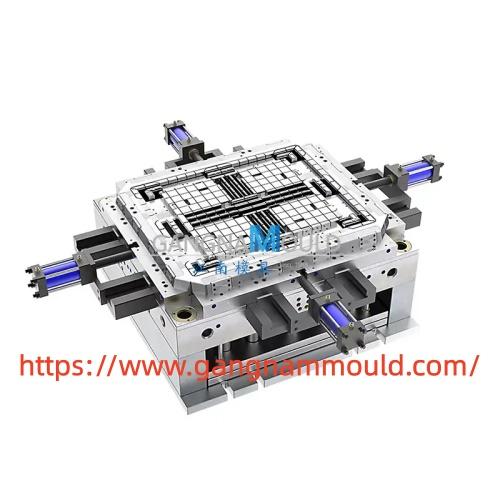
Double Layer Pallet Mold selection requires attention to product geometry, material behavior, cooling, filling, ejection, and machine compatibility. Large logistics platforms often contain broad surfaces, reinforcing ribs, support feet, openings, and connecting structures. These details influence how molten resin travels through the cavity and how the finished component behaves during cooling. Research on large plastic platforms has shown that cooling conditions and processing parameters can have a noticeable relationship with flatness and deformation, making thermal planning an important part of tooling development.
The product drawing should be reviewed carefully before steel processing starts. Dimensions, load requirements, stacking arrangements, forklift access, foot geometry, and reinforcement patterns all affect the tooling structure. A small change in one area may influence gate placement, ejection locations, cooling channels, or the parting arrangement. Early communication gives engineers an opportunity to evaluate these relationships before manufacturing begins.
Material selection is another practical consideration. PP and PE are commonly used for reusable transport platforms because their processing characteristics can suit many logistics applications. The selected grade still needs to match the intended working environment, load conditions, temperature range, impact requirements, and recycling plans. Different resin grades can behave differently during filling and cooling, so the material specification should be confirmed before final engineering decisions are made.
Wall distribution deserves careful review as well. Large flat sections can become difficult to control when thickness changes significantly across the product. Thick areas may retain heat longer than thinner sections, while uneven cooling can contribute to shrinkage differences. Reinforcing ribs can add stiffness, but their dimensions should be coordinated with surrounding walls to avoid creating unnecessary thermal concentration.
Cooling design becomes especially important for large transport products. The cavity and core may contain broad areas that require consistent heat removal, while deeper structural sections may need additional attention. Published research on injection molded logistics platforms has demonstrated that cooling temperature and channel conditions can influence dimensional flatness.
For this reason, cooling channels should be planned according to the actual geometry rather than using a fixed arrangement for every project. Channel diameter, spacing, location, water flow, and access points can all be reviewed during engineering. The goal is to create a practical thermal arrangement that supports balanced cooling across important areas.
Gate positioning also deserves discussion. Large products may require a carefully considered filling route so resin can reach different structural regions without creating unnecessary pressure differences. Gate locations can affect flow length, weld lines, packing behavior, and visible surfaces. Flow analysis can provide useful information before machining, particularly when the product contains several reinforcing sections or broad flat areas.
Ejection is another area that buyers should examine. A large component may need several ejector locations to distribute release force across its structure. If pressure is concentrated around a small region, visible marks or local distortion may occur. The ejector arrangement should therefore work with ribs, feet, support sections, and the overall release direction.
Draft angles also influence release. Vertical surfaces need suitable clearance so the finished component can separate from the forming surfaces without excessive resistance. Deep structural features, textured areas, and narrow spaces may require additional engineering attention. Reviewing these details during the design stage can reduce the need for later modifications.
Venting should not be overlooked either. Air trapped during filling needs suitable escape paths, particularly around corners, ribs, and enclosed structural regions. Poor venting can contribute to incomplete filling, burn marks, or surface irregularities. Proper vent locations should be considered together with the flow path and gate arrangement.
Gangnammould develops tooling around project specific requirements such as product dimensions, resin selection, machine conditions, cooling needs, ejection arrangements, and expected production volume. Providing complete drawings and technical information at the quotation stage can help engineers evaluate the project more accurately and identify potential concerns before machining.
Maintenance planning is also useful for long term production. Water connections, ejector components, inserts, moving parts, and wear areas should be accessible enough for inspection and service. Buyers can also discuss trial procedures, sample approval, dimensional inspection, spare components, and production conditions before the tooling is accepted.
For manufacturers preparing a new logistics platform project, the tooling should be evaluated together with the product rather than as a separate purchase. Structural requirements, resin behavior, filling, cooling, release, and machine conditions all need to work together. Gangnammould provides product and tooling references through https://www.gangnammould.com/product/

 Bangla