


United States Footwear Market Size to Worth USD 121.30 Billion by 2034
IMARC Group has recently released a new research study titled "United States Footwear Market Size, Share, Trends and Forecast by Product, Material, Distribution Channel, Pricing, End User, and Region, 2026-2034", offering a detailed analysis of the market drivers, segmentation, growth opportunities, trends, and competitive landscape to understand the current and future market scenarios.
United States Footwear Market Size & Share 2026-2034
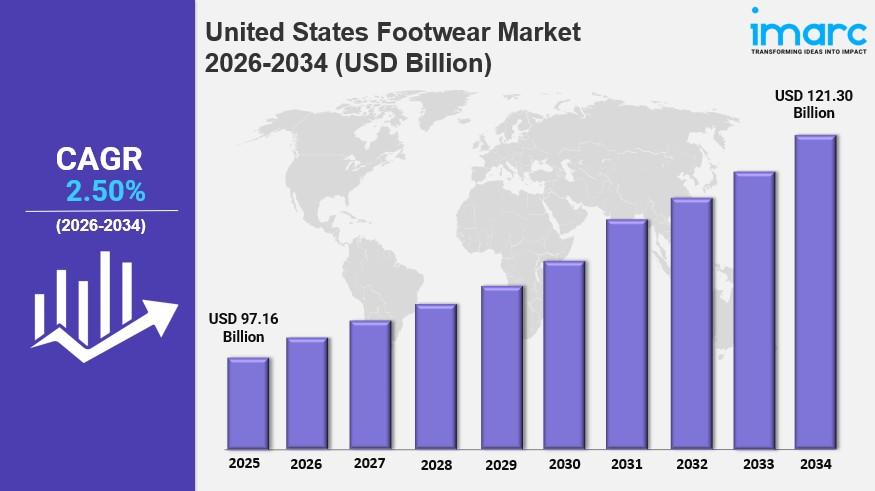
The United States footwear market size was valued at USD 97.16 Billion in 2025 and is projected to reach USD 121.30 Billion by 2034, expanding at a CAGR of 2.50% during 2026-2034. The market is witnessing steady expansion, driven by rising consumer emphasis on comfort, performance, and convenience across urban markets, spurring demand for athletic, casual, and premium footwear categories.
Evolving fashion trends and the growing influence of athleisure culture continue to reshape consumer preferences toward versatile and stylish footwear options. Increasing disposable incomes and digital retail expansion are further fueling accessibility and brand engagement, strengthening the United States footwear market share throughout the forecast period.
Key Market Statistics at a Glance
- Base Year: 2025
- Historical Years: 2020-2025
- Forecast Period: 2026-2034
- Market Size (2025): USD 97.16 Billion
- Projected Market Size (2034): USD 121.30 Billion
- Growth Rate: CAGR of 2.50% (2026-2034)
Explore Opportunities in the United States Footwear Market: Download the IMARC Sample Report: https://www.imarcgroup.com/united-states-footwear-market/requestsample
Key Growth Drivers and Trends in the United States Footwear Market
Growth in the United States footwear market is being driven by rising health and fitness consciousness, as increasing participation in sports, running, and outdoor recreation boosts demand for performance-oriented athletic footwear featuring advanced cushioning, support, and injury-prevention technologies. In September 2025, DICK'S Sporting Goods completed its acquisition of Foot Locker, creating an omni-channel sports and footwear retailer operating over 3,200 stores across 20 countries, reflecting the broader consolidation and omnichannel push reshaping the category.
One of the leading United States footwear market trends is the rapid expansion of e-commerce and digital retail innovation, as consumers increasingly browse, compare, and purchase footwear online. In May 2025, Nike resumed direct sales of its footwear and apparel on Amazon's U.S. website for the first time since 2019, enhancing online accessibility and digital shopping convenience, reflecting bolstering demand for seamless omnichannel experiences among mainstream and premium footwear consumers alike.
Another key factor supporting United States footwear market growth is rising sustainability and eco-friendly practices, as customers and producers gain more awareness regarding environmental impact. In October 2025, The Footwear Collective partnered with Goodwill SoCal to launch the Footwear Futures Project in Los Angeles, collecting and recycling used shoes to promote circularity, reflecting an elevating consumer inclination toward eco-conscious, ethical products across the footwear category.
Speak to an Analyst: https://www.imarcgroup.com/request?type=report&id=2924&flag=C
United States Footwear Industry Segmentation Insights
Breakup by Product:
- Athletic Footwear: Holds the largest market share at 54% in 2025, driven by rising health awareness, sports participation, and the athleisure trend blending performance with everyday style.
- Non-Athletic Footwear: Serves formal, casual, and occasion-based needs, benefiting from steady demand across work, social, and seasonal use cases.
Breakup by Material:
- Leather: Leads the market with a 31% share in 2025, owing to its premium appeal, durability, and classic aesthetics for formal and casual footwear.
- Rubber: Widely used for athletic and outdoor footwear, valued for its flexibility, grip, and water resistance.
- Plastic: Supports affordable, mass-market footwear production with lightweight, versatile applications.
- Fabric: Popular in casual and athleisure footwear for its breathability and comfort.
- Others: Includes emerging and blended materials catering to niche and sustainable footwear segments.
Breakup by Distribution Channel:
- Online Sales: Captures the largest market share at 36% in 2025, driven by convenience, broad product range, competitive pricing, and virtual try-on technologies.
- Footwear Specialists: Benefit from curated assortments and expert guidance for fit and performance-focused purchases.
- Supermarkets and Hypermarkets: Provide broad accessibility for value-oriented, everyday footwear purchases.
- Departmental Stores: Serve consumers seeking a wide brand selection under one roof.
- Clothing Stores: Offer footwear as part of broader apparel and lifestyle shopping trips.
- Others: Includes discount stores, warehouse clubs, and other retail formats.
Breakup by Pricing:
- Mass: Commands the largest market share at 59% in 2025, reflecting strong demand for affordable, value-oriented, and widely available footwear.
- Premium: Benefits from rising consumer interest in quality, brand prestige, and performance-driven footwear.
Breakup by End User:
- Women: Represent the largest segment with a 53% share in 2025, driven by increasing purchasing power, fashion awareness, and expanding footwear offerings.
- Men: Benefit from steady demand across athletic, formal, and casual footwear categories.
- Kids: Reflects consistent demand tied to growth, school, and recreational activity needs.
Breakup by Region:
- South: Holds the largest market share at 39% in 2025, driven by high population density, favorable climate, and strong consumer spending in states like Texas, Florida, Georgia, and North Carolina.
- West: Benefits from a strong athleisure culture and premium footwear demand across major metropolitan hubs.
- Northeast: Driven by affluent consumers and fashion-forward footwear preferences in cities like New York and Boston.
- Midwest: Experiencing steady growth as consumer preferences diversify across athletic and casual footwear.
Key Challenges and Growth Opportunities in the United States Footwear Market
The United States footwear market faces challenges including raw material price volatility tied to leather, rubber, and petroleum-based components, supply chain disruptions from concentrated sourcing regions, and the proliferation of counterfeit products that erode brand equity and consumer trust. Intense competition among domestic and international brands, along with growing private label pressure, further complicates pricing strategies and margins.
Despite these challenges, the market offers considerable growth opportunities driven by continued athleisure convergence, expanding e-commerce and omnichannel retail, and growing consumer preference for sustainable, eco-friendly footwear. In September 2025, Under Armour partnered with UNLESS to introduce plant-based, zero-plastic regenerative sneaker designs in the United States, reflecting expanding opportunities for innovation-led, sustainability-focused growth across the forecast period.
Competitive Landscape
The United States footwear market is intensely competitive, with established multinational corporations, domestic manufacturers, and emerging direct-to-consumer brands competing across diverse product categories and price segments through continuous product innovation, brand positioning, and omnichannel distribution strategies. In September 2025, Designer Shoe Warehouse (DSW) partnered with Epsilon to launch Front Row Connection, a retail media network using AI to enhance omnichannel footwear marketing and consumer targeting, underscoring how data-driven strategies are reshaping competitive dynamics across the industry.
Recent Developments in the United States Footwear Market
- October 2025: NOBULL partnered with the NHL as the Official Training Shoe, supplying footwear to players, coaches, and staff across all 32 U.S. teams, enhancing brand visibility and performance association.
- October 2025: Nike partnered with Aritzia to release the LD1000 “Edition A” sneaker, offering early access via the Aritzia App and targeting female consumers with trend-focused footwear.
- July 2025: Tapestry deepened its partnership with Gen Phoenix, increasing equity to 9.9% through a new three-year contract, enhancing supply chain resilience and sustainable leather fiber scalability.
- May 2025: Nike resumed direct sales of its footwear and apparel on Amazon's U.S. website for the first time since 2019, enhancing online accessibility and digital shopping convenience.
Author IMARC Group
IMARC Group is a leading global market research company providing data-driven insights and expert consulting services to businesses seeking to achieve their strategic objectives. With a multidisciplinary team of industry experts, IMARC delivers reliable market intelligence across sectors including Chemicals and Materials, Healthcare, Technology, Agriculture, and Retail.
Contact Us:
IMARC Group
Email: [email protected]
United States: +1-201-971-6302

 Bangla