


Carbon Credit Tokenization: How Blockchain Is Reshaping the Carbon Market
This creates opportunities for blockchain-based platforms that combine carbon markets, renewable energy markets, and broader environmental asset management.
Business Opportunities in Carbon Tokenization
Carbon tokenization is not limited to a single rThe global focus on reducing carbon emissions has created growing demand for transparent, measurable, and accessible carbon markets. Yet, traditional carbon credit systems can still involve complex verification processes, fragmented registries, limited liquidity, and challenges around tracking ownership and retirement.
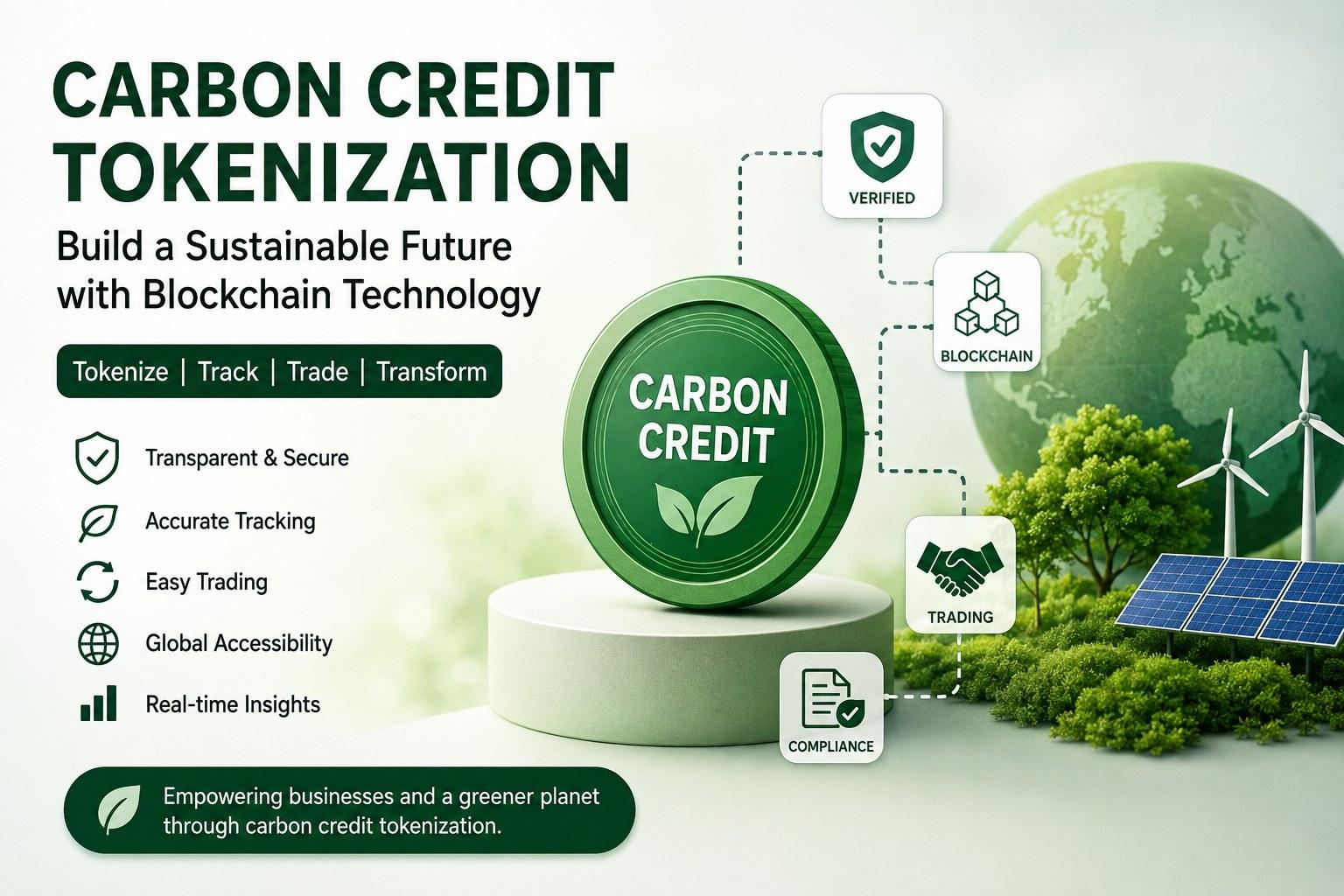
Carbon credit tokenization is emerging as a technology-driven approach to address some of these challenges.
By representing verified carbon credits as blockchain-based digital tokens, organizations can create a more transparent digital infrastructure for issuing, transferring, tracking, and retiring carbon assets.
What Is Carbon Credit Tokenization?
A carbon credit generally represents a verified reduction, avoidance, or removal of greenhouse gas emissions. In many systems, one carbon credit represents one metric tonne of carbon dioxide equivalent.
Tokenization converts the ownership or representation of these verified credits into digital tokens recorded on a blockchain.
Instead of relying only on conventional databases and registry records, tokenized carbon assets can use blockchain infrastructure to provide an auditable record of transactions.
The basic lifecycle can look like this:
Carbon Project → Verification → Registry → Tokenization → Trading → Retirement
The objective is not simply to create another cryptocurrency. The important part is maintaining a clear connection between the digital token and the underlying environmental asset.
Why Does Carbon Credit Tokenization Matter?
Traditional carbon markets can be difficult for new participants to navigate. Buyers may need to understand project methodologies, credit vintages, certification standards, registry information, ownership history, and retirement processes.
Blockchain can introduce another layer of transparency.
A properly designed tokenization platform can connect carbon credit records with smart contracts and digital transactions. This can make it easier for market participants to track the lifecycle of an asset from issuance to retirement.
According to Clarisco's carbon credit tokenization development approach, platforms can incorporate registry integrations, smart contracts, KYC/AML processes, marketplace functionality, and on-chain retirement mechanisms.
How Does the Tokenization Process Work?
1. Carbon Credit Verification
The process begins with identifying verified carbon credits and their underlying project information.
Registry data, certification details, project information, credit vintage, and other relevant metadata need to be evaluated before tokenization.
This step is critical because the credibility of the digital token depends heavily on the quality and traceability of the underlying carbon asset.
2. Registry Integration
A tokenization platform can integrate with carbon registries to synchronize information about eligible credits.
Clarisco describes integration capabilities involving registries such as Verra, Gold Standard, and ACR, along with other carbon-market infrastructure.
Registry integration can help reduce manual processes and provide a stronger connection between off-chain environmental assets and their blockchain representations.
3. Smart Contract Development
Smart contracts define how carbon tokens are created, transferred, and retired.
Depending on the business model, token standards such as ERC-20 or ERC-1155 can be considered.
A well-designed smart contract may include functionality for:
-
Token issuance
-
Credit transfers
-
Batch management
-
Retirement
-
Ownership tracking
-
Registry synchronization
-
Transfer restrictions
Security is particularly important because smart contract vulnerabilities can create significant financial and operational risks.
4. Token Issuance
Once the underlying carbon credits have passed the required verification and structuring process, digital tokens can be issued according to the platform's token model.
The token should maintain a clear relationship with the underlying credit, including relevant project and registry information.
This creates a digital representation that can potentially be transferred across blockchain-based infrastructure.
5. Trading and Marketplace Integration
Tokenized carbon credits can be made available through a dedicated marketplace or integrated with suitable digital asset ecosystems.
A carbon marketplace can include features such as:
-
Buy and sell functionality
-
Order management
-
Corporate purchasing
-
OTC trading
-
Portfolio tracking
-
Credit pricing
-
Retirement workflows
This can help create a more accessible digital environment for organizations interested in carbon assets.
6. Carbon Credit Retirement
Retirement is one of the most important stages in the carbon credit lifecycle.
When a carbon credit is retired, it should no longer be available for another party to claim the same environmental benefit.
Blockchain-based retirement mechanisms can create a permanent on-chain record of the retirement event. Clarisco's platform description highlights on-chain retirement and synchronization with external registry records as part of its approach.
Key Features of a Carbon Credit Tokenization Platform
A modern carbon tokenization platform can combine blockchain infrastructure with carbon-market and compliance functionality.
On-Chain Issuance and Retirement
Recording important lifecycle events on-chain can provide an additional layer of transparency and auditability.
Multi-Registry Integration
Connecting different registry systems can help platforms manage carbon credits from multiple sources.
Fractional Tokenization
Tokenization can allow carbon assets to be represented in smaller digital units, potentially making participation more accessible to different types of buyers.
KYC and AML
Platforms serving investors and corporate buyers may require identity verification and compliance workflows.
ESG Dashboards
Corporate users can benefit from dashboards that help track purchased, held, and retired carbon credits alongside sustainability reporting information.
AI-Assisted Verification
AI can potentially be used to analyze carbon-credit metadata and combine information from sources such as satellite imagery, IoT devices, and registry records to identify unusual patterns or inconsistencies. Clarisco lists AI-powered verification and pricing intelligence among its platform capabilities.
Carbon Tokenization and Green Energy Assets
The concept of tokenization can extend beyond traditional carbon credits.
Renewable energy certificates and other environmental assets can also be represented digitally.
For example, tokenized renewable energy assets could represent verified electricity generation from sources such as:
-
Solar
-
Wind
-
Hydropower
-
Geothermal energy
evenue model.
A platform can potentially generate revenue through several channels, including:
Transaction Fees: Fees charged when users purchase, trade, or retire tokenized credits.
Asset Onboarding Fees: Charges associated with bringing new carbon projects and credits onto the platform.
Subscription Plans: Recurring fees for access to marketplace, analytics, or ESG-management features.
White-Label Licensing: Organizations can deploy branded carbon-market infrastructure instead of developing every component internally.
Compliance and Custody Services: Additional services can support registry synchronization, monitoring, and user verification.
The appropriate revenue model ultimately depends on the platform's target customers, jurisdiction, asset types, and regulatory structure.
Challenges That Businesses Need to Consider
Despite its potential, tokenization does not automatically solve every problem in the carbon market.
Environmental Asset Quality
Putting a low-quality carbon credit on a blockchain does not make the underlying credit higher quality.
The project methodology, verification standard, additionality, permanence, and other environmental characteristics remain important.
Double Counting
One of the biggest concerns is ensuring that the same environmental benefit is not claimed multiple times.
A robust architecture needs mechanisms that connect digital tokens with the underlying registry records and clearly track retirement.
Regulatory Compliance
Carbon markets operate across different regulatory environments.
Businesses should evaluate securities, commodities, environmental-market, tax, AML/KYC, and other applicable requirements with qualified legal and compliance professionals.
Smart Contract Security
Because blockchain transactions can be difficult or impossible to reverse, smart contract security should be treated as a core component rather than an afterthought.
Independent audits, penetration testing, access controls, and secure infrastructure can help reduce technical risks.
Choosing the Right Technology Partner
Building a carbon credit tokenization platform requires more than blockchain development.
The technology stack may need to connect:
Carbon Registries + Smart Contracts + Blockchain + Compliance + Marketplace + ESG Reporting
This means development teams need to understand both Web3 infrastructure and the operational requirements of environmental assets.
Clarisco positions its carbon credit tokenization services around this full-stack approach, including token model design, registry integration, smart contract development, marketplace development, ESG dashboards, KYC/AML workflows, and retirement functionality.
The Future of Tokenized Carbon Markets
Carbon markets are becoming increasingly digital, while blockchain infrastructure continues to mature.
Tokenization could help create new ways to represent, transfer, monitor, and retire environmental assets. It may also make it easier for businesses to connect carbon management with digital finance and ESG reporting systems.
However, the long-term success of tokenized carbon markets will depend on more than blockchain adoption.
Trust, verification, environmental integrity, regulatory clarity, interoperability, and transparent retirement mechanisms will remain fundamental.
The real opportunity is therefore not simply to put carbon credits on a blockchain. It is to build a reliable digital infrastructure around environmental assets.
Final Thoughts
Carbon credit tokenization represents an intersection between climate technology, blockchain, real-world asset tokenization, and digital marketplaces.
When implemented responsibly, it can provide new infrastructure for tracking carbon assets, improving transaction transparency, enabling digital ownership models, and connecting environmental markets with blockchain ecosystems.
For businesses exploring this space, the starting point should be a clear understanding of the underlying carbon assets, regulatory requirements, registry relationships, token economics, and technical architecture.
Only after these foundations are established does blockchain become truly useful.
Interested in building a carbon credit tokenization platform?
Explore Clarisco's carbon credit tokenization development solutions to learn more about the technology, platform features, and development capabilities:
#CarbonCredits #CarbonTokenization #Blockchain #Tokenization #ClimateTech #Web3 #RWA #Sustainability #ESG #GreenTechnology

 Bangla