


UK Payroll Outsourcing: Costs, Benefits, Compliance & Provider Checklist
Introduction
Payroll is one of those business functions that often looks simple from the outside. Employees work their hours, salaries are calculated, deductions are made, and people are paid. In reality, a modern UK payroll operation involves tax calculations, National Insurance, pension duties, statutory payments, employee changes, reporting deadlines, data security, and an increasingly complex regulatory environment.
For a growing business, these responsibilities can quickly consume valuable time. A payroll mistake is not merely an administrative inconvenience either. It can affect an employee's income, create additional correction work, damage trust, and potentially expose an employer to compliance risks.
That is why Payroll Outsourcing in the United Kingdom has become an increasingly relevant solution for businesses that want professional payroll administration without carrying the full operational burden internally. Recent UK payroll research also points towards greater interest in managed payroll and outsourced models, with businesses prioritising integration, security, automation, and compliance alongside basic processing.
For business owners and finance leaders, however, outsourcing payroll should not be treated as simply buying a cheaper administrative service. The right provider should become a dependable extension of the organisation, combining UK payroll services, technology, compliance knowledge, security, and responsive support.
This updated guide explores how payroll outsourcing works, what it costs, what compliance areas businesses should consider, and how to select a provider that can support long-term growth.
What Is Payroll Outsourcing?
Payroll outsourcing is the process of appointing an external payroll specialist to manage some or all of an organisation's payroll responsibilities.
Depending on the agreement, a provider may handle:
- Employee payroll calculations
- PAYE income tax calculations
- National Insurance contributions
- HMRC reporting
- Real Time Information submissions
- Payslip production
- Employee starters and leavers
- Statutory payments
- Workplace pension calculations
- Pension auto-enrolment administration
- Payroll reports
- Year-end payroll administration
- Payroll queries
- Payment preparation
- Payroll data management
A business does not necessarily have to outsource everything. Some organisations choose a fully managed model, while others retain certain responsibilities internally and outsource the technical processing.
This flexibility makes managed payroll services suitable for businesses at different stages of development.
A small company might outsource payroll because it does not have a dedicated payroll specialist. A growing SME may outsource because its finance team is spending too much time processing payroll. A larger organisation may use an external provider because it needs specialist expertise, better technology, greater resilience, or support across multiple payroll groups.
Why UK Businesses Are Reconsidering Their Payroll Strategy
The payroll environment is changing.
Employers are dealing with evolving employment rules, tax requirements, pension responsibilities, technology expectations, and increasingly sophisticated workforce structures. Research published in 2026 shows that UK organisations are placing significant emphasis on payroll system integration, data security, compliance, automation, and employee experience.
At the same time, payroll is becoming more connected to HR and finance.
A modern payroll system should ideally communicate with relevant HR, accounting, time-tracking, benefits, and workforce management systems. This reduces duplicate data entry and can make it easier to identify discrepancies before payroll is finalised.
For a growing business, that connection can be extremely valuable.
Imagine a company that has moved from 15 employees to 80 employees in two years. What was once a straightforward monthly process may now involve multiple departments, overtime, bonuses, new starters, leavers, pension changes, statutory leave, and more frequent employee queries.
The payroll workload has grown with the business.
Outsourcing allows the company to scale the payroll function without necessarily increasing internal payroll headcount at the same rate.
What Does a Payroll Outsourcing Provider Actually Do?
A professional payroll outsourcing company typically creates a defined processing cycle.
The business supplies approved information such as hours, overtime, bonuses, expenses, deductions, new starters, and employee changes.
The provider processes the information, calculates payroll, performs checks, prepares reports, and completes agreed submissions.
The business then reviews and approves the payroll before employees are paid.
The exact workflow differs between providers, but a well-designed process should include clear responsibilities and deadlines.
A typical cycle may look like this:
Step 1: Payroll Data Collection
Relevant payroll changes are submitted by the agreed deadline.
Step 2: Data Validation
The payroll team checks the information for missing or unusual entries.
Step 3: Payroll Processing
Gross pay, deductions, taxes, National Insurance, pension contributions, and statutory payments are calculated.
Step 4: Review
Reports and exception checks are reviewed before payroll is finalised.
Step 5: Approval
An authorised person within the business approves the payroll.
Step 6: Reporting and Submission
Required payroll information is submitted and relevant reports are produced.
Step 7: Employee Payment
Employees receive their wages according to the agreed payment schedule.
This structured workflow is one of the biggest advantages of outsourced payroll services. It replaces informal, person-dependent processes with documented procedures and accountability.
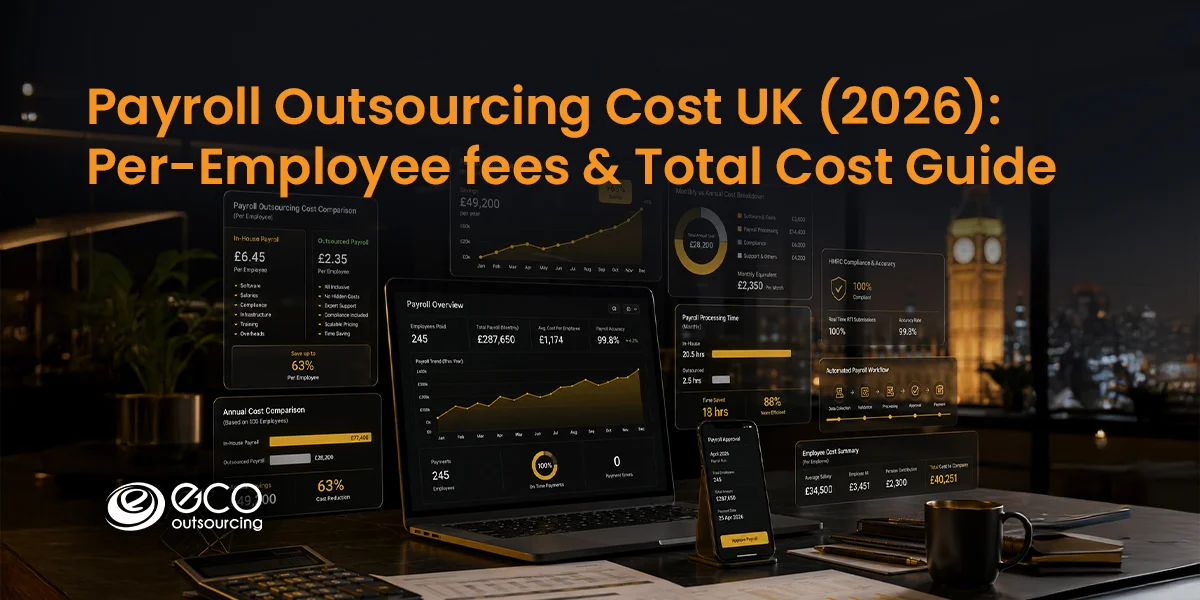
Payroll Outsourcing Costs in the UK
One of the first questions businesses ask is, "How much does payroll outsourcing cost?"
The honest answer is that there is no universal price.
The cost depends on employee numbers, payroll frequency, complexity, software requirements, pension administration, reporting, integrations, and the level of support required.
Some providers charge on a per-employee basis. Others use fixed monthly packages, per-pay-run pricing, or customised contracts.
For basic payroll arrangements, businesses may encounter relatively low per-employee fees. However, more complex payrolls can cost considerably more when specialist processing, multiple pay frequencies, pension administration, bespoke reporting, or additional services are involved.
Therefore, businesses should compare payroll outsourcing UK quotations based on the complete service rather than the advertised starting price.
What Determines Payroll Outsourcing Costs?
Several factors influence the final quotation.
Employee Numbers
The number of employees is usually one of the biggest pricing factors.
A company with ten employees will generally have a different payroll cost from an organisation with 500 employees.
However, larger payrolls can sometimes benefit from economies of scale.
Payroll Frequency
Monthly payroll is generally less intensive than weekly payroll because fewer processing cycles are required.
If an organisation has weekly-paid employees alongside monthly-paid staff, it should make this clear when requesting quotations.
Payroll Complexity
Not all employees are paid in exactly the same way.
Businesses may have:
- Hourly workers
- Salaried employees
- Commission-based employees
- Employees receiving bonuses
- Overtime arrangements
- Salary sacrifice schemes
- Benefits in kind
- Student loan deductions
- Attachments of earnings
- Statutory payments
The more complex the payroll, the more important specialist expertise becomes.
Pension Administration
Workplace pensions can add another layer of payroll administration.
A provider may calculate pension contributions, manage relevant payroll information, support auto-enrolment processes, and provide reports.
Businesses should check whether pension services are included in the base quotation or charged separately.
Reporting
Standard payroll reports may be included in a package, while customised management reports may cost extra.
Ask providers what reports are included before signing a contract.
Integrations
Businesses using accounting, HR, time-tracking, expense, or workforce management platforms may want payroll integrated with those systems.
Integration can save time, but implementation and support may affect the total cost.
Beware of Hidden Payroll Costs
A low headline price can be misleading if important services are excluded.
When comparing payroll services for UK businesses, ask whether the following are included:
- Payroll setup
- Employee migration
- Historical data migration
- New starters
- Leavers
- P45s
- P60s
- Pension administration
- Additional payroll runs
- Payroll corrections
- Emergency payroll processing
- Year-end support
- BACS files
- Custom reports
- Software integration
- Employee queries
- Data export when leaving the provider
The objective is not necessarily to find the cheapest provider.
The objective is to understand the total cost of obtaining a reliable payroll function.
UK Payroll Compliance in 2026
Compliance remains one of the strongest arguments for professional payroll support.
Employers must operate PAYE correctly and meet their reporting obligations. HMRC's 2026/27 employer guidance covers PAYE and National Insurance requirements and provides detailed information for employers operating payroll.
A payroll process also needs to account for workplace pension duties, statutory payments, employee records, and relevant employment-related changes.
The regulatory environment has also continued to evolve.
For example, from April 2026, new rules concerning labour supply chains involving umbrella companies have introduced additional PAYE considerations for agencies and end clients. HMRC states that agencies or end clients can have responsibility for ensuring PAYE is operated correctly in relevant arrangements.
This illustrates an important point: payroll compliance is not static.
A process that worked correctly last year may need updating when legislation or guidance changes.
That is why businesses should ask potential payroll experts UK providers how they monitor regulatory developments and communicate changes to clients.
PAYE and RTI Reporting
PAYE remains a central part of UK payroll.
Employers need to calculate the correct deductions and report payroll information to HMRC through the relevant reporting processes.
Real Time Information, commonly known as RTI, means employers report information about employees' pay and deductions electronically as part of the payroll process.
Errors can create unnecessary administrative work and may require corrections.
A capable payroll provider UK should therefore have robust processes for payroll calculations, checks, submissions, and corrections.
National Insurance Contributions
National Insurance is another important payroll responsibility.
Employers and employees may have different National Insurance obligations depending on circumstances and applicable thresholds.
The calculations can become more complicated when a business has employees with different pay levels, categories, benefits, or employment arrangements.
A professional provider should maintain payroll systems that reflect current requirements rather than relying on outdated calculations or manual spreadsheets.
Workplace Pension and Auto-Enrolment Responsibilities
Workplace pension administration is closely connected to payroll.
Employers need to identify eligible employees, calculate contributions, process deductions, and maintain appropriate records.
A good payroll outsourcing service should be able to coordinate payroll and pension processes efficiently.
Businesses should ask:
- Is pension assessment included?
- Are pension deductions calculated automatically?
- Is pension data transmitted to the pension provider?
- Are employee changes reflected promptly?
- Are pension reports included?
- Who handles pension-related payroll queries?
These questions help establish whether the service is genuinely comprehensive.
Statutory Payments and Employee Changes
Employees may experience circumstances that affect payroll.
These can include sickness, maternity leave, paternity leave, adoption leave, parental leave, or other statutory entitlements.
Businesses need accurate payroll records to calculate relevant payments correctly.
Employee changes also happen regularly.
Someone joins the business. Another employee leaves. Someone changes address. Another receives a new tax code. An employee changes their pension contribution.
Individually, these changes may appear minor.
Across an entire workforce, they can create substantial administrative workload.
This is where payroll support services can provide real value.
Payroll Data Security
Payroll contains some of the most sensitive information held by a business.
Employee records can include:
- Names and addresses
- Bank details
- Salary information
- Tax information
- National Insurance information
- Pension details
- Employee identifiers
- Statutory payment information
Security therefore needs to be treated as a core part of payroll outsourcing.
Businesses should ask providers about access controls, authentication, encryption, backups, audit trails, employee permissions, data retention, incident management, and business continuity.
Payroll research in 2026 shows that cybersecurity and payroll data privacy are among the major priorities for organisations modernising their payroll operations.
A provider that talks extensively about low pricing but cannot clearly explain its security controls should be approached cautiously.
Automation and Modern Payroll Technology
Payroll outsourcing is no longer limited to spreadsheets and manual calculations.
Modern cloud payroll services can provide automated workflows, employee self-service, digital payslips, reporting, system integrations, and automated validation.
Automation can reduce repetitive administrative work, but technology should support human expertise rather than replace proper oversight.
The most useful systems can help identify unusual payroll variations, missing information, or inconsistencies before final approval.
Research into UK payroll also shows strong demand for automation, improved reporting, employee self-service, and integrated systems.
For businesses, the key question is therefore not simply whether a provider uses modern software.
It is whether the software makes payroll more accurate, transparent, secure, and manageable.
How to Choose the Right Payroll Outsourcing Provider
Choosing a provider is ultimately a risk and quality decision.
Before signing a contract, ask prospective providers detailed questions.
1. Do They Understand UK Payroll?
Look for demonstrable experience with UK PAYE, National Insurance, pensions, statutory payments, RTI, and payroll administration.
2. What Exactly Is Included?
Request a written scope of services.
Do not rely solely on verbal promises.
3. How Transparent Is the Pricing?
Ask for a complete breakdown of recurring and one-off charges.
4. Who Will Manage Your Payroll?
Find out whether you will have a dedicated contact or deal with a general support queue.
5. What Happens If Payroll Goes Wrong?
Ask about correction procedures, escalation routes, and emergency support.
6. How Secure Is Employee Data?
Request information about security controls and access management.
7. Can the Service Scale?
Your payroll provider should be able to support you when employee numbers increase.
8. Can It Integrate With Your Existing Systems?
Integration with accounting and HR platforms can reduce duplicate work.
9. How Are Compliance Changes Managed?
The provider should have a clear process for monitoring relevant regulatory developments.
10. What Happens If You Leave?
Review data export, transition support, notice periods, and termination charges.
The Ultimate Payroll Provider Checklist
Use this checklist when evaluating UK payroll outsourcing services:
- UK payroll expertise
- PAYE processing
- RTI submissions
- National Insurance calculations
- Pension administration
- Statutory payment support
- Starter and leaver processing
- P45 and P60 administration
- Secure payroll technology
- Clear approval workflow
- Payroll reporting
- Employee payslips
- Responsive support
- Transparent pricing
- Clear service-level expectations
- Strong data security
- Business continuity arrangements
- Scalable systems
- Accounting and HR integrations
- Clear contract and exit terms
Outsourcing vs In-House Payroll
The decision between outsourcing and keeping payroll internally depends on the business.
An internal payroll function may provide greater direct control and can make sense for large organisations with established payroll teams.
However, internal payroll also creates responsibilities around staffing, software, training, compliance monitoring, holiday cover, system maintenance, and business continuity.
With outsourced payroll UK services, businesses can access external expertise without necessarily hiring a dedicated internal payroll team.
The choice should therefore be based on the total cost and operational value of each model.
Consider:
In-house payroll
- Direct internal control
- Immediate access to payroll information
- Requires internal expertise
- Requires software and system investment
- Creates dependency on internal staff
- Requires ongoing compliance training
Outsourced payroll
- Access to specialist expertise
- Reduced administrative workload
- Potentially scalable
- External technology and processes
- Dedicated service support
- Requires careful provider selection
Neither model is universally better.
The right choice is the one that provides the best combination of control, accuracy, cost, compliance, and scalability for the organisation.
Benefits of Payroll Outsourcing for SMEs
Small and medium-sized businesses often benefit significantly from outsourcing.
Reduced Administrative Pressure
Business owners and finance teams can spend less time processing payroll.
Access to Expertise
Businesses can access specialists without necessarily employing a full-time payroll expert.
Greater Process Consistency
Documented workflows can reduce dependence on individual employees.
Improved Scalability
Payroll processes can expand alongside the workforce.
Better Compliance Support
Specialists can monitor relevant payroll requirements and help maintain compliant processes.
Stronger Business Continuity
If an internal payroll employee is unavailable, the business may face immediate difficulties. An outsourced team can provide greater operational resilience.
More Time for Strategic Work
Finance teams can focus more on budgeting, cash flow, reporting, forecasting, and business performance instead of repetitive payroll administration.
Common Payroll Outsourcing Mistakes
Businesses can undermine the benefits of outsourcing by making poor decisions during provider selection.
One common mistake is choosing the cheapest quotation without reviewing the service scope.
Another is failing to clarify who is responsible for supplying accurate payroll information.
Some businesses also underestimate the importance of implementation.
Even an excellent provider cannot process accurate payroll from incomplete or incorrect employee information.
Another mistake is assuming outsourcing means the employer has no responsibility.
Outsourcing transfers processing responsibilities, but employers still need appropriate oversight and governance.
How to Transition to an Outsourced Payroll Provider
A successful transition should be carefully planned.
Stage One: Review Your Existing Payroll
Document your current processes, pay dates, employee groups, deductions, pensions, reporting, and approval procedures.
Stage Two: Clean Your Data
Check employee information before transferring it to the new provider.
Stage Three: Define Responsibilities
Agree who supplies information, who processes payroll, who reviews reports, and who provides final approval.
Stage Four: Configure the System
Set up payroll rules, employee records, pension details, reporting, and integrations.
Stage Five: Test
Run appropriate validation or parallel checks before the first live payroll.
Stage Six: Go Live
Move to the new payroll process once both parties are confident that the information and workflow are correct.
Stage Seven: Review
After the first few payroll cycles, evaluate accuracy, communication, response times, reporting, and employee feedback.
What Does Good Payroll Outsourcing Look Like?
Good payroll outsourcing should feel almost uneventful.
Employees are paid correctly.
Reports arrive when expected.
Questions receive timely responses.
Changes are processed properly.
Compliance deadlines are understood.
Management knows who is responsible for each stage.
Problems are identified before they become payroll crises.
That is the real value of professional payroll outsourcing.
It is not simply about removing a task from an employee's workload. It is about creating a dependable process around something that affects every employee and has important financial and compliance consequences.
Frequently Asked Questions
Is Payroll Outsourcing Worth It for Small Businesses?
It can be. Small businesses often lack dedicated payroll expertise and may benefit from professional processing, compliance support, and predictable workflows.
How Much Does UK Payroll Outsourcing Cost?
Pricing varies according to employee numbers, payroll frequency, complexity, pension administration, reporting, technology, and support requirements. Businesses should request a complete quotation rather than relying on a basic advertised rate.
Can Payroll Outsourcing Reduce Errors?
A professional provider can reduce the risk of errors by using specialist processes, payroll software, validation checks, and documented workflows. However, the quality of the provider and the accuracy of information supplied by the business remain important.
Does Outsourcing Payroll Remove Employer Responsibility?
No. Employers still need appropriate oversight and should ensure that their payroll arrangements meet applicable obligations.
Can Payroll Outsourcing Support Business Growth?
Yes. A scalable payroll service can allow businesses to add employees without having to expand their internal payroll administration at the same pace.
Is Payroll Outsourcing Secure?
It can be, provided the provider uses appropriate security controls and handles employee data responsibly. Security should be evaluated before signing the contract.
Final Thoughts
The role of payroll has changed significantly. It is no longer simply a repetitive administrative exercise completed at the end of each month. Payroll now sits at the intersection of finance, HR, technology, compliance, employee experience, and data security.
For businesses considering Payroll Outsourcing in the United Kingdom, the strongest approach is to look beyond the monthly fee.
Consider the provider's UK payroll expertise, compliance processes, technology, security controls, reporting capabilities, responsiveness, pricing structure, and ability to scale.
The 2026 payroll environment makes this even more important. Businesses are facing evolving compliance requirements while also looking for better automation, integration, reporting, and security.
Eco Outsourcing provides structured outsourcing solutions designed to help businesses operate more efficiently through dedicated expertise and organised workflows. For organisations that want to reduce payroll administration while maintaining professional standards, dependable payroll outsourcing services can provide a practical foundation for sustainable growth.
The right provider should not merely calculate salaries. It should create a payroll process that is accurate, accountable, secure, scalable, and easier for your business to manage.
When payroll is handled properly, employees can focus on their work, finance teams can focus on financial performance, and business leaders can focus on growth.

 Bangla