


Dangerous Goods Logistics Market Growth: The Shift Toward Smarter, Safer Cargo Movement
The Market Shift Everyone Should Be Watching
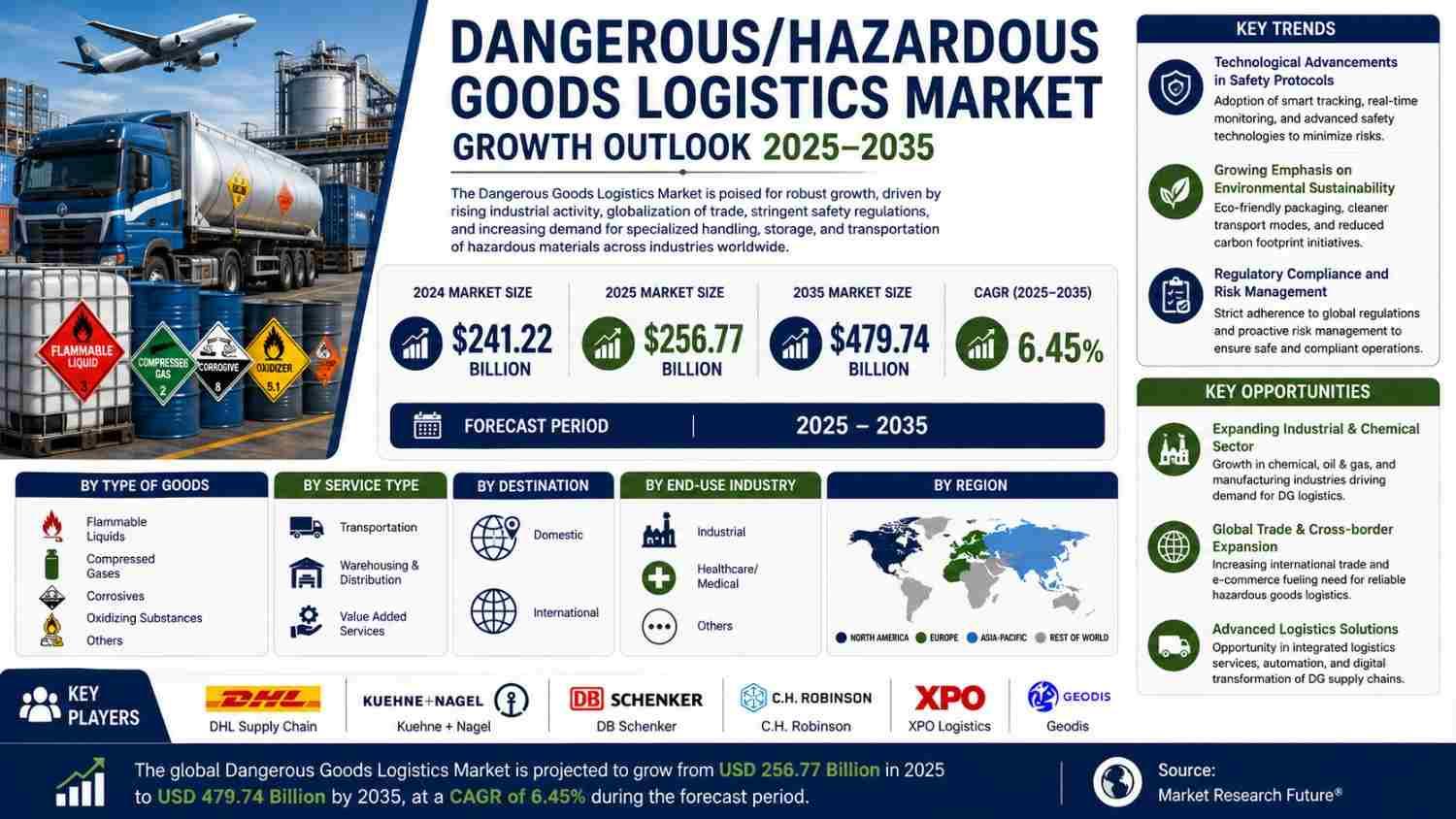
The movement of hazardous materials is becoming a test of how resilient a supply chain really is. Chemicals, gases, corrosive substances and specialized industrial materials are indispensable to modern production, yet their transportation cannot be managed solely around speed and freight cost. The Hazardous Goods Logistics Industry was valued at USD 241.22 billion in 2024 and reached USD 256.77 billion in 2025. It is forecast to reach USD 479.74 billion by 2035, expanding at a CAGR of 6.45% during 2025-2035. The underlying change is economic as much as operational: companies increasingly need logistics partners capable of reducing disruption, managing regulatory exposure and protecting the integrity of specialized cargo.
This makes hazardous logistics an infrastructure business hidden inside broader industrial supply chains.
A chemical manufacturer may view transportation as one component of its operating costs. A pharmaceutical company may see it as a continuity issue. A logistics provider sees both perspectives at once. That intersection is where much of the market's development is occurring.
What Is Creating New Demand
The first demand engine is industrial interdependence. Modern manufacturing rarely operates from locally sourced inputs alone. Raw materials can travel between countries before becoming part of a finished product, and the movement may involve roads, ports, warehouses and international borders.
Every additional logistics stage creates an opportunity for delay or error.
That is particularly significant for hazardous materials because not every warehouse or carrier can handle every category of goods. Storage compatibility, packaging requirements, documentation and employee training influence the network design.
Healthcare is another source of specialized demand. Pharmaceutical and medical supply chains require dependable transportation for materials that can be sensitive to handling conditions or subject to strict controls.
The result is a logistics market where specialized knowledge can be as important as physical transportation assets.
Applications Are Changing the Meaning of Logistics
Industrial applications remain central because hazardous materials support chemical processing, manufacturing and other production activities. Logistics providers serving these customers must understand that a transportation delay can quickly become a manufacturing problem.
Healthcare and medical applications introduce different priorities. Reliability, traceability and controlled handling can matter more than simply minimizing freight cost.
Domestic and international movements also require different operating models. Domestic shipments may benefit from established road networks and shorter transit times, while international cargo involves additional documentation, border processes and coordination between transportation modes.
This diversity is why hazardous-goods logistics is increasingly moving toward integrated services covering transportation, warehousing, distribution and value-added support.
The Economics Behind Specialized Handling
At first glance, specialized hazardous logistics can appear more expensive than ordinary freight. Dedicated equipment, compliant packaging, trained employees, documentation systems and specialized facilities all carry costs.
But comparing only the transportation price misses the larger economic equation.
A delay can interrupt production. A compliance error can create additional handling or border delays. A damaged shipment can create product loss and reputational consequences. For industrial customers, the cost of an interruption can be considerably higher than the incremental cost of specialized logistics.
This creates room for logistics providers to compete on total supply-chain value rather than freight rates alone.
The challenge is balancing those benefits against customers' constant pressure to control logistics budgets.
Technology Is Becoming a Risk-Management Tool
Digitalization is changing the economics of hazardous logistics by improving information flow.
Traditional logistics systems often answer basic questions: where is the shipment and when will it arrive? Modern systems can move toward more contextual information, connecting shipment status with route conditions, warehouse events and operational alerts.
Tracking technologies can improve visibility. Automated warehouse systems can reduce manual movement. Data platforms can help logistics teams identify recurring delays and inefficient routes.
The long-term opportunity is predictive logistics. If historical shipment information can identify patterns associated with delays or operational risk, companies can intervene earlier rather than responding after a problem occurs.
This is especially valuable for hazardous goods because prevention is generally more economical than remediation.
Sustainability Is Becoming a Logistics Constraint
Environmental pressure is also reshaping the sector. Hazardous-goods logistics cannot simply pursue lower emissions by applying the same strategy used for ordinary freight.
Safety requirements may restrict equipment choices, routing or consolidation options. Some materials require specific containment and handling systems regardless of their environmental cost.
That creates a more complex sustainability equation.
Companies can still improve performance through route optimization, better load planning, reduced empty miles, more efficient warehouses and carefully selected transportation modes. The objective is to reduce environmental impact without weakening safety controls.
The strongest sustainability strategies will therefore be those that improve efficiency and safety simultaneously.
Regional Growth Depends on Industrial Development
Regional demand is closely tied to the location of manufacturing and industrial activity.
North America has a mature logistics infrastructure supporting chemical, industrial and healthcare supply chains. Specialized providers can build on established transportation networks and advanced logistics technology.
Europe's dense manufacturing network and cross-border trade create demand for sophisticated coordination. Environmental and regulatory expectations also encourage logistics companies to invest in compliance and efficiency.
Asia-Pacific presents substantial structural opportunity because of its manufacturing base and continued industrial development. The expansion of chemical, pharmaceutical and other industries increases the need for specialized transportation and warehousing.
Other regions may offer opportunities where industrial activity is growing faster than specialized logistics infrastructure. In these markets, establishing compliant facilities and trained logistics networks can become a competitive advantage.
Competitive Dynamics Are Becoming More Integrated
The competitive field includes DHL Supply Chain, Kuehne + Nagel, DB Schenker, C.H. Robinson, XPO Logistics and Geodis.
Their competitive relevance is connected to network breadth and the ability to coordinate multiple logistics functions. Hazardous-goods customers often need more than a truck or container. They need a system that connects transportation with warehousing, documentation and operational visibility.
That favors providers with broad geographic networks and digital infrastructure.
It also leaves room for specialized operators that understand particular industries or cargo categories deeply. The market does not necessarily require every provider to offer every service. Specialization can remain valuable where customers have technically demanding requirements.
Emerging Opportunities
One of the most interesting opportunities is the expansion of digital risk-management services. Data can become a logistics asset when it helps companies identify inefficient routes, recurring delays or weak points in the handling process.
Specialized warehouse development is another opportunity, particularly in industrial regions where production capacity is expanding faster than storage infrastructure.
Cross-border logistics also has room for improvement. International shipments require coordination among carriers, customs processes, warehouses and regulatory systems. Technology that connects these participants can reduce information gaps.
Sustainable logistics solutions provide a further opportunity, particularly where efficiency improvements reduce both emissions and operating costs.
Risks That Could Slow Adoption
The market is not immune to constraints. Regulatory complexity can increase operating costs, while inconsistent requirements across jurisdictions can make international logistics difficult.
Infrastructure gaps can also limit expansion. A logistics provider may have strong transportation capabilities but still face constraints if suitable storage facilities or compliant handling infrastructure are unavailable in a target market.
Technology introduces its own risks. Poor-quality data, cybersecurity concerns and system integration problems can undermine the value of digital platforms.
Cost pressure remains another issue. Customers may recognize the importance of specialized logistics but still demand competitive pricing, particularly during periods of weak industrial activity.
What the Next Decade Could Look Like
By 2035, hazardous-goods logistics is likely to look less like a collection of transportation services and more like a connected risk-management network.
Digital visibility should become increasingly standard. Warehousing is likely to become more automated where safety and economics permit. Sustainability will increasingly be evaluated alongside cost and compliance.
The providers that stand out will not necessarily be those moving the greatest volume. They will be those capable of integrating safety, visibility, regulatory discipline and operational efficiency.
The projected market expansion to USD 479.74 billion is therefore best understood as a reflection of a deeper supply-chain requirement: hazardous materials need logistics systems designed around their specific risks.

 Bangla