


Europe Battery Storage Market: Emerging Trends and Opportunities
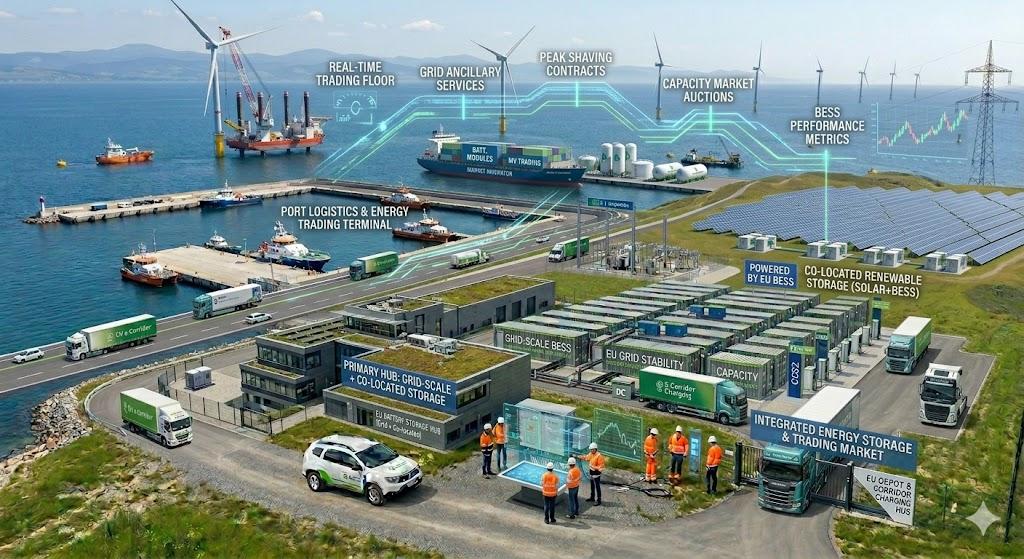
How Battery Storage Is Reshaping Europe’s Power Grid
Battery storage is becoming an important component of Europe’s energy transition, but the reasons for deployment vary widely between countries and project types. Renewable targets, electricity-market structures, network constraints, industrial demand, and investment conditions all influence where projects are developed. Understanding these differences is essential for businesses seeking opportunities across the regional storage landscape.
The Europe Battery Storage (Grid + Co-located) Market spans utility-scale batteries connected directly to electricity networks and systems installed alongside renewable generation. These configurations can support different objectives while sharing a broader purpose: improving flexibility in an electricity system where generation is increasingly variable and demand is becoming more electrified.
Grid-scale batteries can help operators manage short-term imbalances and respond to sudden changes in supply or demand. Their speed makes them suitable for frequency-related services and balancing applications. In markets with active wholesale trading, batteries can also charge when electricity prices are lower and discharge when prices rise. This creates an opportunity to combine system-support functions with commercial energy arbitrage.
Co-located batteries can improve the performance of solar and wind projects by allowing electricity to be shifted away from periods of excess production. A solar project paired with storage, for example, can potentially extend its delivery profile beyond peak sunlight hours. This may improve the value of generation and reduce exposure to negative or very low prices during periods of abundant renewable output.
Location is a critical consideration for both models. Grid batteries benefit from sites where flexibility services are valuable, connection opportunities are available, and market signals support frequent operation. Co-located systems may be particularly attractive where renewable projects encounter connection limitations or curtailment risks. Developers must therefore evaluate grid conditions alongside land, permitting, infrastructure, and expected revenue opportunities.
Country-level policy can significantly affect investment decisions. Some markets provide clearer pathways for storage participation, while others continue to refine rules covering network fees, balancing services, capacity mechanisms, and market access. Regulatory consistency can reduce development risk and make financing easier. Investors are consequently paying close attention to policy reforms and auction designs that could unlock additional storage capacity.
Supply chains also influence project economics. Battery cells, power conversion equipment, thermal management systems, transformers, and control platforms all contribute to total project cost. Procurement strategies must consider not only upfront pricing but also warranty conditions, degradation expectations, service availability, and equipment compatibility. Developers increasingly need suppliers capable of supporting assets throughout their operating lives.
Safety and sustainability are becoming central procurement considerations. Battery projects require appropriate fire protection, monitoring, thermal management, and emergency planning. At the same time, buyers are examining material sourcing, recycling pathways, and lifecycle impacts. Strong environmental and safety practices can support permitting, community acceptance, and long-term asset resilience.
Software provides another source of differentiation. Modern battery management and energy management systems can optimize charging, discharging, and participation across multiple markets. Forecasting tools can incorporate weather, demand, and price signals, while automated controls can react quickly to changing conditions. These capabilities can help operators capture more value without increasing physical capacity.
According to the Europe Battery Storage (Grid + Co-located) Market Report, market prospects should be evaluated through a combination of deployment models, technology choices, regulatory conditions, competitive dynamics, and demand for flexibility.
This supports investment decisions. Looking ahead, Europe’s storage market is likely to become more diversified. Projects will increasingly be designed around local system requirements instead of a universal business model. Developers that understand regional market rules, select suitable technologies, and build flexible operating strategies can strengthen their position. As renewable penetration rises, storage will remain a critical tool for creating a more adaptable, reliable, and commercially responsive power system.

 Bangla