

Insomnia Market Size, Share, Industry Overview, Latest Insights and Forecast 2026-2034

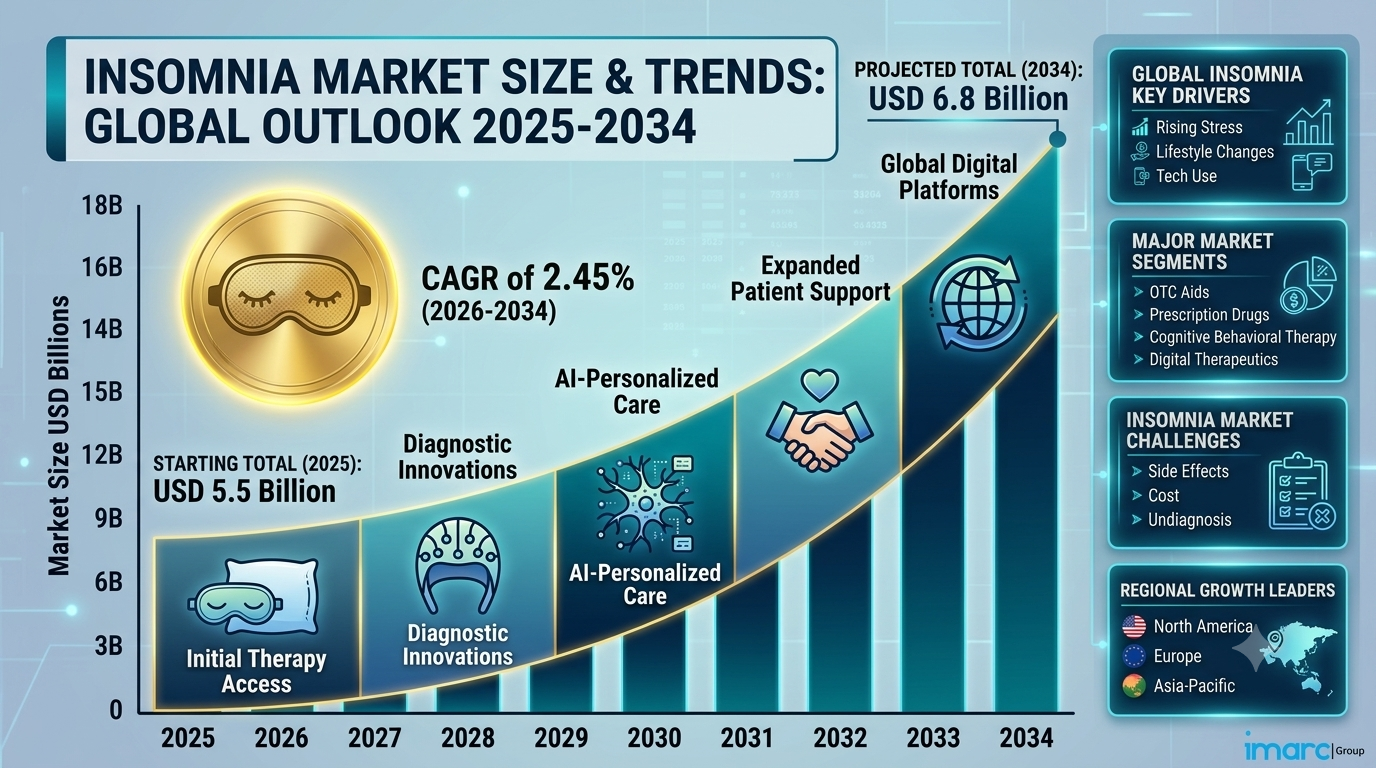
According to IMARC Group, the global Insomnia Market Size reached USD 5.5 Billion in 2025 and is projected to reach USD 6.8 Billion by 2034, expanding at a CAGR of 2.45% during 2026–2034. This steady Insomnia Market Growth reflects rising prevalence of sleep disorders linked to stress and aging, advancements in diagnostic technologies, robust research into novel therapies, increasing healthcare expenditure, and growing consumer preference for non-pharmacological treatment options such as cognitive behavioral therapy.
Insomnia Industry Overview
Insomnia is a common sleep disorder marked by difficulty initiating or maintaining sleep, often resulting in daytime fatigue, impaired concentration, and reduced quality of life. Treatment approaches span a broad spectrum — from behavioral interventions such as cognitive behavioral therapy for insomnia (CBT-I) to pharmacological options including prescription sleep aids and over-the-counter remedies. The growing understanding of insomnia’s links to mental health, chronic disease, and lifestyle factors is reshaping how the condition is diagnosed and managed globally.
The insomnia market spans a broad continuum of therapeutic approaches and distribution formats:
- Non-pharmacological therapy: Cognitive behavioral therapy, hypnotherapy, and medical devices supporting drug-free sleep management
- Pharmacological therapy: Prescription sleep aids and over-the-counter formulations addressing varying severities of insomnia
- Drug class innovation: Benzodiazepines, nonbenzodiazepines, melatonin antagonists, orexin antagonists, and antidepressants tailored to specific patient needs
- Retail and institutional access: Hospital pharmacies, retail pharmacies, drug stores, and fast-growing online pharmacy channels
- Digital health integration: Sleep-tracking apps, AI-based coaching platforms, and telemedicine-enabled behavioral therapy programmes
Global Insomnia Market Size & Key Statistics
Below are the key Insomnia Market statistics drawn from IMARC Group’s comprehensive market analysis:
Base Year - 2025
Historical Period - 2020–2025
Forecast Period - 2026–2034
Insomnia Market Size in 2025 - USD 5.5 Billion
Market Forecast in 2034 - USD 6.8 Billion
Market Growth Rate (2026–2034) - 2.45% CAGR
Largest Region - North America (36.4% share)
Leading Drug Class - Benzodiazepines (28.9% share)
Leading Therapy Segment - Pharmacological Therapy
Leading Distribution Channel - Hospital Pharmacies
Request for a Sample Report for Detailed Insomnia Market Share Evaluation: https://www.imarcgroup.com/insomnia-market/requestsample
Key Market Drivers & Insomnia Market Trends in 2025
Several powerful forces are shaping Insomnia Market Trends and fuelling sustained growth expectations across global healthcare and wellness markets:
1. Rising Prevalence of Stress, Anxiety, and Mental Health Disorders
The growing incidence of stress, anxiety, and mental health disorders is positively influencing the market. Survey data from the American Psychiatric Association indicates that reported anxiety among US adults rose from 32% in 2022 to 43% in 2024. Modern lifestyles marked by work pressure, digital distractions, and social challenges have led to widespread sleep disturbances, increasing demand for medical interventions and driving pharmaceutical companies to develop safer, non-addictive sleep therapies.
2. Growing Aging Population and Higher Risk of Sleep Disorders
The expanding global aging population is significantly contributing to insomnia market growth. According to the WHO, by 2030 one in six people globally will be aged 60 or older. Older adults are more prone to sleep disturbances due to age-related physiological changes, chronic illnesses, and medication side effects, driving demand for prescription medications, behavioral therapies, and natural sleep aids tailored to elderly needs.
3. Increasing Adoption of Digital Lifestyles and Screen Exposure
The growing dependence on digital devices is a defining Insomnia Market Trend. Industry reports indicate that by Q3 2024, users aged 16 to 64 spent an average of 6 hours and 38 minutes daily on screens. Blue light exposure inhibits melatonin secretion and disrupts natural sleep cycles, pushing consumers toward sleep aids, mobile applications, and behavioral therapies to improve rest quality.
4. Advancements in Diagnostic Technologies and Digital Health Solutions
Improved diagnostic accuracy through sleep-tracking wearables and AI-based platforms is expanding access to personalized insomnia care. Digital sleep-coaching applications combining sound-based tracking with tailored insights are enabling remote diagnosis and continuous monitoring, extending insomnia management beyond traditional clinical settings into everyday consumer wellness routines.
5. Growing Consumer Preference for Non-Pharmacological Treatments
Increasing consumer demand for cognitive behavioral therapy for insomnia (CBT-I) and other non-drug interventions is reshaping the treatment landscape. Government initiatives promoting sleep health awareness, combined with growing concern over long-term dependency risks associated with certain sleep medications, are accelerating adoption of behavioral and digital therapeutic alternatives worldwide.
6. Strategic Industry Collaborations and Pharmaceutical R&D
Pharmaceutical companies continue to invest in research collaborations aimed at developing safer hypnotics, orexin receptor antagonists, and non-addictive long-term formulations. Regulatory approvals for new indications and expanded patient populations are further strengthening the pipeline of insomnia therapeutics and supporting sustained Insomnia Market Growth across developed and emerging healthcare systems.
Key Market Segmentation
By Therapy Type
Pharmacological Therapy — Leading Segment: Pharmacological therapy, comprising prescription sleep aids and over-the-counter sleep aids, is driven by the increasing demand for effective treatments targeting insomnia’s physiological mechanisms. Pharmaceutical innovation aimed at improved efficacy and safety profiles, along with research into sustained-release formulations and combination therapies, continues to expand this segment.
Non-Pharmacological Therapy: This segment includes hypnotherapy, cognitive behavioral therapy, medical devices, and other behavioral interventions. Rising consumer preference for drug-free approaches and growing clinical validation of CBT-I are driving steady adoption across both clinical and consumer wellness settings.
By Drug Class
Benzodiazepines — Largest Segment: Benzodiazepines lead the Insomnia Market Share with around 28.9% share in 2025, favored for their rapid onset of action and efficacy in managing anxiety disorders, insomnia, seizures, and muscle spasms. Ongoing R&D aimed at minimizing side effects and improving patient compliance continues to sustain their clinical prominence.
Other Drug Classes: Antidepressants, melatonin antagonists, nonbenzodiazepines, and orexin antagonists round out the drug class segmentation, each addressing specific patient profiles and treatment-duration requirements.
By Distribution Channel
Hospital Pharmacies — Leading Channel: Hospital pharmacies lead distribution channel demand, driven by the need for specialized pharmaceutical services and close coordination between healthcare providers and pharmacists for complex insomnia treatment regimens.
Retail Pharmacies, Drug Stores & Online Pharmacies: Retail pharmacies and drug stores benefit from accessibility and convenience for routine medication needs, while online pharmacies are the fastest-growing channel, supported by rising telemedicine adoption and e-commerce-enabled healthcare delivery.
Regional Insomnia Market Analysis
North America — Largest
United States & Canada; over 36.4% market share in 2025, advanced healthcare infrastructure, high diagnosis rates, growing elderly population, favourable reimbursement policies
Europe
Germany, France, UK, Italy, Spain, Russia; strong regulatory focus on safe, non-addictive treatments, rising CBT-I adoption, growing digital health uptake
Asia Pacific
China, Japan, India, South Korea, Australia, Indonesia; rising stress and urbanization, expanding middle class, growing healthcare access and awareness
Latin America
Brazil, Mexico; rising urbanization, socioeconomic pressures, expanding access to healthcare services and digital wellness tools
Middle East & Africa
Lifestyle stress, changing work cultures, improving healthcare infrastructure and growing availability of sleep clinics and wellness supplements
North America leads the global Insomnia Market Share, accounting for over 36.4% in 2025, anchored by the United States’ advanced clinical infrastructure and high diagnostic testing rates — with the US alone accounting for 80% of the North American market. Asia Pacific represents a fast-growing regional market, driven by rising academic and workplace stress, an expanding middle class, and increasing healthcare access across China, Japan, and India.
Connect for Detailed Insomnia Market Share Segmentation Analysis — Speak to an Analyst: https://www.imarcgroup.com/request?type=report&id=6148&flag=C
Leading Players in the Global Insomnia Industry
The global insomnia market features a mix of diversified pharmaceutical multinationals and focused sleep-therapeutics specialists. Key companies covered in the IMARC Group report include:
Aurobindo Pharma USA - United States (subsidiary of Aurobindo Pharma, India)
Eisai Inc. - Japan
Idorsia Pharmaceuticals, Ltd - Switzerland
Mallinckrodt Pharmaceuticals - Ireland / United States
Merck & Co., Inc - United States
Neurim Pharmaceuticals LTD - Israel
Pfizer Inc - United States
Sanofi S.A. -France
Latest Insomnia Market Industry Developments
September 2025 — Johnson & Johnson: Johnson & Johnson revealed findings from the Phase 3 MDD3005 26-week clinical trial assessing seltorexant versus quetiapine extended release (XR) as an add-on therapy for adults with major depressive disorder and insomnia symptoms, reporting significantly fewer side effects and higher study completion for seltorexant.
July 2024 — Neurim Pharmaceuticals: Neurim Pharmaceuticals received a positive CHMP opinion for Slenyto® (Pediatric Prolonged-Release Melatonin) to treat insomnia in children with neurogenetic disorders, expanding its approved indication.
June 2024 — Merck & Co.: Merck revealed that its trial for insomnia medication suvorexant demonstrated continued effectiveness over a 12-month period in a late-stage study — the first sleep aid trial to run a full year.
About us
IMARC Group is a leading global market research company providing data-driven insights and expert consulting services to businesses seeking to achieve their strategic objectives. With a multi-disciplinary team of industry experts, IMARC delivers thorough, reliable market intelligence across sectors including Healthcare, Technology, Chemicals, Energy, Food & Beverages, and more.
Contact Us
IMARC Group
United States: +1-201-971-6302
India: +91-120-433-0800
United Kingdom: +44-753-714-6104
