


Solder Paste and SMT Adhesives: A Complete Guide for PCB Assembly Buyers
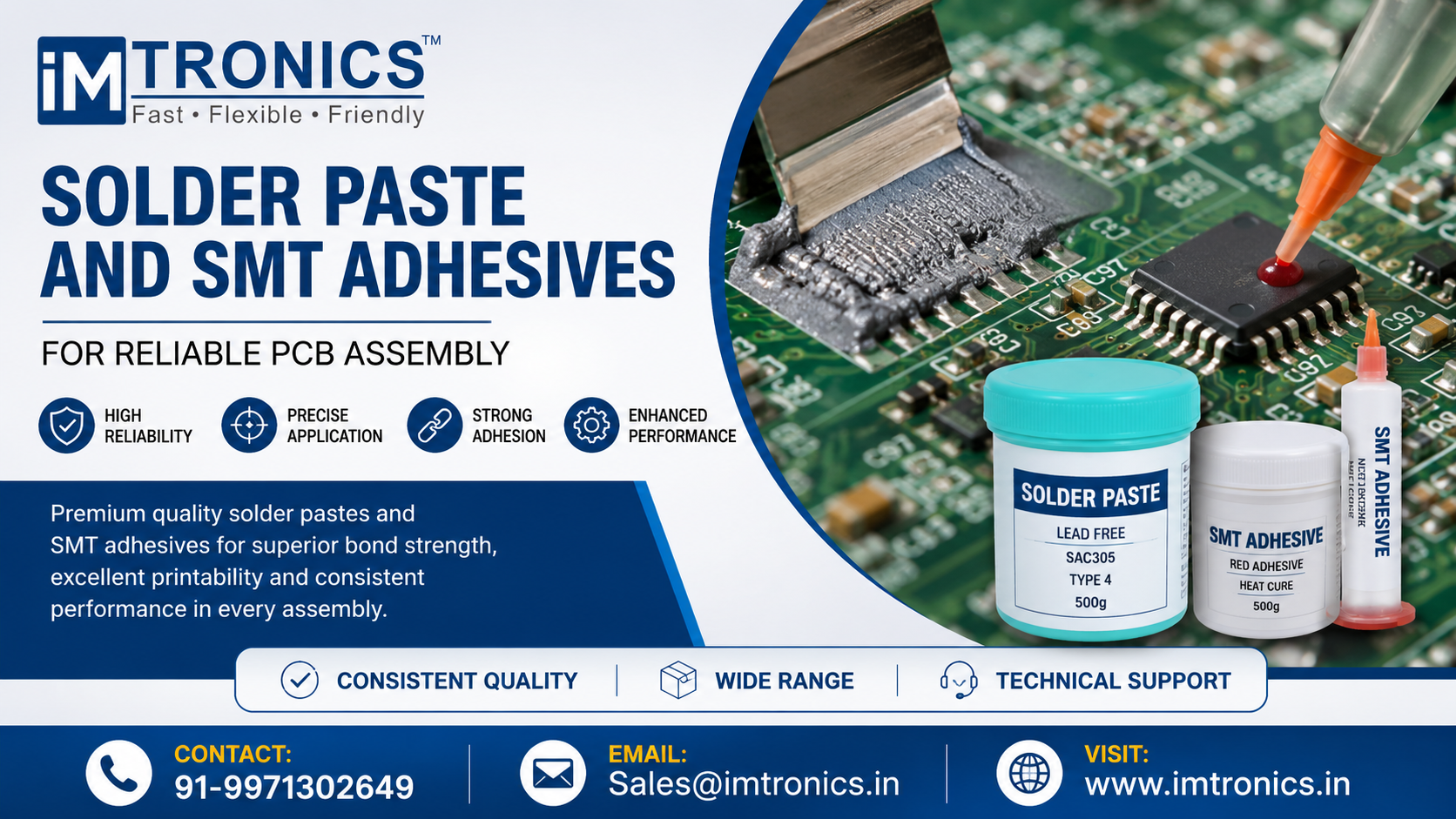
A reel of the wrong solder paste can sit in a factory fridge for six weeks before anyone notices the alloy is off. By then, three production runs have gone out with marginal joints, and nobody can say exactly when things went wrong. That's the real risk buyers face when sourcing Solder Paste and SMT Adhesives — not a lack of options, but too many options with too little scrutiny applied to them. India's EMS sector has grown fast since 2015, and the paste and adhesive supply chain hasn't always kept pace with what SMT lines actually demand.
Most buyers assume paste is paste. It isn't. Particle size, flux activity, tack time, and storage stability all shift depending on what you're assembling — a wearable with 01005 components behaves nothing like an automotive power module. Get the match wrong and you inherit tombstoning, bridging, or adhesive that won't hold parts through a reflow cycle. This guide walks through specification, evaluation, and sourcing so you're not learning these lessons on a live production floor.
The Spec Detail Most Buyers Skip
Solder paste is a suspension of metal alloy powder in flux, and the two variables that decide most of your outcomes are particle size (Type 3 through Type 6) and metal content by weight, usually between 88% and 92%.
Alloy Composition
SAC305 remains the default lead-free alloy for general assembly, but low-silver alloys and bismuth-based blends are increasingly specified for thermal cycling resistance in automotive and industrial boards. A supplier who can't tell you the exact silver percentage in their SAC blend hasn't looked at their own certificate of analysis.
SMT Adhesives
Epoxy-based SMT adhesives, used for wave soldering and mixed-technology boards, are graded by cure temperature, viscosity, and dot-transfer consistency. Snap-cure adhesives cure in under 60 seconds at 150°C; standard versions can take four to five minutes. If your line runs a fast wave process, a slow-cure adhesive will bottleneck the entire cell — not the paste, the adhesive.
What Buyers Actually Gain From Getting This Right
-
Fewer reflow defects, measured in fallout rate. Matching particle size to stencil aperture typically cuts bridging defects that otherwise show up as rework hours nobody budgeted for.
-
Predictable shelf stability. Paste stored and rotated correctly avoids the slow drift in tack and viscosity that causes intermittent — and hard to diagnose — print failures.
-
Lower total cost per board, not per kilogram. A cheaper paste that raises your defect rate by even half a percent on a 50,000-unit run costs more than the price difference ever saved.
Why Location Is a Supply Chain Decision, Not Just an Address
Solder paste and SMT adhesives are temperature-sensitive. A shipment that sits in an unrefrigerated transit warehouse for four days in an Indian summer can lose viscosity stability before it ever reaches your line. That's not theoretical — it's the reason cold-chain logistics matter as much as the chemistry itself for Solder Paste and SMT Adhesives Suppliers in India.
We work with EMS units, PCB assembly houses, and OEMs across India's major electronics clusters — Bengaluru, Pune, Noida, and Chennai among them — where same-region stocking cuts transit time and keeps paste within its cold-chain window. Buyers searching for Solder Paste and SMT Adhesives Manufactures in India or comparing Solder Paste and SMT Adhesives Dealers in India should weight proximity and cold-storage capability as heavily as unit price, because a paste that arrives temperature-compromised is not a bargain regardless of what it cost.
About Us
We've been supplying SMT equipment, consumables, and production line solutions to Indian electronics manufacturers since 2013. IMTronics started by supporting a handful of EMS units around Delhi NCR, and we now work with production and quality teams across the country who need equipment and materials that actually match their line's tolerances — not just a datasheet that reads well.
One thing we've learned the hard way: we stopped stocking a particular low-cost paste line in 2020 after two customers independently reported tack-time drift within three weeks of delivery, well inside the stated shelf life. We pulled it from our catalog and switched suppliers rather than keep selling something we couldn't stand behind. That's the kind of call you only make after watching enough production runs go sideways to know the difference between a supplier's claim and a supplier's actual batch consistency.
Conclusion
Getting Solder Paste and SMT Adhesives right isn't about finding the cheapest jar on a supplier's price list — it's about matching alloy, particle size, and cure profile to what your line and your board actually demand. The manufacturers who treat this as a technical decision, not just a procurement line item, are the ones who avoid the 11 p.m. calls about failed reflow. As fine-pitch assembly becomes standard even outside high-end electronics, that gap between "paste is paste" and "paste that matches your process" is only going to matter more.
FAQs
What's the difference between Type 3 and Type 4 solder paste?
Type 3 has larger particles (25–45 microns) and suits standard-pitch work; Type 4 (20–38 microns) is finer and better for tighter apertures. If you're running anything below 0.5mm pitch, Type 3 will clog your stencil more than you'd expect.
How long does solder paste last in storage?
Most SAC305 paste holds for six months refrigerated at 0–10°C, though we've seen batches lose print consistency closer to the four-month mark if the fridge temperature isn't tightly controlled. Always check the actual certificate, not a rounded shelf-life claim on the box.
Can I use the same adhesive for wave and reflow processes?
No. Wave soldering adhesives are cure-optimized for the wave process's thermal profile; using them in a reflow-only line usually means incomplete cure and parts shifting before solder solidifies.
Are Solder Paste and SMT Adhesives Manufacturers in India certified to IPC standards?
Reputable ones are, but certification varies by product line, not just by company. Ask for the IPC J-STD-005 or J-STD-004 documentation for the specific SKU you're buying, not a general company certificate.
What MOQ should I expect from Solder Paste and SMT Adhesives Distributors?
It ranges widely — some distributors set MOQs at a single jar for trial orders, others require carton-level minimums. We keep ours low for first orders specifically so buyers can validate a paste on their line before committing to volume.

 Bangla