


What Was Einstein’s IQ? Separating Fact From Fiction
Albert Einstein is one of the most famous intellectual figures in history. His name has become almost synonymous with genius, and his scientific work transformed the way people understand space, time, gravity, light, and the universe itself. More than a century after his most important discoveries, people remain fascinated by his extraordinary mind.
One question appears again and again: what is einstein's iq?
The internet offers several answers. Some websites claim Einstein had an IQ of 160. Others suggest 170, 180, or an even higher number. These figures are often presented as established facts, but there is a major problem with them. There is no reliable evidence that Albert Einstein ever took a standardized IQ test and received any of these scores.
So, what do we actually know about Einstein's intelligence? How did the famous IQ numbers become associated with him, and what can his scientific achievements tell us about his intellectual abilities?
To understand the answer, it is important to separate historical facts from popular myths.
What Is Einstein's IQ?
The most accurate answer to what is einstein's iq is that his exact IQ is unknown.
Einstein was born in 1879, at a time when modern intelligence testing did not yet exist in its current form. Intelligence tests began developing in the early 20th century, but there is no credible historical record showing that Einstein completed a standardized IQ examination.
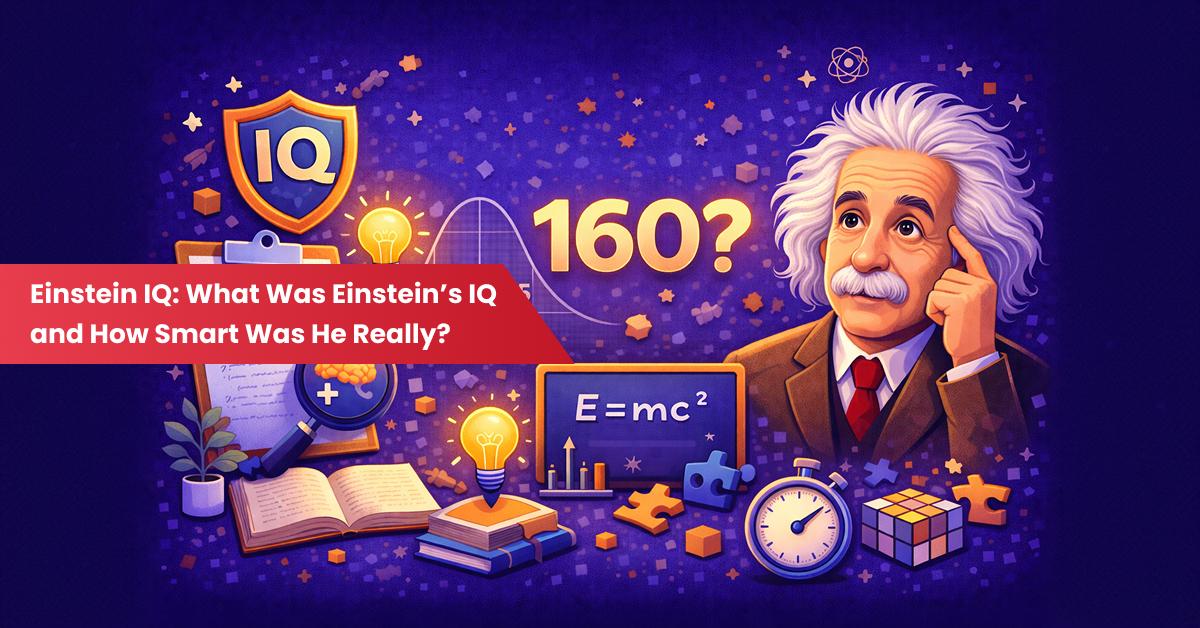
The number 160 is the figure most commonly associated with him. However, this number is generally considered an estimate rather than an official measurement.
Some sources have suggested that Einstein's IQ was 170 or 180. These claims are even more difficult to verify because there is no documented test result supporting them.
Therefore, it would be misleading to say that Einstein definitely had an IQ of 160. A more accurate statement is that some retrospective estimates place his hypothetical IQ around 160.
Where Did the 160 IQ Claim Come From?
The origins of Einstein's famous IQ estimate are not particularly clear.
Over time, biographies, educational websites, media articles, and online publications have repeated the figure of 160. Because the number appears so frequently, it can seem as though it must come from an official test.
However, repetition is not evidence.
The estimate likely reflects attempts to quantify the intelligence of a person whose achievements were clearly extraordinary. Einstein developed theories that fundamentally changed physics, so it is understandable that people would associate him with an exceptionally high IQ.
The problem is that scientific achievement cannot be used to calculate an exact IQ score.
IQ tests are designed to measure specific cognitive abilities under standardized conditions. They are not designed to assign numerical scores retrospectively to historical figures based on their accomplishments.
Did Einstein Ever Take an IQ Test?
There is no reliable evidence that Einstein took a standardized IQ test that produced a documented score.
This is one of the most important facts to remember when discussing his intelligence.
Modern IQ testing became more established during Einstein's lifetime, but that does not mean that every famous intellectual was tested. Einstein's scientific reputation was based on his work, not on an intelligence examination.
If an official test report existed, it would provide strong evidence for a specific IQ score. In the absence of such documentation, numbers like 160 should remain classified as estimates.
This distinction may seem minor, but it is essential when separating fact from fiction.
Why Is Einstein Considered a Genius?
Although his IQ is unknown, there is overwhelming evidence that Einstein possessed extraordinary intellectual abilities.
His ability to think about complex scientific concepts in unconventional ways was particularly remarkable.
Einstein frequently used thought experiments to explore difficult problems. He imagined hypothetical situations involving light, motion, clocks, trains, and observers, then considered what those situations would imply about the laws of physics.
This approach helped him challenge traditional assumptions about space and time.
His work eventually led to special relativity, which changed fundamental ideas about motion, time, and energy.
Einstein's genius therefore involved much more than mathematical calculation. He demonstrated conceptual reasoning, creativity, imagination, curiosity, and persistence.
These qualities are difficult to summarize with a single IQ number.
Einstein's Miracle Year
One of the strongest examples of Einstein's intellectual ability came in 1905.
That year is commonly called Einstein's "miracle year." He published several groundbreaking papers that made major contributions to physics.
His research into the photoelectric effect helped establish important foundations for quantum physics and eventually contributed to his Nobel Prize in Physics.
He also published his theory of special relativity, which introduced a revolutionary understanding of space and time.
Another paper provided an explanation of Brownian motion that helped support the existence of atoms and molecules.
Producing several important scientific contributions in one year was an extraordinary accomplishment.
These achievements do not allow us to calculate Einstein's IQ, but they provide powerful evidence of his exceptional reasoning abilities.
General Relativity and Einstein's Intellectual Ability
Einstein's achievements continued long after 1905.
In 1915, he presented the general theory of relativity, one of the most influential theories in modern physics.
General relativity transformed the understanding of gravity. Instead of treating gravity simply as a force between objects, Einstein described it in terms of the geometry of spacetime.
Developing this theory required advanced conceptual and mathematical reasoning.
The theory also made predictions that could be tested through astronomical observations. Later observations supported important aspects of Einstein's predictions, further establishing his scientific reputation.
The development of general relativity demonstrates why Einstein is considered one of history's greatest scientific thinkers.
His intellectual achievement was not simply a matter of solving difficult mathematical problems. He developed a new conceptual framework for understanding physical reality.
Myth: Einstein Was Bad at Math
One persistent myth claims that Einstein was bad at mathematics when he was young.
This is inaccurate.
Einstein demonstrated strong mathematical ability from an early age. He developed an interest in mathematics and science and eventually acquired the mathematical knowledge necessary for advanced theoretical physics.
The myth may have been influenced by stories about his experiences in formal education. Einstein was often critical of rigid teaching methods and did not always fit comfortably into conventional educational environments.
However, disliking a particular educational system is not evidence of poor mathematical ability.
In fact, mathematics became an important component of his scientific career, especially as he developed general relativity.
Myth: Einstein Was a School Failure
Another popular story suggests that Einstein was a poor student who failed at school before unexpectedly becoming a genius.
This is another oversimplification.
Einstein did experience difficulties with aspects of formal education, but the idea that he was generally an unsuccessful student is misleading.
He was intellectually curious and independent. He often wanted to understand concepts rather than simply memorize information.
This independent approach may have contributed to his disagreements with conventional educational practices.
Rather than demonstrating a lack of intelligence, his educational experiences reveal a person who preferred questioning and exploration over unquestioning acceptance.
Can IQ Measure Genius?
The question of what is einstein's iq also raises a broader issue: can IQ really measure genius?
IQ tests can be useful tools for measuring certain cognitive abilities. Depending on the test, these abilities can include logical reasoning, working memory, processing speed, verbal comprehension, and visual-spatial reasoning.
However, genius involves much more.
Scientific breakthroughs often require creativity, curiosity, persistence, imagination, specialized knowledge, and the ability to recognize important questions.
A person can have a very high IQ without producing revolutionary scientific work. Conversely, scientific achievement cannot be fully explained by IQ.
Einstein's career demonstrates this distinction particularly well.
His ability to think creatively and challenge accepted assumptions was central to his achievements. These characteristics are not completely captured by a standardized intelligence score.
What About IQ Scores of 170 or 180?
Claims that Einstein had an IQ of 170 or 180 should be treated with caution.
There is no reliable historical evidence confirming either figure.
Such numbers are likely examples of retrospective speculation. They may be based on the assumption that someone capable of Einstein's achievements must have possessed an extraordinarily high IQ.
While that assumption is understandable, it cannot produce a scientifically valid score.
Without an actual standardized test result, nobody can determine whether Einstein would have scored 150, 160, 170, or another number.
The safest conclusion is that he had exceptional intellectual abilities but no verified IQ score.
Why the Exact Number Does Not Matter
It is natural to want a numerical answer when discussing intelligence. Numbers make comparisons easier and can create the impression of certainty.
But Einstein's legacy demonstrates why intelligence is more complicated than a test score.
His greatest strength may have been his ability to ask unusual questions.
He questioned assumptions about time and space that many scientists had accepted for generations. He used imagination to explore hypothetical situations and combined those ideas with rigorous scientific reasoning.
His accomplishments were also supported by years of study and persistent intellectual effort.
Whether his hypothetical IQ would have been 150 or 180 does not change the importance of his discoveries.
The Truth About Einstein's IQ
So, what is einstein's iq according to the available evidence?
The exact figure is unknown.
The commonly reported IQ of 160 is an estimate rather than a documented test result. Claims of 170 or 180 are even more speculative.
What can be established with confidence is that Einstein was an exceptionally intelligent and creative thinker.
His work changed physics and influenced scientific thought across the world. His theories of relativity transformed concepts that had previously seemed fundamental and unquestionable.
His intellectual abilities included abstract reasoning, imagination, mathematical understanding, conceptual visualization, curiosity, and persistence.
These qualities explain his extraordinary achievements much better than a single number.
Final Thoughts
The mystery surrounding Einstein's IQ continues because people naturally want to quantify extraordinary intelligence.
The question what is einstein's iq may never have a definitive numerical answer. There is no verified IQ test score for Albert Einstein, and the popular figure of 160 should be treated as an estimate rather than historical fact.
The myths surrounding Einstein's intelligence are also worth examining. He was not a failed mathematician who suddenly became a genius, nor was his greatness dependent on a mysterious IQ number.
Einstein's true intellectual legacy comes from his ability to think differently.
He questioned established ideas, imagined possibilities that others had overlooked, and transformed those ideas into theories that changed our understanding of reality.
His exact IQ may remain unknown, but his extraordinary contribution to science is beyond dispute. Ultimately, Einstein's story shows that intelligence is not merely a number. It is also the ability to remain curious, think creatively, challenge assumptions, and pursue difficult questions with determination.

 Bangla