


Small Modular Reactors: Europe’s Emerging Path to Energy Resilience
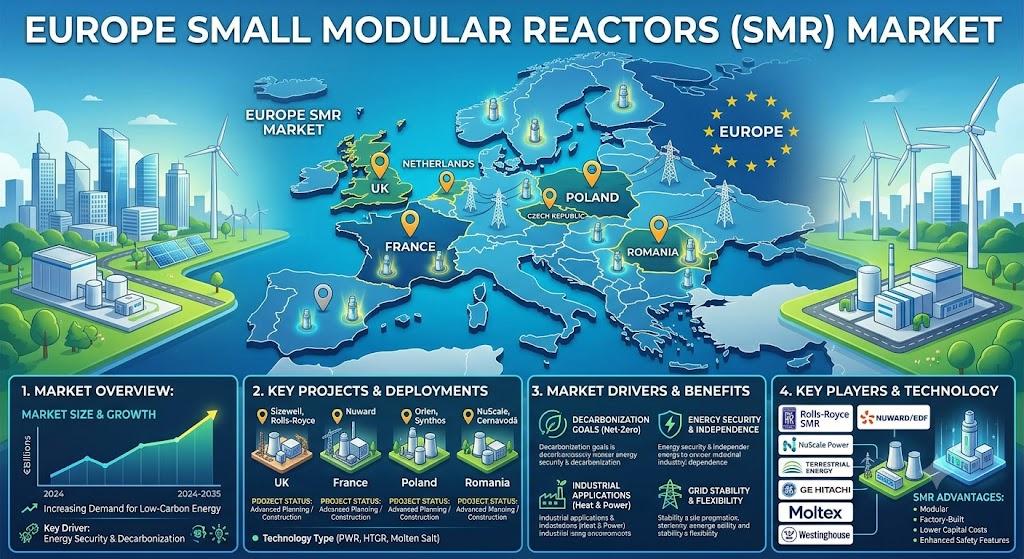
Europe Small Modular Reactors: What Could Define the Next Five Years
Europe is reassessing the role of nuclear power as electricity demand rises, renewable capacity expands, and energy security remains a strategic priority. Small modular reactors are part of this reassessment because they offer a potential route to firm low carbon generation through smaller units and standardized designs. The technology is still progressing toward commercial maturity, but interest from governments, utilities, industrial users, and investors is creating a more active development environment.
A central question is how quickly SMRs can move from design programs into physical projects. The Europe Small Modular Reactors Market Report perspective highlights the importance of evaluating the entire project chain rather than reactor technology alone. Licensing, site selection, financing, fuel, construction, grid connection, workforce, and long term operations all influence whether a project can become commercially viable.
Standardization could be one of the most important advantages. Large nuclear projects often involve extensive engineering and complex site work. SMRs seek to repeat proven designs and manufacture more components in factories. If developers achieve meaningful production volumes, factory learning could improve quality, reduce construction uncertainty, and shorten schedules. However, these benefits will only emerge if customers commit to enough projects to sustain a manufacturing pipeline.
Regulatory progress will therefore be closely watched. Nuclear safety requirements are necessarily demanding, but developers also need predictable procedures. Cooperation among European regulators could make standardized deployment easier by encouraging consistent approaches to similar technologies. This does not mean reducing safety standards. Instead, it can mean sharing technical knowledge and avoiding unnecessary duplication while retaining independent oversight.
Financing is another decisive factor. First projects carry risks that are difficult to price because commercial reference plants may be limited. Public sector participation can help address some early-stage uncertainty through guarantees, contracts, infrastructure support, or strategic investment. Private capital may become more available as licensing and construction milestones demonstrate that designs can be delivered as planned.
Demand diversity could strengthen the business case. SMRs can potentially supply electricity to grids, industrial facilities, data centers, and other continuous users. They may also provide heat or steam for industrial processes and support hydrogen production. These applications could create revenue streams that differ from traditional utility power sales. A project with multiple customers may also have greater resilience than one dependent on a single market.
European energy systems are becoming more interconnected, making grid integration important. SMRs could provide steady generation alongside variable wind and solar resources. Batteries and other storage technologies can respond quickly to short term changes, while nuclear can provide sustained output. Transmission expansion and demand flexibility can complete the system. The value of SMRs may therefore depend partly on how well they fit into a diversified electricity portfolio.
Supply chain development is another area to monitor. SMR deployment will require nuclear-grade components, engineering services, digital controls, construction capabilities, fuel services, and maintenance expertise. Europe’s established nuclear base provides a useful foundation, but new investment may be necessary to support series production. Companies that build certified manufacturing capacity early could become strategic suppliers.
The competitive environment will remain broad. Renewables, storage, grid modernization, hydroelectric resources, and other low carbon technologies will continue attracting investment. SMRs will need to prove their value through dependable output, practical economics, flexible applications, and strong execution.
The next five years could therefore be a defining period for European SMRs. Announcements will matter less than measurable progress in licensing, financing, supply agreements, construction, and customer commitments. Projects that demonstrate repeatability and credible costs can establish a pathway for wider adoption.
If Europe can connect technological development with industrial capacity, supportive policy, disciplined finance, and public confidence, SMRs could become a meaningful component of the region’s future energy mix. Their success will depend on delivery across the complete value chain, from reactor design and manufacturing to operation, maintenance, and responsible end of life management.
Commercial success will depend on credible schedules, transparent costs, reliable suppliers, strong regulation, customer commitments, and evidence that standardized deployment can improve economics across repeated projects.

 Bangla