


Global Quantum Computing Advanced Packaging Market Rises Toward USD 278.65 Million by 2036
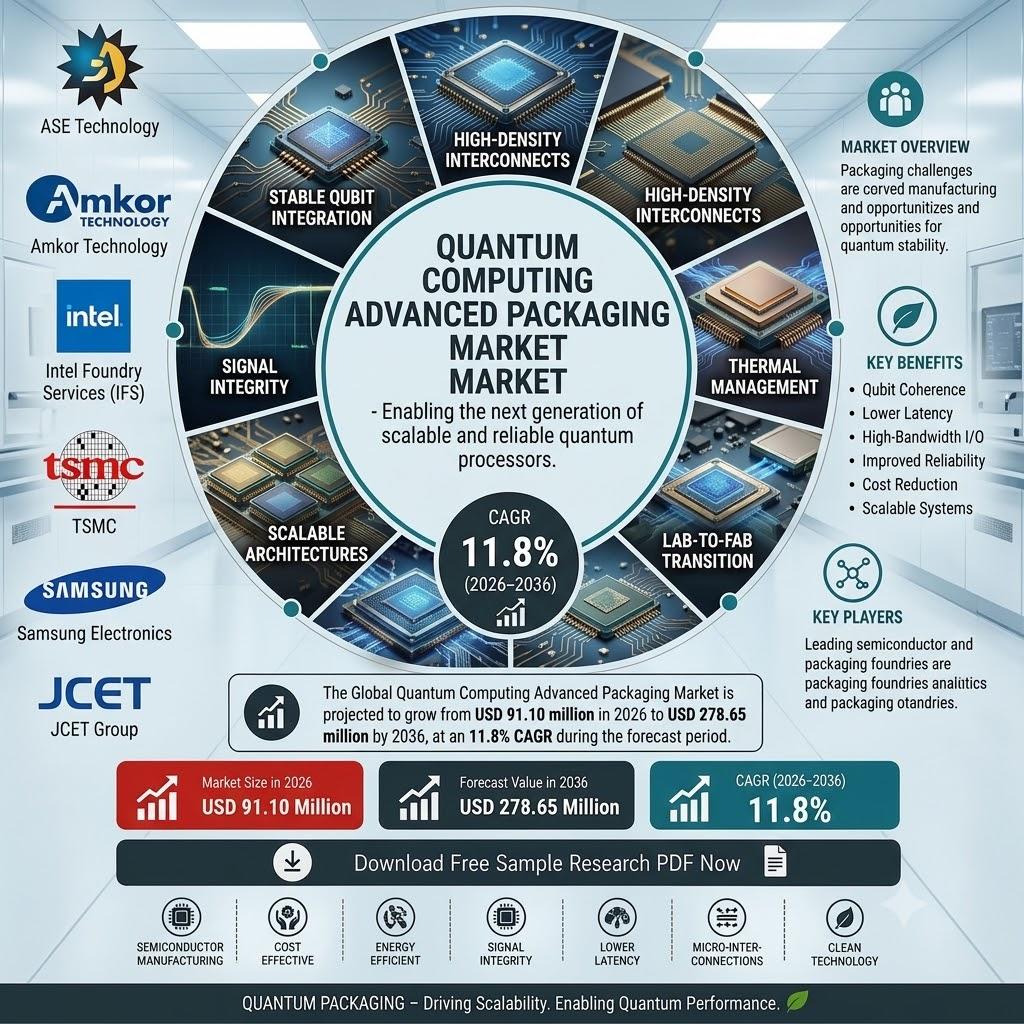
The global quantum computing advanced packaging market is projected to reach USD 278.65 million by 2036, rising from USD 91.10 million in 2026 at an 11.8% CAGR, according to Fact.MR analysis. The market is gaining attention as quantum processors move beyond laboratory prototypes toward more stable and scalable systems that require specialized physical integration and interconnection.
The growth represents an absolute dollar opportunity of USD 187.55 million between 2026 and 2036. Advanced packaging is becoming a critical hardware layer because quantum systems must preserve qubit stability while accommodating dense control and readout connections inside cryogenic environments.
Get detailed market forecasts, competitive benchmarking, and pricing trends: https://www.factmr.com/connectus/sample?flag=S&rep_id=13416
Quantum Computing Advanced Packaging Market Gains From Processor Scaling
Quantum processors face packaging requirements that conventional integrated-circuit architectures cannot adequately address. Extreme sensitivity to environmental noise, millikelvin operating temperatures, high input/output density, and the need to connect large numbers of control lines are creating demand for specialized packaging architectures.
Fact.MR is a market research firm that provides industry analysis, market forecasts, and strategic intelligence across global markets.
The quantum computing advanced packaging market is therefore closely tied to the effort to increase qubit counts and connectivity. Packaging must support thermal management, signal integrity, low-temperature reliability, and dense interconnects without compromising quantum-state stability.
Research laboratories currently represent the largest customer segment. The segment accounts for 50.0% of market share in 2026, reflecting the role of national laboratories, university consortia, and dedicated quantum research institutes in developing and testing emerging quantum architectures.
A particularly relevant detail is the current concentration of demand around research environments. These organizations require highly customized, low-volume packaging solutions while testing architectures that could later influence commercial packaging standards.
Superconducting Qubits Lead Quantum Packaging Demand
Superconducting qubits account for 45.2% of the qubit-type market share in 2026, making the technology the leading segment. The position reflects the maturity of superconducting architectures and their continued pursuit by major technology companies developing scalable, gate-based quantum processors.
Packaging these systems presents a difficult engineering task. Packages must operate reliably at millikelvin temperatures while managing numerous coaxial connections for control and readout. Electromagnetic interference must also be minimized to protect quantum-system performance.
The development of cryogenic quantum chip packaging is consequently becoming a central area of technology advancement. Other important categories include 3D heterogeneous integration, high-density interconnect systems, and thermal management solutions.
2.5D Interposers Hold 48.3% Package Share
By package type, 2.5D interposer packaging accounts for 48.3% of market share in 2026. The architecture enables quantum processor dies and classical control ASICs to be positioned alongside one another on silicon or glass interposers.
Short, high-density interconnect paths are a key advantage. The architecture also supports heterogeneous integration of materials and technologies, which is particularly relevant to quantum-classical computing systems.
The development of modular packaging approaches could provide another avenue for market expansion. Fact.MR analysis identifies co-design between quantum processors and their packages as an opportunity for improving development timelines and system yield.
Netherlands Leads Country Growth at 13.1% CAGR
The Netherlands is forecast to record the fastest growth among the countries highlighted in the analysis, with a 13.1% CAGR from 2026 to 2036. The country's quantum ecosystem includes QuTech, a collaboration between TU Delft and TNO, alongside advanced semiconductor equipment capabilities associated with ASML.
The United States follows with a 12.4% CAGR, supported by major technology companies, quantum startups, national laboratories, and semiconductor packaging capabilities. The country's research and commercial ecosystem spans multiple qubit modalities, creating demand for different packaging approaches.
Japan is projected to expand at a 12.1% CAGR. Its strengths in materials science, precision manufacturing, and ceramics engineering support development of substrates and packages designed for demanding cryogenic conditions.
Germany records an 11.4% CAGR. Its engineering-oriented ecosystem is focused on repeatable packaging processes, interface standardization, automated assembly, and testing methodologies that can support the transition from laboratory development toward pre-commercial systems.
Advanced Packaging Becomes a Quantum Hardware Enabler
The market is developing around a clear technical requirement: quantum processors cannot scale simply by increasing qubit counts. Physical interconnection, thermal control, electromagnetic shielding, and signal integrity must advance alongside the processor itself.
High development costs remain a constraint. Low production volumes, specialized cryogenic materials, and limited standardization currently restrict participation largely to well-funded quantum programs.
At the same time, partnerships between quantum hardware developers and established semiconductor packaging companies are emerging as a key market dynamic. ASE Technology, Amkor Technology, Intel Foundry Services, TSMC, Samsung Electronics, and JCET Group are among the companies identified in the competitive landscape.
The market is expected to expand from USD 91.10 million in 2026 to USD 278.65 million in 2036, representing approximately 3.1 times growth over the forecast period.
To View Top Reports
https://net-pals.com/blogs/32845/Peptide-Rich-Firming-Creams-Market-to-Reach-USD-5-17
https://uddokta64.com/blogs/7337/Peptide-Rich-Firming-Creams-Market-Set-to-Reach-USD-5
https://acmingle.com/blogs/18857/Peptide-Rich-Firming-Creams-Market-Expected-to-Hit-USD-5
https://zeuspage.org/blogs/52512/Peptide-Rich-Firming-Creams-Market-Poised-to-Reach-USD-5
About Fact.MR
Fact.MR is a global market research and consulting firm delivering actionable intelligence, market forecasts, and strategic insights across industries. Its research helps businesses evaluate emerging opportunities, understand competitive dynamics, and make informed decisions across evolving markets.

 Bangla