

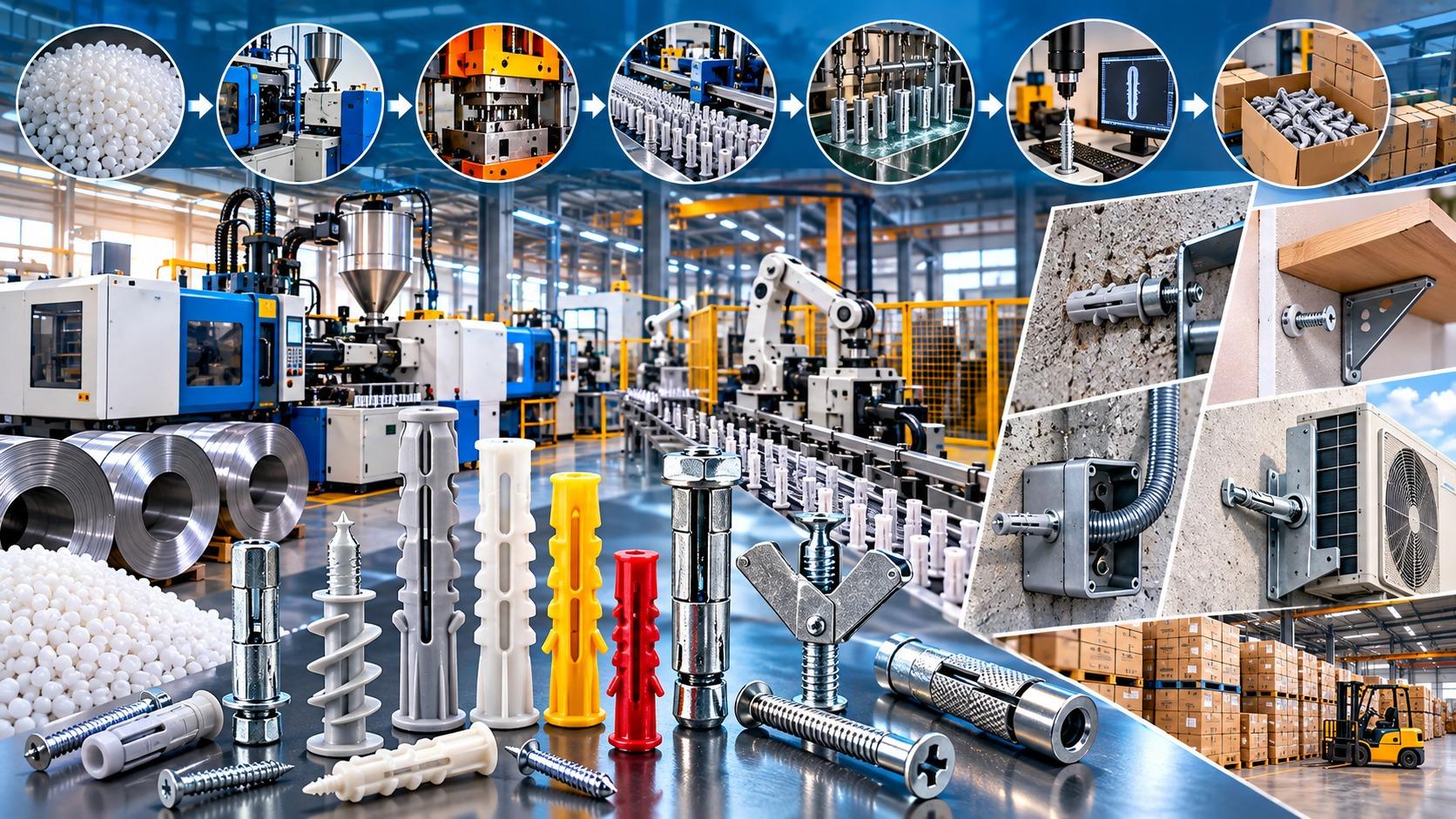
Wall Anchors Manufacturing Plant Setup DPR 2026: Raw Materials, Machinery Cost & Business Plan

IMARC Group’s “Wall Anchors Manufacturing Plant Project Report 2026: Industry Trends, Plant Setup, Machinery, Raw Materials, Investment Opportunities, Cost and Revenue” provides a comprehensive guide for establishing a wall anchors manufacturing plant setup cost. The report covers the complete process flow, unit operations, raw material requirements, utility requirements, infrastructure requirements, machinery and technology, manpower, packaging, transportation, and other essential aspects involved in setting up and operating a wall anchors manufacturing unit.
The report also provides an in-depth assessment of project economics, including capital investment, project funding, operating expenses, income and expenditure projections, fixed and variable costs, direct and indirect costs, expected return on investment (ROI), net present value (NPV), profit and loss account, taxation, depreciation, liquidity analysis, profitability analysis, payback period, uncertainty analysis, and sensitivity analysis. The report ID is SR112026A14117.
What are Wall Anchors?
Wall anchors are fastening components designed to securely attach screws into substrates that cannot independently support loads, including drywall, plaster, hollow blocks, and masonry. They function by expanding, gripping, toggling, or interlocking within the wall material to distribute stress and improve holding strength. Wall anchors can be manufactured from plastic, nylon, metal, or fiber-reinforced polymers and are valued for their load-bearing capacity, dimensional stability, corrosion resistance, and compatibility with different screw types. They are widely used for mounting fixtures, cabinets, electrical systems, plumbing supports, HVAC components, shelves, and other installations.
Wall Anchors Manufacturing Process:
The manufacturing process varies according to the type and material of the wall anchor. Plastic and nylon anchors are generally produced through precision injection molding, while metal anchors may undergo stamping, rolling, machining, heat treatment, and surface finishing.
- Raw material preparation and inspection
- Material drying or pre-treatment where required
- Injection molding for plastic and nylon anchors
- Cooling and automated ejection
- Trimming and deflashing
- Metal stamping, rolling, or machining
- Heat treatment where applicable
- Surface finishing, coating, or plating
- Assembly of multi-piece anchors
- Dimensional and mechanical quality testing
- Packaging and storage
- Transportation and distribution
Market Trends and Drivers of Wall Anchors Industry:
The wall anchors industry is benefiting from increasing investments in residential, commercial, and industrial construction projects. Growing construction activity, residential renovation, commercial fit-outs, infrastructure upgrades, and interior installation projects are supporting demand for reliable fastening solutions.
The increasing adoption of advanced polymer engineering and precision molding technologies is helping manufacturers improve product durability, dimensional accuracy, load performance, and production efficiency. Automation, including multi-cavity injection molding and high-speed metal forming, is also improving manufacturing productivity and supporting economies of scale.
Product innovation is another important market driver, with manufacturers developing fastening systems that offer higher load-bearing capacity, improved installation efficiency, greater substrate compatibility, and enhanced safety. The growing demand for certified and reliable anchoring systems in construction and renovation applications is expected to create additional opportunities for manufacturers.
The global wall anchors market was valued at USD 3.8 Billion in 2025 and is projected to reach USD 5.4 Billion by 2034, exhibiting a CAGR of 4.12% during 2026–2034.
Key Investment Highlights:
- Process Used: Raw material preparation, injection molding for plastic/nylon anchors, cooling and ejection, trimming and deflashing, metal forming, heat treatment, surface finishing, assembly, and quality testing.
- End-Use Industries: Construction and building materials, electrical and plumbing installation, furniture and interior fittings, HVAC mounting systems, retail display and shelving installations, and industrial equipment mounting.
- Applications: Securing fixtures to drywall and hollow walls, mounting shelves and cabinets, installing electrical boxes, fastening plumbing brackets and pipe supports, hanging artwork and mirrors, installing ceiling anchors, and supporting mechanical and HVAC components.
- Plant Capacity: 250–400 million units annually for a medium-scale plant.
- Gross Profit Margin: 25–30%.
- Net Profit Margin: 12–15%.
- Raw Materials: 55–65% of OpEx.
- Utilities: 8–12% of OpEx.
Request For a Sample Report: https://www.imarcgroup.com/wall-anchors-manufacturing-plant-project-report/requestsample
Wall Anchors Plant Capacity:
A medium-scale wall anchors manufacturing plant generally has a production capacity of approximately 250–400 million units per year. The capacity can be customized according to the proposed plant location, market demand, investment objectives, product portfolio, automation level, machinery configuration, and targeted production volume.
Wall Anchors Plant Profit Margins:
A typical wall anchors manufacturing plant can achieve gross profit margins of approximately 25–30%, while net profit margins can range between 12–15%. Actual profitability depends on production capacity utilization, raw material prices, product mix, selling prices, automation, labor expenses, energy consumption, packaging, transportation, maintenance, and market conditions.
Wall Anchors Plant Cost Analysis:
Raw materials represent the largest component of operating expenditure, accounting for approximately 55–65% of total OpEx. Utility expenses account for around 8–12% of OpEx. Other operating expenses include transportation, packaging, salaries and wages, depreciation, maintenance, taxes, quality control, and other administrative and operating expenses.
Major capital expenditure components include land and site development, civil works, machinery and equipment, utilities and auxiliary systems, initial working capital, pre-operative expenses, and contingency provisions. Machinery represents a significant portion of capital expenditure for the plant.
Major Applications:
- Construction and Building Materials: Fastening fixtures, fittings, panels, and other components to walls and masonry.
- Electrical Installations: Mounting electrical boxes, switches, fixtures, and related equipment.
- Plumbing: Securing plumbing brackets, pipe supports, and associated installations.
- Furniture and Interior Fittings: Installing shelves, cabinets, mirrors, fixtures, and interior components.
- HVAC Systems: Supporting mechanical and HVAC components.
- Retail Displays: Mounting shelving, display systems, signage, and fixtures.
- Industrial Equipment: Securing equipment and components to suitable wall or masonry substrates.
Why Invest in Wall Anchors Manufacturing?
- Growing construction and infrastructure activity.
- Rising demand from residential and commercial renovation projects.
- Increasing use of fastening systems in interior installations.
- Growing adoption of precision injection molding and automated production.
- Opportunities across construction, electrical, plumbing, furniture, HVAC, and industrial applications.
- Demand for durable, high-load-bearing, and corrosion-resistant fastening solutions.
- Product innovation is creating opportunities for advanced anchoring systems.
- Expansion of professional construction and DIY installation markets.
Key Aspects to Setup a Wall Anchors Plant:
- Location to Setup Plant
- Market Research
- Plant Layout
- Construction and Infrastructure
- Equipment/Machinery Procurement
- Documentation and Licenses
- Raw Material Sourcing
- Quality Assurance Systems
- Environmental and Safety Compliance
- Scrap Collection and Recycling
- Cost Analysis
Requirements to Setup a Facility:
- Funds
- Machinery
- Land
- Raw Materials
- Skilled Manpower
- Quality Testing Infrastructure
- Reliable Power and Utility Supply
- Raw Material Storage Facilities
- Material Handling Systems
- Packaging Infrastructure
- Finished Goods Warehouse
- Scrap Collection and Recycling Area
- Transportation Infrastructure
Types of Costs to Setup a Factory:
- Land, Location and Site Development Cost
- Plant Layout Cost
- Civil Works and Construction Cost
- Machinery Requirements and Costs
- Raw Material Requirements and Costs
- Packaging Requirements and Costs
- Transportation Requirements and Costs
- Utility Requirements and Costs
- Human Resource Requirements and Costs
- Quality Control and Testing Costs
- Maintenance and Compliance Costs
- Scrap Management and Recycling Costs
- Other Capital and Operating Costs
Project Economics:
- Capital Investments
- Operating Costs
- Expenditure Projections
- Revenue Projections
- Product Pricing and Margins
- Taxation and Depreciation
- Profit Projections
- Break-Even Analysis
- Payback Period
- Net Present Value
- Internal Rate of Return
- Liquidity Analysis
- Uncertainty Analysis
- Sensitivity Analysis
- Economic Feasibility Analysis
Key Questions Answered in the Report:
- How has the wall anchors market performed so far and how will it perform in the coming years?
- What is the market segmentation of the global wall anchors market?
- What is the regional breakup of the global wall anchors market?
- What are the price trends of various feedstocks in the wall anchors industry?
- What is the structure of the wall anchors industry and who are the key players?
- What are the various unit operations involved in a wall anchors manufacturing plant?
- What is the total size of land required for setting up a wall anchors manufacturing plant?
- What is the layout of a wall anchors manufacturing plant?
- What are the machinery requirements for setting up a wall anchors manufacturing plant?
- What are the raw material requirements for setting up a wall anchors manufacturing plant?
- What are the packaging requirements for setting up a wall anchors manufacturing plant?
- What are the transportation requirements for setting up a wall anchors manufacturing plant?
- What are the utility requirements for setting up a wall anchors manufacturing plant?
- What are the human resource requirements for setting up a wall anchors manufacturing plant?
- What are the infrastructure costs for setting up a wall anchors manufacturing plant?
- What are the capital costs for setting up a wall anchors manufacturing plant?
- What are the operating costs for setting up a wall anchors manufacturing plant?
- What should be the pricing mechanism of the final product?
- What will be the income and expenditures for a wall anchors manufacturing plant?
- What is the time required to break even?
- What are the profit projections for setting up a wall anchors manufacturing plant?
- What are the key success and risk factors in the wall anchors industry?
- What are the key regulatory procedures and requirements for setting up a wall anchors manufacturing plant?
- What are the key certifications required for setting up a wall anchors manufacturing plant?
Key Features:
- Customization Scope — The report can also be customized based on the requirements of the customer.
- Post-Sale Analyst Support — 10–12 Weeks.
- Report Delivery Format — PDF and Excel through email.
- Editable PPT/Word format can also be provided on special request.
Ask Analyst for Customized Report: https://www.imarcgroup.com/request?type=report&id=14117&flag=C
How IMARC Can Help?
IMARC Group provides detailed market intelligence, plant feasibility studies, technical assessments, cost modeling, and financial analysis to support investment decisions in the wall anchors industry. The report provides insights into market trends, market segmentation, regional analysis, price trends, competitive landscape, regulatory landscape, manufacturing processes, land and site development, plant layout, machinery, raw materials, packaging, transportation, utilities, manpower, capital expenditure, operating expenditure, product pricing, profitability, and financial feasibility.
The study can also be customized according to specific plant locations, production capacities, machinery configurations, and additional analytical requirements.
Services:
- Plant Setup
- Factory Auditing
- Regulatory Approvals and Licensing
- Company Incorporation
- Incubation Services
- Recruitment Services
- Marketing and Sales
Contact Us:
IMARC Group
134 N 4th St. Brooklyn, NY 11249, USA
Email: [email protected]
Tel No:(D) +91 120 433 0800
United States: +1–201971–6302

