

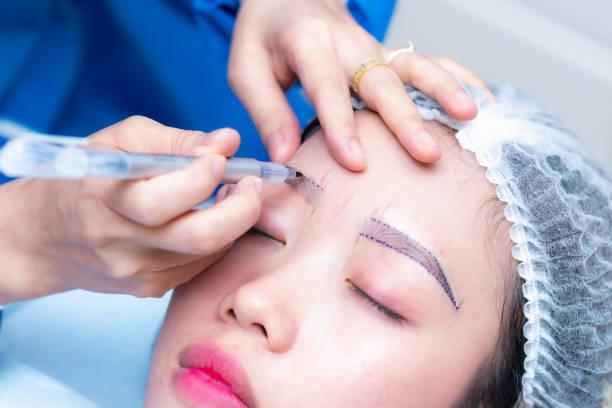
Sparse eyebrows can often be improved when the underlying follicles have been permanently lost and there is enough suitable donor hair for reconstruction. An Eyebrow Hair Transplant in Dubai can restore selected low-density areas by placing individual follicles according to the existing brow pattern, hair direction, and desired density rather than treating the eyebrow as one uniform block.
Understanding Sparse Brow Areas
Sparse eyebrows are not always the same as a clearly defined bald patch. Some patients retain hair throughout the eyebrow but have noticeably reduced follicular density in particular zones. The brow may therefore look incomplete even though individual hairs are still present.
Diffuse Sparsity Versus a Defined Gap
A discrete gap has a recognizable area where hair is absent, while diffuse sparsity can extend gradually across several centimeters. The transition may be subtle: the inner brow can appear reasonably full, the central portion may become lighter, and the arch or tail can progressively lose visual weight.
This distinction matters during treatment planning. Filling a diffuse area as though it were an empty patch can produce an unnatural concentration of transplanted follicles. A better reconstruction strategy considers the native hairs that remain and distributes new follicles around them.
Why Brow Density Is Visually Sensitive
Eyebrow hairs are relatively short and their orientation changes across the brow. Hair near the inner portion generally follows a different directional pattern from hair approaching the arch and tail. Because the eyebrow sits directly within facial expression anatomy, even small changes in density or direction can affect how the entire face appears.
The official Tajmeels treatment information describes eyebrow transplantation as a precision procedure in which donor hairs are individually extracted, prepared according to the intended shape and direction, and implanted into fine recipient openings.
How Sparse Areas Are Assessed Before Transplantation
The first step is not simply counting how many hairs are missing. A clinician needs to determine where the existing follicles are located, how they are distributed, and whether the apparent sparsity is stable.
Mapping the Existing Brow
Assessment can divide the eyebrow into functional zones: the medial portion, central body, arch transition, and lateral tail. Each area may have a different degree of thinning.
The assessment should also consider the patient's previous brow shape. Repeated plucking, trauma, burns, medical treatment, aging, hormonal changes, and certain medical conditions can contribute to eyebrow hair loss. These causes are recognized among the reasons patients may seek eyebrow reconstruction.
Evaluating Donor Hair Suitability
Scalp follicles are commonly used as the donor source for eyebrow transplantation. The quality of the donor hair matters because eyebrow reconstruction requires follicles capable of producing hairs that can be managed to resemble the surrounding brow.
The donor region must therefore be examined for follicular availability, hair characteristics, and the amount that can be harvested without creating an undesirable donor-area change. The official treatment page notes that donor hairs are extracted individually from the scalp before being prepared for eyebrow implantation.
The Planning Response to Different Sparse Patterns
Sparse brow reconstruction requires a distribution strategy rather than simply adding the maximum possible number of follicles. The goal is to create a convincing density transition between native and transplanted hairs.
| Sparse pattern | Typical visual effect | Planning response |
|---|---|---|
| Diffuse thinning across the brow body | Brow appears lighter overall | Selective reinforcement between existing follicles |
| Weak arch transition | Shape loses definition | Controlled placement following the changing direction |
| Broad lateral sparsity | Tail appears faded or shortened | Gradual lateral distribution with a tapered finish |
| Mixed native and transplanted zones | Density looks inconsistent | Blend new follicles with existing hair rather than clustering them |
| Uneven regional thinning | One section appears heavier than another | Zone-specific placement based on the existing anatomy |
This type of mapping helps avoid an artificial “filled-in” appearance. The eyebrow should retain small variations in spacing and direction because naturally growing brow hair does not form a perfectly uniform grid.
Why Selective Placement Matters in Sparse Brows
A sparse region may still contain functioning follicles. That changes the recipient-site strategy.
Working Around Native Follicles
When native hairs remain, new recipient sites need to be planned carefully so existing follicles are not unnecessarily disturbed. The objective is reinforcement, not replacement of every native hair.
Spacing also matters. Excessively close placement can create an unnatural cluster, while excessive spacing may leave the area visually weak. The appropriate arrangement depends on the patient's existing density and the shape being reconstructed.
Creating a Density Gradient
Natural eyebrows generally have visual transitions rather than an identical density from one end to the other. A reconstructed brow can therefore require a gradual change in follicular concentration.
The arch may need stronger definition than an adjacent transition zone, while the tail often benefits from controlled tapering rather than an abrupt endpoint. These decisions should be made during individualized design rather than applied from a fixed template.
Direction Is as Important as Density
Increasing the number of hairs does not automatically produce a natural eyebrow. Direction determines how light reflects from the hairs and how they integrate visually with the surrounding brow.
Inner Brow Direction
The medial eyebrow requires careful directional planning because hairs near this region contribute to the characteristic beginning of the brow. Overly uniform placement can make the area appear manufactured.
Arch and Tail Direction
As the brow approaches the arch and tail, the orientation changes. Follicles need to be inserted according to this transition so the hairs lie in a direction compatible with the surrounding anatomy.
The treatment process described by Tajmeels includes creating fine eyebrow recipient openings and individually implanting prepared grafts according to the intended shape, direction, and size.
For patients researching eyebrow hair restoration options in Dubai, this distinction between adding hair and controlling its final direction is particularly important when sparsity is spread across an otherwise intact eyebrow.
When Sparse Brow Areas May Respond Well to Reconstruction
A patient may be considered for eyebrow transplantation when reduced density is persistent and the underlying follicles are unlikely to recover naturally. The cause of the loss, stability of the brow pattern, donor availability, and expectations all influence the assessment.
Persistent Loss From Plucking
Long-term mechanical removal can damage follicles and progressively reduce visible growth. When an area no longer produces sufficient native hair, transplantation may be considered as a reconstructive option.
Sparse Brows After Trauma
Burns and other injuries can permanently alter the skin and destroy follicles. Scarred tissue requires particularly careful assessment because recipient-site characteristics may differ from normal skin.
Age-Related Brow Changes
Brow density can change with aging. A patient may notice reduced fullness rather than complete hair loss. In these situations, the treatment objective may be conservative reinforcement rather than recreating a completely new eyebrow.
Medically Related Loss
Certain medical treatments and conditions can affect eyebrow hair. The cause should be established before reconstruction because active or unresolved hair-loss conditions may require appropriate medical management first. Tajmeels identifies chemotherapy, hormonal changes, medical conditions, burns, aging, and genetics among potential causes associated with eyebrow hair loss.
What Happens to the Transplanted Hair After Placement
Eyebrow transplantation is not an instant-density procedure. The transplanted follicles require time to establish growth.
Early Healing
The treatment page describes a typical recovery period of approximately five to seven days, with redness, swelling, or tenderness potentially occurring during the first few days. Scabbing can develop during the first one to two weeks, and patients are advised to avoid rubbing or disturbing the treated area.
Temporary Shedding
Some transplanted hairs may shed during the weeks after implantation. This does not necessarily mean the follicle has failed. The follicle can remain in place while a new hair cycle develops.
Progressive Growth
According to the clinic's published treatment timeline, new fine hairs may begin developing during the following months, with more noticeable density around months four to six and fuller results developing over approximately six to twelve months.
This timeline is important for patients who are evaluating the result too early. Sparse brow correction should be judged after sufficient time has passed for the transplanted follicles to progress through their growth cycle.
Dubai Factors That Matter for Sparse Brow Recovery
Dubai's environment can influence how patients manage the healing period. Strong sunlight, outdoor heat, and extensive air-conditioning can create practical aftercare challenges.
Sun Exposure
Direct sunlight should be minimized during the early healing period because recently treated skin is more vulnerable. The clinic's published aftercare guidance specifically advises avoiding sunlight and following the prescribed care instructions after the procedure.
Indoor Air Conditioning
Frequent exposure to air-conditioned environments can contribute to skin dryness. Patients should follow the specific cleansing and topical-care instructions provided after treatment rather than introducing additional products without professional guidance.
Busy Daily Schedules
People with demanding work and social schedules may be tempted to resume normal grooming too quickly. Allowing the recipient area to heal without rubbing, scratching, or unnecessary manipulation is important during the initial recovery period.
How to Judge Whether Sparse Brow Correction Looks Natural
The success of a reconstruction should not be judged solely by the number of implanted follicles. Several visual factors work together.
Density Integration
New hairs should visually connect with the native brow instead of forming a separate transplanted section. This is particularly important when the original brow still contains substantial native hair.
Directional Continuity
The implanted hairs should follow the directional changes of the surrounding eyebrow. A density increase with incorrect orientation can remain visibly noticeable.
Shape Preservation
The reconstructed area should complement the patient's facial anatomy rather than forcing the eyebrow into an unrelated standardized shape.
Long-Term Grooming
Scalp-derived eyebrow hairs may behave differently from native eyebrow hairs and can require ongoing trimming. Patients should understand this practical aspect before deciding on transplantation.
What Patients in Dubai Should Do Next
If sparse eyebrow areas remain despite previous grooming changes or natural regrowth efforts, the next step is a professional assessment rather than automatically choosing a high-density transplant. A clinician can determine whether the problem is diffuse thinning, localized follicular loss, altered growth direction, scarring, or another underlying issue, then assess donor suitability and design a proportionate reconstruction plan.
The published Tajmeels treatment information states that eyebrow transplantation is performed under local anesthesia, with the procedure generally taking around two to four hours, while visible maturation continues over the following months. A consultation can therefore focus on the specific sparse zones, native follicle preservation, donor characteristics, and the density gradient needed for a natural-looking result.
The Strategic Investment
Sparse eyebrow areas can be addressed most effectively when the treatment is planned around anatomy rather than simply adding more hair. The combination of follicular selection, recipient-site precision, directional placement, density control, and appropriate aftercare determines how naturally new growth can integrate with the existing brow. For patients considering Eyebrow Hair Transplant in Dubai, a personalized assessment at Tajmeels Clinic provides a pathway to evaluate the sparse areas individually and develop a reconstruction strategy suited to the patient's existing brow structure.
